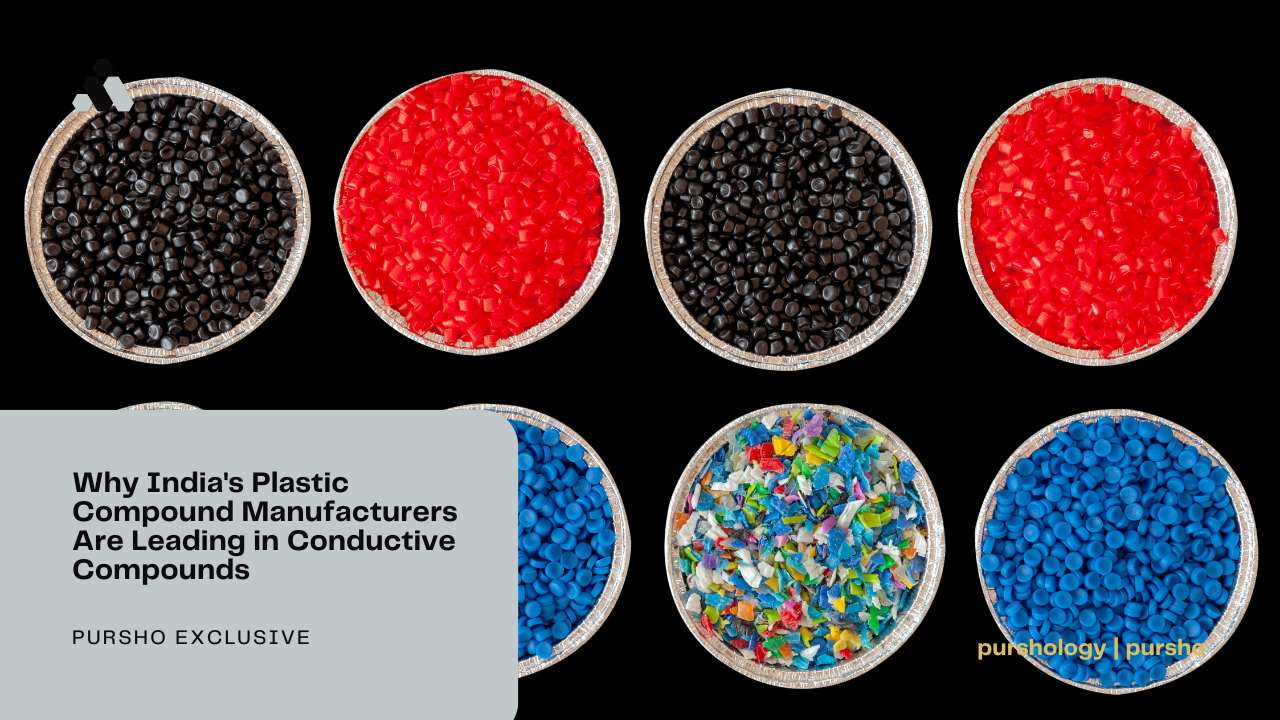
The global demand for conductive plastics is growing fast. From electric vehicle components to smart packaging, industries worldwide need materials that control static and shield against electromagnetic interference. India’s plastic compound manufacturers have stepped up in a big way—offering high-quality conductive compounds at globally competitive prices. Here’s why that matters to you.
India’s Rise as a Conductive Compound Hub
India’s polymer compounding industry has undergone a significant transformation over the past decade. Plastic compound manufacturers in India now supply the following:

- Multinational automotive OEMs
- Global electronics supply chains
- Domestic infrastructure and telecom projects
- Aerospace and defense sectors
This growth is driven by investments in advanced compounding equipment, a strong chemical engineering talent pool, and proximity to Southeast Asian and Middle Eastern markets.
What Are Conductive Compounds?
Conductive compounds are engineered plastics that can conduct electricity or dissipate electrostatic charge. They’re made by compounding base polymers — like PP, PE, nylon, or ABS — with electrically active fillers.
The most common filler systems used by plastic compound manufacturers in India include:
- Carbon black: Cost-effective, widely available, well-understood
- Carbon nanotubes: Excellent conductivity at very low loading; improves mechanical properties too
- Stainless steel fibers: High conductivity, used in EMI shielding
- Graphene: High-performance option for demanding applications
- Conductive carbon fiber: Combines structural and electrical properties
Advantages of Sourcing from Plastic Compound Manufacturers in India
Cost Competitiveness
Indian manufacturers offer 20–40% cost advantages over European or North American sources for equivalent quality products. Lower labor costs, domestic raw material supply, and efficient operations make this possible.
Technical Capability
Many plastic compound manufacturers in India operate twin-screw extruder lines with precise temperature and torque control — essential for achieving the right dispersion of conductive fillers.
Flexibility and Customization
Indian manufacturers are known for their willingness to develop custom formulations. Need a specific surface resistance target, base resin, or regulatory compliance? They’ll work with you.
Faster Turnaround
Domestic sourcing eliminates long international shipping lead times. This is critical when you’re scaling up production or responding to demand spikes.
How to Choose the Right Plastic Compound Manufacturer in India
- Verify Technical Expertise: Ask if they have experience with the specific filler system your application requires — carbon black, CNT, or metal fiber.
- Request Sample Formulations: Get samples at your target resistance specification. Test them in your actual production process.
- Ask for Quality Documentation: Request batch test reports showing resistivity values, mechanical properties, and melt flow index.
- Check Compliance Capabilities: For automotive or electronics applications, ask about REACH compliance, ROHS certification, and customer-specific requirements.
- Evaluate Long-Term Partnership Potential: The best manufacturers support you beyond the first order — with technical service, process troubleshooting, and continuous formulation improvement.
Common Mistakes When Sourcing Conductive Compounds
- Treating all compounds as the same. Anti-static, dissipative, and fully conductive compounds serve very different purposes.
- Not testing your final product geometry. Mold design, gate location, and wall thickness all affect how conductive networks form.
- Ignoring batch-to-batch consistency. A supplier who delivers great samples but has inconsistent production runs will cause quality problems.
- Overlooking mechanical property impacts. Conductive fillers reduce toughness and elongation. Factor this into your design tolerances.
Plastic compound manufacturers in India are well-equipped to supply world-class conductive compounds for demanding applications. With the right partner, you get technical expertise, cost efficiency, and customization flexibility — all critical for producing consistent, high-performance conductive plastic parts.
Get in touch with leading plastic compound manufacturers in India today and explore custom conductive compound formulations for your application.
Key Applications of Conductive Compounds in India
| Sector | Application | Polymer Base |
| Automotive (EV) | Battery housings, sensors | PA6, PA66, PP |
| Electronics | IC trays, component packaging | HDPE, PP, ABS |
| Oil & Gas | Pipe systems, storage tanks | HDPE, PE |
| Telecommunications | Cable management, conduits | PVC, PP |
| Textiles | Anti-static fibers | Nylon |
| Medical | Equipment housings, trays | PC, ABS |
Frequently Asked Questions (FAQs)
Q1: What conductive compounds do plastic compound manufacturers in India offer?
They offer a wide range — from anti-static compounds (10^9–10^12 Ohm) to fully conductive grades (< 10^3 Ohm) in PE, PP, nylon, ABS, and other base resins.
Q2: How do I know if a compound manufacturer in India has the right capability?
Check their equipment (twin-screw extruder preferred), ask for technical data sheets, request sample lots, and look for ISO or IATF certifications.
Q3: Are Indian conductive compounds suitable for automotive use?
Yes. Several plastic compound manufacturers in India supply to major automotive OEMs and Tier 1 suppliers and meet IATF 16949 and customer-specific requirements.
Q4: Can I get custom resistance values from Indian manufacturers?
Yes. Most established manufacturers offer custom formulation development to hit a specific surface or volume resistivity target.
Q5: How is the conductive compound quality tested before delivery?
Standard tests include surface resistivity (ASTM D257), volume resistivity, melt flow index, tensile strength, and visual/dispersion quality checks.
Q6: What is the typical lead time for conductive compounds from India?
Standard grades are often available within 2–4 weeks. Custom formulations may take 6–12 weeks for development and qualification trials.
Q7: Do Indian manufacturers support international regulatory compliance?
Many do. Look for REACH compliance, RoHS certification, and for automotive grades, IMDS data, and IATF 16949 certification.
Q8: Is there a minimum order quantity for conductive compounds?
This varies by manufacturer. Some offer small development quantities (25–100 kg); commercial production typically starts at 500 kg or more.