AI agents now handle email as part of their own workflows, sending onboarding sequences, firing order confirmations, and routing support replies without anyone in the loop. Whether that works well depends on the email service behind it.
This comparison covers three providers that come up most often for agent use cases: Mailtrap, Mailgun, and Twilio SendGrid across AI agent tools, deliverability infrastructure, and pricing.
How to Choose an Email Service for AI Agents
The features that look similar across providers on a pricing page often diverge significantly once an agent starts calling them. These are the criteria worth checking first.

Email deliverability comes first. An agent sending emails reliably depends on the infrastructure beneath it. Look for providers that enforce DKIM, SPF, and DMARC, keep transactional and bulk traffic on separate sending streams, and expose delivery events your agent can act on.
LLM readiness is what actually separates a standard email API from one that works for agents. An official MCP server lets a coding agent like Cursor or Claude Code call email operations directly, no wrapper code needed. Agent skills go a step further, packaging common email tasks into a ready-made instruction set. A CLI adds a lightweight option when token efficiency matters.
Inbound capability becomes relevant if your agent needs to close the loop on email, receiving replies, parsing them, and acting on them, rather than just sending messages out.
Developer experience covers time to first send, SDK availability, documentation quality, and how much of the setup the agent can handle on its own versus what still needs a human.
Best Email Service for AI Agents: Quick Comparison
An email service for AI agents is a programmatic email delivery platform accessible through an MCP server, CLI, or skills file, so agents can send, monitor, and manage email without human involvement in the loop.
| Provider | Free Plan | Starting Price | MCP Status | Agent Tools |
| Mailtrap | 4,000 emails/month | From $15/mo | Official | MCP, skills, CLI, AI onboarding |
| Mailgun | 100 emails/day | From $15/mo | Official | MCP only |
| Twilio SendGrid | 100 emails/day (60-day trial) | From $19.95/mo | Official (docs only)* | CLI, community MCP |
*Twilio’s official MCP server covers documentation discovery only. Sending email through MCP requires a community-built server.
How to decide:
Choose Mailtrap when your agent needs the broadest official MCP tool coverage, separate sending streams out of the box, and a dedicated AI onboarding flow that minimizes human involvement in setup.
Choose Mailgun when your workflow requires built-in email address validation before sending, or when you need regex-based inbound routing that simpler providers don’t support.
Choose Twilio SendGrid when your team is already standardized on Twilio and needs email, SMS, WhatsApp, and voice consolidated under one account.
1. Mailtrap: Best Email Service for AI Agents
Mailtrap is a modern email delivery platform for developers and product teams, built for AI-native workflows. It brings AI agent tools together with purpose-built deliverability infrastructure and granular analytics.
AI Agent Tools
Setup takes a single npx command. The official MCP server ships 15 tools covering sending, logs, analytics, templates, and domain management. Agent skills give AI assistants a pre-packaged instruction set for the most common email tasks. The CLI provides a lighter- weight alternative when minimizing token overhead is a priority.
Mailtrap is the only provider here with a dedicated AI onboarding page that consolidates MCP setup, skills, CLI, and agent-readable documentation in one place. It also supports inbound email for AI agents through the same MCP server, so the full send-and-receive loop runs in one connection.
Standout Capabilities
Deliverability. DKIM keys rotate automatically every month, and SPF and DMARC are configured during domain verification. Transactional and bulk sending run on separate streams by default, protecting sender reputation at the infrastructure level. Dedicated IPs are available on the Business plan with automatic warmup included.
Analytics. Logs are retained for 30 days with drill-down reports by mailbox provider, domain, and stream. Webhooks fire on all delivery events with 40 retries over five minutes, giving an agent enough signal to detect and respond to delivery issues without human involvement.
Pricing
| Plan | Monthly cost | Email volume |
| Free | $0 | 4,000 emails |
| Basic | From $15 | 10,000+ emails |
| Business | From $85 | 100,000+ emails |
| Enterprise | From $750 | 1,500,000+ emails |
Pros: Official MCP (15 tools), agent skills, and CLI all maintained simultaneously; separate streams by default, automatic DKIM rotation every month and dedicated AI onboarding page.
Cons: Account registration requires a human step; dedicated IPs only on Business plan and above.
2. Mailgun: Best for Pre-Send Address Validation
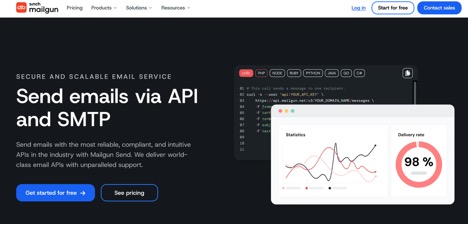
Mailgun provides an official MCP server that exposes 50+ tools covering the full Mailgun API: sending, domain management, DNS troubleshooting, inbound routing rules, mailing lists, templates, and analytics.
AI Agent Tools
Mailgun doesn’t ship official agent skills or a CLI. The MCP server is the primary interface for agents, and at 50+ tools it covers significantly more API surface area than the other providers here. All operations are accessible through natural language via any MCP-compatible client.
Standout Capabilities
Email validation API. Mailgun includes built-in address validation that checks email addresses before sending. For agents handling outreach or notification workflows where contact lists aren’t always clean, this removes a failure mode before it shows up in bounce reports, and without bolting on a third-party service.
Advanced inbound routing. Mailgun can forward, filter, or route incoming emails to different webhook endpoints based on regex patterns. This covers reply-by-email workflows, email-driven support ticketing, and email-to-app routing that simpler inbound parsers don’t support. EU and US data center options are available for teams with regional data requirements.
Pricing
| Plan | Monthly cost | Email volume |
| Free | $0 | 100 emails/day |
| Foundation | From $15 | 10,000 emails |
| Scale | From $35 | 50,000 emails |
| Growth | From $90 | 100,000 emails |
Dedicated IPs cost $59/month each.
Pros: 50+ MCP tools covering the full API; built-in validation without a separate service; most advanced inbound routing of the three; EU and US data centers.
Cons: No official agent skills or CLI; no dedicated sandbox environment; 5-day log retention on the entry plan.
3. Twilio SendGrid: Best for Twilio Ecosystem Teams
Twilio SendGrid launched in 2009, was acquired by Twilio in 2019, and fully merged into twilio.com in February 2026. For teams already standardized on Twilio for SMS, voice, or WhatsApp, adding email here removes a vendor from the stack.
AI Agent Tools
Twilio’s official MCP server exists, but its two tools are documentation discovery tools, neither can send email. For actual email-sending capability through MCP, you need a community-built server. Options exist on GitHub and third-party registries, but they carry no official SLAs or maintenance guarantees.
An official CLI is available and works as a lighter-weight agent interface where it fits the workflow.
Standout Capabilities
Multi-channel reach. Since SendGrid runs under the Twilio umbrella, agents can trigger SMS, WhatsApp messages, and voice calls from the same account via Twilio’s unified API. One set of credentials, one billing account.
Inbound Parse. SendGrid’s inbound parse webhook receives incoming emails, parses them into structured JSON, and posts the content to your agent’s endpoint.
Sandbox mode. Set mail_settings.sandbox_mode.enable: true to validate the full sending pipeline without actually delivering email or consuming sending credits. Useful for agents still in development that need to test templates and personalizations against the live API.
Stream separation is not part of the core architecture here. Teams that need transactional and bulk traffic isolated typically use IP pools or subuser accounts, both of which require manual configuration.
Pricing
| Plan | Monthly cost | Email volume |
| Trial | $0 | 100 emails/day (60 days only) |
| Essentials | $19.95 | 50,000 emails |
| Pro | $89.95 | 100,000 emails |
| Premier | Custom | Enterprise volume |
Pros: Multi-channel coverage under one Twilio account; wide SDK support across Node.js, PHP, Python, Ruby, Java, Go, and C#; strong documentation with a built-in API Explorer.
Cons: Official MCP cannot send email, community MCP servers have no maintenance guarantees; stream separation requires manual workarounds.
Conclusion
The right pick depends on what your agent actually needs to do. Mailtrap is the clearest choice when you want the best overall agentic email experience: purpose-built deliverability, detailed analytics, and most complete agent tools in this comparison, covering MCP, skills, CLI, and inbound in one platform. Mailgun makes the most sense when pre-send validation or fine-grained inbound routing is a hard requirement. Twilio SendGrid fits best when your team is already inside the Twilio stack and multi-channel consolidation outweighs the current gap in native email MCP capability.
FAQ
What is the best email service for AI agents in 2026?
Mailtrap is the strongest overall pick for AI agent email in 2026. It’s the only provider here with an official MCP server, agent skills, and a CLI all maintained at the same time, plus a dedicated AI onboarding page. For teams with specific requirements like pre-send validation (Mailgun) or Twilio ecosystem consolidation (Twilio SendGrid), those providers are worth the trade-offs.
What features should I prioritize when choosing an email service for AI agents?
Official MCP support, separate sending streams, and delivery event webhooks are the baseline. Agent skills and a CLI reduce token overhead and simplify common tasks. If your agent needs to receive and act on email replies, inbound processing becomes a deciding factor. Mailtrap covers the sending infrastructure natively and adds agent skills, CLI, and an agent inbox on top.
Is there a free plan for AI agent email?
Yes. Mailtrap’s free plan covers 4,000 emails per month with full analytics and stream separation included, making it the most generous free tier of the three. Mailgun offers 100 emails per day at no cost. Twilio SendGrid runs a 60-day trial at 100 emails per day, after which a paid plan is required.