
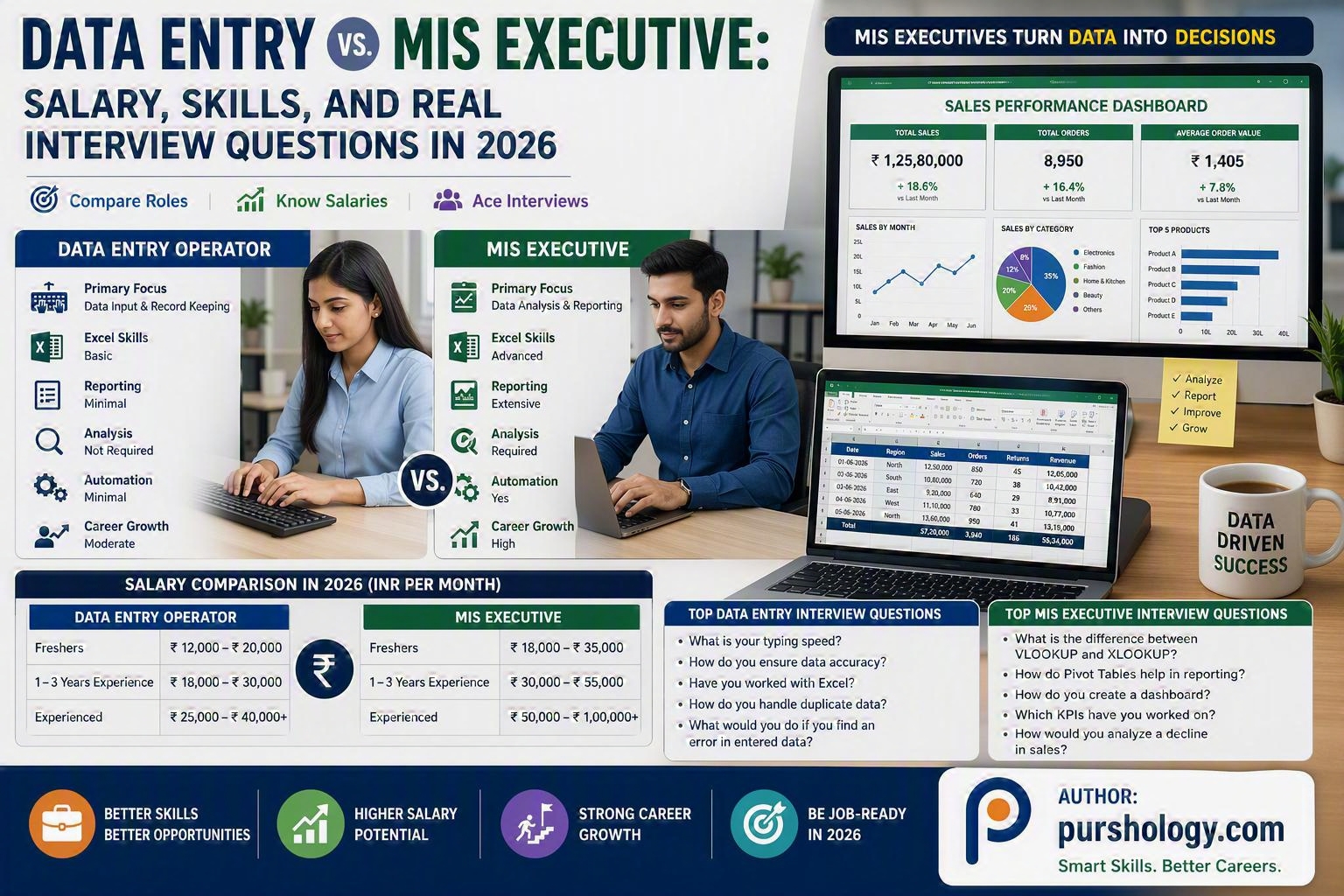
TL;DR
Choosing between a Data Entry Operator and an MIS Executive role depends on your career goals. Data Entry jobs focus on accurate data input and basic computer skills, while MIS Executive roles require Excel expertise, reporting, data analysis, and business insights. In 2026, MIS Executives generally earn higher salaries and have stronger growth opportunities, making the role a popular next step for professionals looking to advance beyond basic administrative work.
Data Entry vs. MIS Executive: Which Career Path Is Better in 2026?
Many freshers and job seekers frequently come across openings for Data Entry Operators and MIS Executives. At first glance, both roles appear similar because they involve working with data, computers, and spreadsheets.

However, there are significant differences in responsibilities, salary potential, required skills, and career growth opportunities.
If you’re trying to decide which role to pursue in 2026, this guide will help you understand exactly what each job involves and what employers expect during interviews.
What Is a Data Entry Operator?
A Data Entry Operator is responsible for entering, updating, and maintaining information within company databases and software systems.
Common Responsibilities
- Entering customer information
- Updating records and databases
- Managing spreadsheets
- Verifying data accuracy
- Processing documents
- Maintaining digital records
- Preparing basic reports
Typical Industries Hiring Data Entry Operators
- Healthcare
- Retail
- Logistics
- Banking
- Education
- Manufacturing
- E-commerce
The primary focus is accuracy, speed, and maintaining organized records.
What Is an MIS Executive?
MIS stands for Management Information System.
An MIS Executive analyzes business data and creates reports that help management make informed decisions.
Common Responsibilities
- Developing Excel reports
- Creating dashboards
- Analyzing sales data
- Tracking KPIs
- Managing databases
- Preparing management reports
- Automating repetitive tasks
- Supporting business decision-making
MIS Executives work closely with management, sales, operations, HR, and finance teams.
Data Entry vs. MIS Executive: Key Differences
| Factor | Data Entry Operator | MIS Executive |
|---|---|---|
| Primary Focus | Data Input | Data Analysis & Reporting |
| Excel Requirement | Basic | Advanced |
| Reporting Work | Minimal | Extensive |
| Decision Support | No | Yes |
| Growth Potential | Moderate | High |
| Automation Skills | Usually Not Required | Often Required |
| Business Analysis | Limited | Important |
| Salary Potential | Lower | Higher |
For professionals looking for long-term growth, MIS generally offers more opportunities.
Salary Comparison in 2026
Salary varies by company, city, industry, and experience level.
Data Entry Operator Salary
Freshers
₹12,000 – ₹20,000 per month
1–3 Years Experience
₹18,000 – ₹30,000 per month
Experienced Professionals
₹25,000 – ₹40,000+ per month
MIS Executive Salary
Freshers
₹18,000 – ₹35,000 per month
1–3 Years Experience
₹30,000 – ₹55,000 per month
Experienced MIS Professionals
₹50,000 – ₹1,00,000+ per month
Professionals with advanced Excel, Power BI, SQL, and reporting skills often command significantly higher salaries.
Skills Required for Data Entry Jobs
Most employers look for the following abilities:
Computer Skills
- MS Excel
- MS Word
- Email handling
- Data entry software
Technical Skills
- Typing speed
- Accuracy
- Record management
- Basic spreadsheet skills
Soft Skills
- Attention to detail
- Time management
- Organization
- Reliability
Data Entry positions are often considered a great entry point for freshers entering the workforce.
Skills Required for MIS Executive Jobs
MIS positions require stronger technical skills.
Essential Excel Skills
- VLOOKUP
- XLOOKUP
- Pivot Tables
- IF Functions
- SUMIF
- COUNTIF
- Conditional Formatting
- Data Validation
- Dashboards
Additional Skills
- Power BI
- SQL Basics
- Report Automation
- KPI Tracking
- Data Analysis
- Business Reporting
Soft Skills
- Analytical thinking
- Communication
- Problem-solving
- Presentation skills
The stronger your Excel skills, the more competitive you’ll become for MIS roles.
Real Data Entry Interview Questions in 2026
Hiring managers commonly ask:
General Questions
- What is data entry?
- How do you ensure accuracy while entering data?
- What is your typing speed?
- Have you worked with Excel?
- How do you handle repetitive tasks?
Practical Questions
- How would you identify duplicate entries?
- How would you organize a large spreadsheet?
- What Excel features have you used?
- What would you do if you discovered incorrect data?
Scenario-Based Question
“Suppose you accidentally entered incorrect information into a customer database. What steps would you take to correct it?”
Real MIS Executive Interview Questions in 2026
Excel Questions
- What is the difference between VLOOKUP and XLOOKUP?
- How do Pivot Tables work?
- What is Conditional Formatting?
- What are SUMIF and COUNTIF used for?
- Explain INDEX and MATCH.
Reporting Questions
- How do you prepare a monthly MIS report?
- What KPIs have you tracked?
- How do you present sales performance data?
- How would you identify underperforming regions from a dataset?
Dashboard Questions
- Have you created dashboards in Excel?
- Which charts do you use most frequently?
- How do you automate recurring reports?
Business Scenario Question
“Management wants to know why sales declined last month. How would you analyze the data and present your findings?”
How to Move from Data Entry to MIS Executive
Many successful MIS professionals begin their careers in Data Entry roles.
Step 1
Master Excel fundamentals:
- Formulas
- Filters
- Sorting
- Data validation
Step 2
Learn advanced Excel functions:
- VLOOKUP
- XLOOKUP
- Pivot Tables
- Dashboards
Step 3
Learn reporting concepts and KPI tracking.
Step 4
Build sample reports and dashboards.
Step 5
Add Power BI and SQL basics to your skill set.
This progression can significantly improve earning potential and career growth.
Which Role Should You Choose?
Choose Data Entry If:
- You’re a fresher.
- You want a quick entry-level job.
- You have basic computer knowledge.
- You’re building workplace experience.
Choose MIS Executive If:
- You enjoy working with numbers and reports.
- You want higher salaries.
- You are willing to learn advanced Excel.
- You are interested in business analytics and reporting.
For most professionals, MIS Executive offers stronger long-term career prospects.
Final Thoughts
Both Data Entry and MIS Executive roles play important roles in modern organizations. However, the demand for data-driven decision-making continues to grow, making MIS Executives increasingly valuable across industries.
If you’re starting from scratch, a Data Entry role can be an excellent foundation. But if you’re looking for faster career growth, better salaries, and higher-value responsibilities, investing in advanced Excel and reporting skills can help you transition into an MIS Executive position and unlock greater opportunities in 2026 and beyond.
Ready to Build a High-Growth Career?
Start learning advanced Excel, reporting, and dashboard-building skills today. Whether you’re aiming for your first Data Entry job or preparing for an MIS Executive interview, the right skills can dramatically improve your employability and earning potential.
Visit Purshology.com for practical career guides, interview preparation tips, Excel tutorials, and job-ready skill development resources.