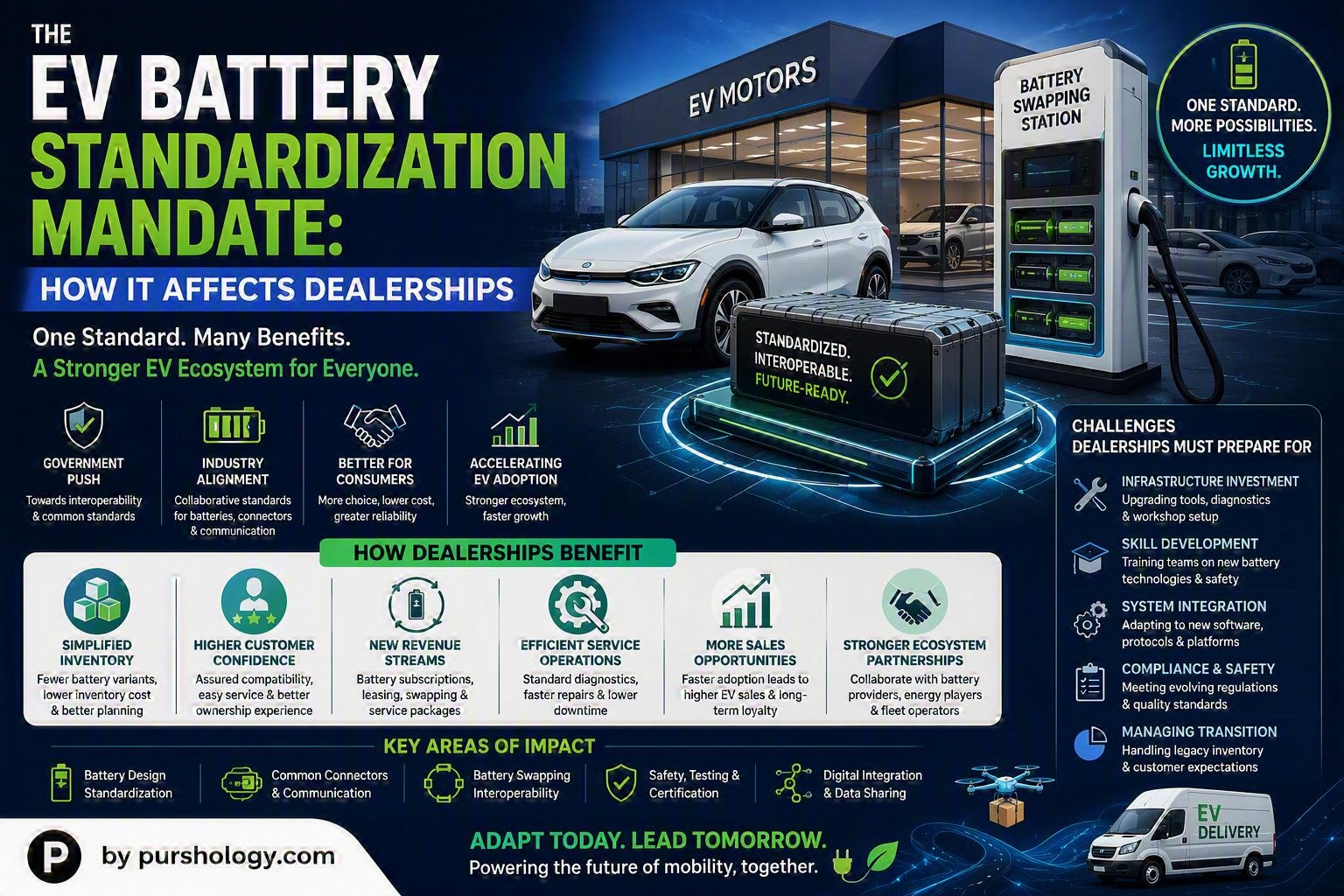
TL;DR:
As India moves toward greater EV battery standardization and interoperability, dealerships are entering a new era of electric mobility. Standardized battery formats, communication protocols, connectors, and battery-swapping frameworks could simplify inventory management, improve customer confidence, and accelerate EV adoption. However, dealerships will also face challenges related to training, infrastructure investment, service transformation, and evolving OEM relationships. The dealerships that adapt early will gain a significant competitive advantage.
India’s electric vehicle market is evolving rapidly.

While EV adoption continues to grow across two-wheelers, three-wheelers, passenger vehicles, and commercial fleets, one major challenge has remained: battery fragmentation.
Different manufacturers often use different battery designs, connectors, communication systems, and charging ecosystems. This lack of interoperability creates complexity for consumers, service networks, and dealerships alike.
To support long-term EV growth, policymakers and industry stakeholders have been working toward greater battery standardization and interoperability, particularly in the battery-swapping ecosystem. Efforts focus on creating standards around battery form factors, communication protocols, connectors, and interoperability while still preserving innovation.
For dealerships, these changes could reshape business operations in profound ways.
Why Battery Standardization Matters
One of the biggest barriers to EV adoption is uncertainty.
Consumers frequently worry about:
- Battery replacement costs
- Charging compatibility
- Battery availability
- Long-term service support
- Resale value
Battery standardization aims to reduce these concerns by creating a more consistent ecosystem across manufacturers and service providers. Policymakers have emphasized interoperability as a key objective for enabling large-scale battery-swapping infrastructure and improving customer convenience. [pib.gov.in], [niti.gov.in]
Marketing Takeaway
The easier EV ownership becomes, the faster consumer adoption is likely to accelerate.
Simplified Inventory Management
For dealerships, inventory complexity has been a growing challenge.
Today, dealers may need to stock multiple battery variants, chargers, and replacement components for different vehicle models.
A more standardized ecosystem can help dealerships:
- Reduce inventory costs
- Streamline spare parts management
- Improve stock availability
- Lower warehousing requirements
- Accelerate service turnaround times
Standardization could ultimately make dealership operations more efficient and predictable.
Business Impact
Lower inventory complexity can improve profitability and working capital efficiency.
Increased Consumer Confidence
Customers often hesitate before purchasing an EV because of battery-related concerns.
Questions frequently include:
- Will replacement batteries remain available?
- Will technology become obsolete?
- How expensive will future maintenance be?
- What happens if the manufacturer exits the market?
Greater standardization can provide reassurance that batteries and related infrastructure will remain accessible and compatible over time. Interoperability is specifically intended to improve reliability and customer convenience across the ecosystem.
Marketing Takeaway
Trust remains one of the strongest drivers of EV sales growth.
Growth of Battery Swapping Networks
Battery swapping is increasingly being viewed as a key solution for reducing downtime and range anxiety, particularly for two-wheelers and three-wheelers. Swapping allows users to exchange discharged batteries for charged ones within minutes instead of waiting for conventional charging. [niti.gov.in]
For dealerships, this creates new opportunities:
- Battery subscription sales
- Fleet partnerships
- Swapping station management
- Battery leasing services
- Service package expansion
Dealerships may evolve from vehicle sellers into mobility service hubs.
Business Opportunity
Recurring battery-service revenue could become a major profit center.
Service Departments Will Need New Skills
The shift toward standardized batteries doesn’t eliminate service requirements.
In fact, dealerships may need to strengthen technical capabilities.
Areas requiring expertise include:
- Battery diagnostics
- Battery-health monitoring
- Software management
- Thermal systems
- Swapping infrastructure
- Safety compliance
As EV adoption grows, dealerships with highly trained EV service teams will gain a competitive edge.
Marketing Takeaway
The future of dealership success may depend as much on technical expertise as vehicle sales.
Changes in OEM Relationships
Battery standardization could alter how dealerships interact with manufacturers.
Historically, proprietary batteries often locked customers into specific ecosystems.
As interoperability improves, consumers may gain greater flexibility in battery sourcing and servicing. Policymakers have emphasized creating interoperability while maintaining innovation within the battery ecosystem.
This may encourage OEMs to compete more aggressively on:
- Vehicle design
- Software experience
- Performance
- Safety
- Customer service
rather than battery exclusivity alone.
Marketing Takeaway
Differentiation will increasingly shift from hardware ownership to customer experience.
Faster EV Adoption Could Drive Higher Sales
One of the biggest dealership benefits may be increased EV market penetration.
Battery standardization can help address key adoption barriers including:
- Range anxiety
- Charging concerns
- Battery replacement fears
- Technology uncertainty
The easier EV ownership becomes, the larger the potential customer base becomes.
Business Impact
Growing consumer confidence can directly translate into stronger vehicle sales.
New Revenue Streams for Dealers
The traditional dealership model is changing.
Battery standardization and swapping ecosystems may unlock new business opportunities including:
- Battery subscriptions
- Battery leasing
- Battery health certification
- Fleet battery management
- Extended warranties
- Charging and swapping partnerships
Instead of relying solely on vehicle margins, dealerships can create recurring service-based revenue.
Marketing Takeaway
The most successful EV dealerships will be service businesses, not merely retail outlets.
Challenges Dealerships Must Prepare For
Despite the opportunities, adaptation won’t be seamless.
Dealerships may face challenges such as:
- Initial infrastructure investments
- Staff retraining costs
- New compliance requirements
- Software and system upgrades
- Managing legacy inventory
Dealers that delay transformation could find themselves struggling as customer expectations evolve.
Business Reality
Transition costs today may lead to stronger competitiveness tomorrow.
What Forward-Thinking Dealerships Are Doing
Leading dealerships are already preparing by:
✅ Investing in EV-specific service bays
✅ Training technicians in battery management
✅ Building charging infrastructure
✅ Exploring battery-swapping partnerships
✅ Educating customers on EV ownership
✅ Developing subscription-based service offerings
These initiatives position dealerships for long-term growth as battery ecosystems mature.
Final Thoughts
Battery standardization has the potential to become one of the most important developments in India’s EV journey. By promoting interoperability, simplifying service requirements, supporting battery-swapping networks, and reducing consumer uncertainty, standardization could accelerate electric vehicle adoption across the country.
For dealerships, the shift presents both opportunities and challenges. While operational changes and investments will be required, the long-term benefits include stronger customer confidence, simplified inventory management, new recurring revenue streams, and increased vehicle sales.
The dealerships that embrace the transition early will be best positioned to lead the next phase of India’s electric mobility revolution.
Ready for the Next Wave of EV Growth?
If you’re a dealership operator, automotive entrepreneur, or mobility investor, now is the time to reassess your EV strategy. The future of automotive retail is not just about selling vehicles, it’s about building a complete mobility ecosystem around batteries, energy, service, and customer convenience.