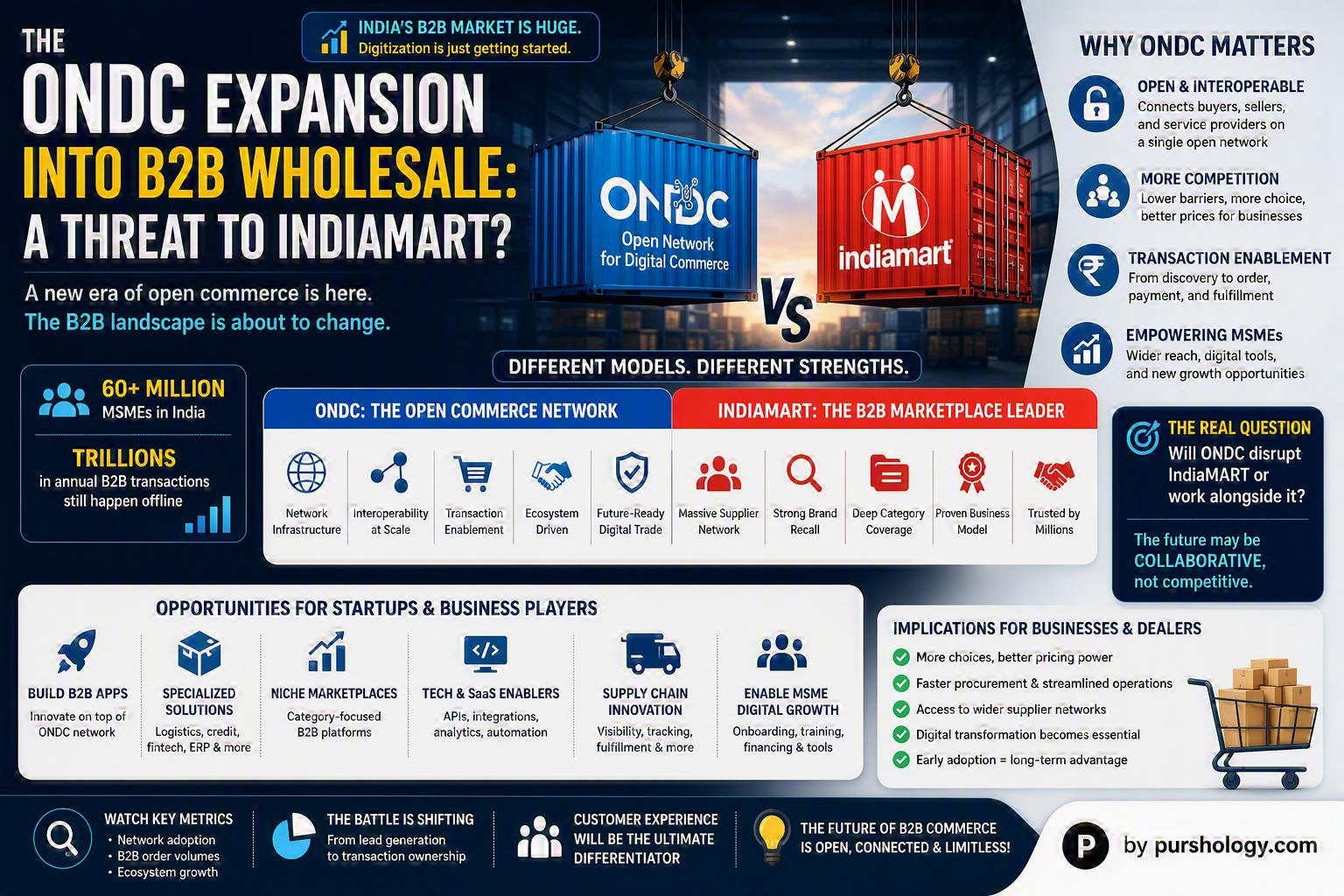
TL;DR:
As ONDC (Open Network for Digital Commerce) expands beyond consumer commerce into B2B transactions, it is increasingly entering territory historically dominated by platforms like IndiaMART. However, ONDC and IndiaMART currently serve different strategic roles. While IndiaMART operates as a lead-generation and supplier-discovery marketplace, ONDC is building an open digital commerce infrastructure that could eventually enable direct B2B transactions at scale. The real question isn’t whether ONDC will replace IndiaMART, but how much of India’s B2B commerce stack it can gradually absorb.
India’s B2B commerce market is one of the largest and most under-digitized opportunities in the country.

For years, IndiaMART has been the default platform for supplier discovery, wholesale sourcing, and business procurement. Millions of buyers use the platform to find manufacturers, dealers, distributors, and service providers across thousands of product categories.
But a new challenger is emerging.
The Open Network for Digital Commerce (ONDC) has already disrupted conversations around eCommerce by promoting an open, interoperable marketplace model. Now, as ONDC expands its capabilities into B2B commerce and wholesale transactions, industry observers are asking an increasingly important question:
Could ONDC become a serious threat to IndiaMART?
Let’s break it down.
Understanding the Difference Between ONDC and IndiaMART
Before comparing the two, it’s important to understand that they are fundamentally different models.
IndiaMART
IndiaMART primarily functions as:
- A supplier discovery platform
- A B2B lead-generation engine
- A digital business directory
- A quotation marketplace
- A sourcing platform
Its core value lies in connecting buyers and sellers.
ONDC
ONDC functions as:
- An open commerce network
- A transaction infrastructure layer
- An interoperability framework
- A digital commerce ecosystem
Instead of being a marketplace itself, ONDC allows multiple buyers, sellers, logistics providers, and technology partners to transact across a common network.
Marketing Takeaway
IndiaMART owns the marketplace. ONDC wants to own the rails.
Why ONDC’s B2B Expansion Matters
India’s B2B market is significantly larger than its consumer commerce market.
Large opportunities exist across:
- Industrial supplies
- Manufacturing inputs
- FMCG distribution
- Wholesale procurement
- Agricultural trade
- Retail replenishment
- Hospitality procurement
Historically, much of this commerce has remained fragmented and relationship-driven.
ONDC aims to standardize and digitize these processes.
If successful, it could create a nationwide procurement layer connecting businesses of all sizes.
The Biggest Threat: Transaction Ownership
One of IndiaMART’s strengths is supplier discovery.
However, many transactions happen outside the platform after buyers and sellers establish contact.
This model works well because buyers often want direct negotiation and customized pricing.
ONDC introduces a different possibility.
Instead of stopping at lead generation, the network can potentially facilitate:
- Product discovery
- Order management
- Payment processing
- Logistics integration
- Fulfillment tracking
This means ONDC could gradually move closer to owning the transaction itself.
Why This Is Important
Platforms controlling transactions typically gain:
- More data
- Higher engagement
- Better retention
- Stronger network effects
This is where ONDC becomes strategically interesting.
SMEs Could Drive ONDC Adoption
India has over 60 million MSMEs, many of which struggle with:
- Market access
- Procurement efficiency
- Technology adoption
- Distribution challenges
ONDC’s open infrastructure model could make participation easier and more affordable for smaller businesses.
Potential benefits include:
- Reduced dependence on intermediaries
- Wider customer access
- Lower platform lock-in
- Improved competition
For small businesses, openness can be highly attractive.
Marketing Takeaway
Lower barriers to entry often accelerate ecosystem growth.
IndiaMART Still Has Major Advantages
Despite the excitement around ONDC, IndiaMART remains a formidable player.
Key competitive advantages include:
Massive Supplier Base
IndiaMART has spent decades building supplier relationships and business listings.
Strong Brand Recall
For many procurement professionals, IndiaMART is synonymous with B2B sourcing.
Deep Category Coverage
The platform supports thousands of product categories and industries.
Established Revenue Model
Premium subscriptions and lead monetization remain proven and scalable.
Marketing Takeaway
Distribution advantages built over decades are difficult to replicate quickly.
Where ONDC Could Win
If ONDC successfully scales B2B commerce, it may gain advantages in:
Interoperability
Businesses can connect across multiple applications and service providers.
Transaction Efficiency
Integrated ordering and fulfillment could reduce friction.
Ecosystem Innovation
Open networks often encourage greater innovation among participating partners.
Cost Structure
Reduced platform dependency may create more competitive economics.
Marketing Takeaway
Open ecosystems frequently expand faster than closed marketplaces.
The Future Isn’t Winner-Takes-All
Many analysts frame the debate as:
ONDC vs IndiaMART
The reality may be:
ONDC + IndiaMART
IndiaMART itself could potentially participate in open commerce ecosystems while continuing to leverage its discovery and supplier network strengths.
Businesses often use multiple procurement channels simultaneously.
Future B2B commerce may involve:
- IndiaMART for discovery
- ONDC for transactions
- Specialized software for procurement
- Independent logistics networks
The ecosystem is likely to become more interconnected rather than consolidated.
What Investors Should Watch
Over the next few years, several indicators will reveal the competitive impact of ONDC’s B2B expansion:
✅ Active B2B sellers on ONDC
✅ Wholesale transaction volumes
✅ MSME participation rates
✅ Logistics integration maturity
✅ Repeat purchase activity
✅ Procurement use cases beyond retail
✅ Network-wide order values
These metrics will provide a clearer picture than headline announcements.
The Strategic Implications for IndiaMART
Whether ONDC becomes a direct threat or not, it creates pressure in key areas:
- Transaction enablement
- Workflow automation
- B2B payment integration
- Digital procurement experiences
- Ecosystem partnerships
IndiaMART will likely need to continue evolving beyond lead generation to maintain long-term leadership.
The future of B2B commerce increasingly favors platforms that help businesses complete transactions, not just discover suppliers.
Final Thoughts
ONDC’s expansion into B2B wholesale is one of the most important developments in India’s digital commerce landscape. While it does not immediately threaten IndiaMART’s leadership in supplier discovery, it does introduce a new model that could reshape how businesses transact, procure, and manage supply chains.
IndiaMART currently possesses scale, trust, and network advantages built over years of market leadership. However, ONDC’s open-network architecture could gradually redefine the economics of B2B commerce by making transactions more interoperable, competitive, and accessible.
The real battle won’t be fought over listings. It will be fought over who owns the future of digital procurement in India.
Ready for the Next Phase of B2B Commerce?
Whether you’re a startup founder, wholesaler, distributor, manufacturer, or investor, now is the time to closely monitor the evolution of ONDC and the response from established players like IndiaMART. The companies that adapt first to the next generation of digital trade infrastructure will be the biggest beneficiaries of India’s B2B commerce revolution.