TL;DR:
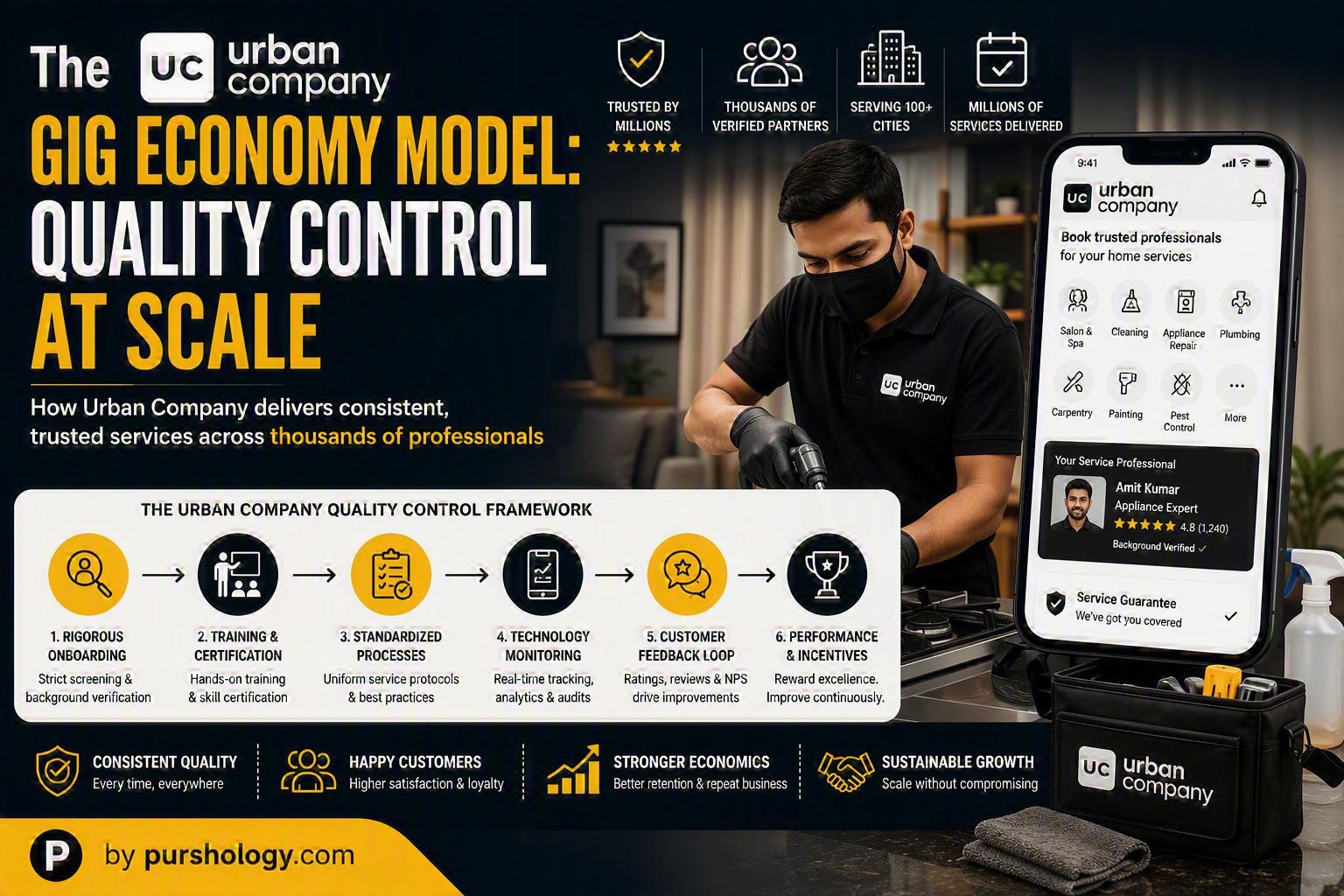
Urban Company cracked one of the biggest challenges in the gig economy: maintaining consistent service quality while scaling across cities and service categories. By combining rigorous partner onboarding, training academies, technology-driven quality monitoring, customer feedback loops, and performance-based incentives, Urban Company transformed freelance service delivery into a standardized and trusted consumer experience. Its model offers valuable lessons for businesses seeking to scale service operations without compromising quality.
The gig economy has revolutionized how services are delivered. From ride-sharing apps to food delivery platforms, millions of consumers now rely on independent professionals for everyday needs.

However, one major challenge persists across gig economy businesses: quality control.
How do you ensure a customer receives the same high-quality experience every time when services are delivered by thousands of independent workers?
Urban Company found an answer.
The company has built one of India’s most successful home services platforms by creating systems that balance scale with consistency. From salon services and appliance repairs to cleaning and home maintenance, Urban Company has developed a model that enables reliable service delivery across a vast network of professionals.
Let’s examine how Urban Company built a scalable quality-control engine in the gig economy.
The Core Challenge of Gig Economy Businesses
Traditional service businesses control quality through direct employee management.
Gig platforms operate differently.
Service professionals often:
- Work independently
- Operate across different locations
- Have varying skill levels
- Serve diverse customer segments
- Manage their own schedules
Without standardization, customer experiences can become inconsistent.
Urban Company recognized early that trust would be the foundation of long-term growth.
Marketing Takeaway
In service-based businesses, consistency is often more valuable than rapid expansion.
Rigorous Partner Selection
One of Urban Company’s biggest advantages starts before a partner delivers their first service.
The platform follows strict onboarding processes that evaluate:
- Technical expertise
- Professional experience
- Communication skills
- Service quality standards
- Customer interaction capabilities
Rather than focusing solely on expanding partner numbers, Urban Company prioritizes selecting professionals capable of meeting platform expectations.
This ensures a stronger quality baseline across the network.
Marketing Takeaway
Hiring standards directly influence customer satisfaction and brand reputation.
Training as a Competitive Advantage
Urban Company doesn’t simply connect customers with service providers.
It invests heavily in partner development.
Through dedicated training programs, professionals learn:
- Service procedures
- Customer engagement practices
- Hygiene standards
- Safety protocols
- Brand expectations
This training creates uniformity across thousands of service professionals.
Customers receive a more predictable experience regardless of location.
Marketing Takeaway
Training transforms independent workers into consistent brand ambassadors.
Standardization Creates Trust
One reason customers return to Urban Company is predictability.
The platform standardizes:
- Service workflows
- Equipment requirements
- Pricing structures
- Safety procedures
- Customer interaction guidelines
Whether a customer books a salon service in Bengaluru or an appliance repair in Delhi, the experience follows a similar framework.
This reduces uncertainty and increases trust.
Marketing Takeaway
Customers are more likely to repurchase when they know exactly what to expect.
Technology-Powered Quality Monitoring
Urban Company leverages technology to monitor service performance at scale.
The platform collects data on:
- Customer ratings
- Review sentiment
- Service completion rates
- Response times
- Repeat bookings
- Cancellation rates
This information allows the company to quickly identify quality issues and implement corrective measures.
Technology enables management of thousands of professionals without relying solely on manual supervision.
Marketing Takeaway
Data-driven quality management scales more effectively than traditional oversight methods.
Customer Feedback Drives Continuous Improvement
Every completed service generates valuable insights.
Urban Company actively captures customer feedback through:
- Ratings
- Reviews
- Surveys
- Complaint resolution systems
This constant flow of information creates a powerful quality-control loop.
High-performing professionals are rewarded, while performance concerns are addressed through coaching or corrective action.
The result is continuous service improvement.
Marketing Takeaway
Customer feedback should be treated as a strategic growth asset rather than a support function.
Incentives Align Performance
Quality control becomes easier when incentives support desired outcomes.
Urban Company aligns rewards with performance metrics such as:
- Customer satisfaction
- Service quality
- Reliability
- Repeat business
- Professional conduct
Top-performing partners gain access to more earning opportunities and stronger visibility within the platform.
This encourages consistent service excellence.
Marketing Takeaway
When incentives align with customer outcomes, quality naturally improves.
Building Trust Through Transparency
Consumers appreciate transparency, especially when inviting service professionals into their homes.
Urban Company addresses this through:
- Verified professional profiles
- Customer ratings
- Service guarantees
- Transparent pricing
- Secure payment systems
These measures reduce purchase anxiety and strengthen customer confidence.
Trust becomes an advantage that competitors struggle to replicate.
Marketing Takeaway
Transparency is one of the strongest drivers of customer loyalty in service marketplaces.
The Importance of Repeat Customers
Urban Company understands that sustainable growth comes from retention, not just acquisition.
By focusing on service quality, the platform increases:
- Repeat bookings
- Customer lifetime value
- Word-of-mouth referrals
- Brand advocacy
A satisfied customer often becomes a recurring customer across multiple service categories.
This significantly improves business economics.
Marketing Takeaway
Quality is often the most effective customer retention strategy.
Expanding Without Diluting Standards
Many platforms struggle as they scale.
Urban Company’s success lies in creating systems rather than relying solely on individual managers.
Its growth model is supported by:
- Standardized processes
- Centralized training
- Performance analytics
- Quality benchmarks
- Scalable technology infrastructure
These systems allow expansion into new cities and services without compromising customer experience.
Marketing Takeaway
Scalable systems create sustainable growth.
Key Lessons from Urban Company’s Growth Strategy
Urban Company’s approach can be summarized through several key principles:
✅ Select partners carefully
✅ Invest heavily in training
✅ Standardize service delivery
✅ Use technology to monitor quality
✅ Leverage customer feedback continuously
✅ Align incentives with performance
✅ Prioritize trust and transparency
✅ Focus on customer retention
Together, these elements create a sustainable competitive advantage in the gig economy.
Final Thoughts
Urban Company has demonstrated that scaling a gig economy business does not have to come at the expense of quality. By combining technology, training, performance management, and customer-centric processes, the company created a reliable marketplace that customers trust repeatedly.
Its success highlights an important lesson for modern businesses: growth is sustainable only when quality scales alongside it. In an increasingly competitive service economy, the brands that master consistency will be the ones that win customer loyalty and long-term market leadership.
Ready to Scale Service Quality Without Compromising Experience?
If your business relies on distributed teams, independent professionals, or service marketplaces, focus on building systems that ensure consistency, accountability, and customer satisfaction. The companies that turn quality into a scalable process will become the next category leaders.