TL;DR
As D2C and e-commerce brands scale, spreadsheets and disconnected tools quickly become operational bottlenecks.
Here are the best cloud ERP solutions for fast-growing online businesses:

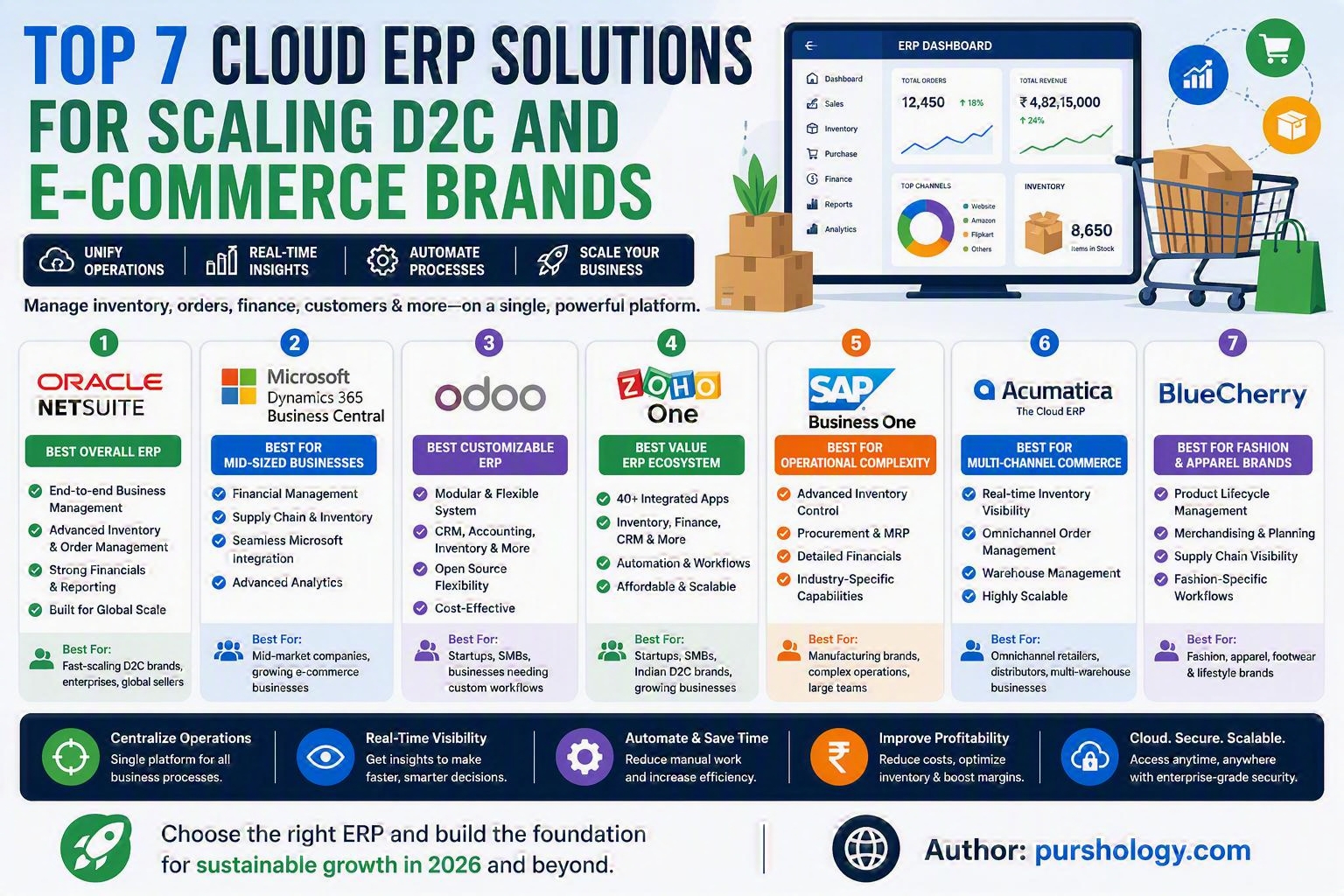
- NetSuite ERP – Best overall ERP for scaling brands
- Microsoft Dynamics 365 Business Central – Best for growing mid-sized businesses
- Odoo ERP – Best open and customizable ERP
- Zoho One – Best value for startups and SMBs
- SAP Business One – Best for operational complexity
- Acumatica Cloud ERP – Best for multi-channel commerce
- BlueCherry ERP – Best for apparel and fashion brands
Best Overall: NetSuite ERP
Best Value: Zoho One
Best for Fast-Growth Brands: Microsoft Dynamics 365 Business Central
Why D2C and E-commerce Brands Need ERP Software in 2026
Growing an online business isn’t just about generating sales anymore.
As brands scale, they must manage:
- Inventory across multiple warehouses
- Online marketplace integrations
- Customer orders
- Procurement
- Finance and accounting
- Supply chain operations
- Returns and refunds
- Demand forecasting
- Multi-channel sales
Managing these processes across separate platforms often leads to inefficiencies, stock discrepancies, and lost revenue.
A cloud ERP system centralizes operations and provides real-time visibility across the business.
1. NetSuite ERP
Best Overall ERP for Scaling E-commerce Brands
NetSuite remains one of the most powerful cloud ERP solutions available.
Key Features
✅ Inventory management
✅ Financial management
✅ Demand planning
✅ Supply chain management
✅ Warehouse management
✅ Order management
✅ Multi-channel commerce support
Why It Stands Out
NetSuite offers a unified platform that connects finance, inventory, fulfillment, and customer management.
High-growth D2C brands often choose NetSuite as they transition from startup to enterprise scale.
Best For
- Fast-scaling brands
- Multi-channel sellers
- International businesses
- Enterprise e-commerce companies
2. Microsoft Dynamics 365 Business Central
Best for Mid-Sized Businesses
Business Central combines ERP functionality with Microsoft’s powerful ecosystem.
Key Features
✅ Financial management
✅ Inventory tracking
✅ Sales management
✅ Purchasing workflows
✅ Reporting and analytics
✅ Integration with Microsoft 365
Why It Stands Out
Businesses already using Microsoft tools benefit from seamless workflows and familiar user experiences.
Best For
- Mid-market companies
- Wholesale businesses
- E-commerce businesses
- Distribution companies
3. Odoo ERP
Best Customizable ERP Platform
Odoo offers a modular ERP system that allows companies to deploy only the applications they need.
Key Features
✅ Inventory management
✅ CRM
✅ Accounting
✅ HR management
✅ Manufacturing
✅ Ecommerce integration
✅ Marketing tools
Why It Stands Out
Brands can start small and add functionality as they grow.
Best For
- Startups
- SMBs
- Custom workflow environments
- Budget-conscious businesses
4. Zoho One
Best Value ERP Ecosystem
Zoho One delivers an integrated business operating system with dozens of connected applications.
Key Features
✅ Inventory management
✅ Accounting
✅ CRM
✅ Project management
✅ Helpdesk
✅ HR management
✅ Business analytics
Why It Stands Out
The platform provides exceptional value, particularly for growing D2C brands seeking affordability without sacrificing functionality.
Best For
- Startups
- Growing online brands
- Indian businesses
- Service and commerce businesses
5. SAP Business One
Best for Operational Complexity
SAP Business One is designed for businesses managing increasingly sophisticated operations.
Key Features
✅ Advanced inventory control
✅ Procurement management
✅ Manufacturing support
✅ Financial reporting
✅ Customer management
✅ Supply chain visibility
Why It Stands Out
SAP offers deep operational insights and robust scalability.
Best For
- Manufacturing-driven brands
- Complex supply chains
- Global businesses
- Large operations teams
6. Acumatica Cloud ERP
Best for Multi-Channel Commerce
Acumatica has gained popularity for its flexibility and ecommerce capabilities.
Key Features
✅ Real-time inventory
✅ Order processing
✅ Financial management
✅ Warehouse operations
✅ Commerce integrations
✅ Operational dashboards
Why It Stands Out
The platform handles multi-channel selling exceptionally well.
Best For
- Omnichannel retailers
- D2C brands
- Wholesale distributors
- Multi-warehouse businesses
7. BlueCherry ERP
Best for Fashion and Apparel Brands
BlueCherry specializes in apparel, footwear, and lifestyle businesses.
Key Features
✅ Product lifecycle management
✅ Inventory optimization
✅ Supply chain visibility
✅ Vendor management
✅ Production planning
✅ Omnichannel support
Why It Stands Out
The platform was specifically built for fashion and retail operations.
Best For
- Apparel brands
- Lifestyle brands
- Fashion retailers
- Footwear companies
Quick Comparison
| ERP Solution | Best For | Scalability | Ecommerce Support |
|---|---|---|---|
| NetSuite | Large D2C Brands | Excellent | Excellent |
| Dynamics 365 | Mid-Market Companies | Excellent | Very Good |
| Odoo | Flexible Operations | Very Good | Very Good |
| Zoho One | SMBs & Startups | Very Good | Very Good |
| SAP Business One | Complex Operations | Excellent | Good |
| Acumatica | Omnichannel Commerce | Excellent | Excellent |
| BlueCherry | Fashion Brands | Very Good | Excellent |
How to Choose the Right ERP
Choose NetSuite If:
- You are experiencing rapid growth
- You sell across multiple channels
- You need enterprise-level capabilities
Choose Dynamics 365 If:
- Your team already uses Microsoft products
- You need strong financial controls
- Scalability is a priority
Choose Odoo If:
- Customization is essential
- You want modular deployment
- Budget flexibility matters
Choose Zoho One If:
- You’re a startup or SMB
- Value for money is important
- You want an integrated business ecosystem
Choose SAP Business One If:
- Operations are becoming increasingly complex
- Manufacturing is part of your model
Choose Acumatica If:
- Omnichannel inventory management is critical
- You operate multiple warehouses
Choose BlueCherry If:
- You’re in fashion or apparel retail
- Product lifecycle management is important
Final Verdict
For most scaling D2C and e-commerce brands in 2026, NetSuite ERP remains the gold standard, offering deep operational visibility, powerful automation, and enterprise-grade scalability.
However, businesses seeking a more cost-effective solution should strongly consider Zoho One, while Microsoft Dynamics 365 Business Central provides an excellent middle ground for growing companies.
The right ERP doesn’t just manage operations—it creates the foundation for sustainable growth, better customer experiences, and improved profitability.
Ready to Scale Your E-commerce Operations?
Choosing the right ERP can simplify inventory management, improve fulfillment accuracy, automate financial processes, and help your brand scale without operational chaos.
Need expert guidance on selecting and implementing the ideal ERP solution for your D2C or e-commerce business? Contact Purshology today and discover how the right technology stack can accelerate growth and improve operational efficiency.