B2B software discovery is no longer limited to Google. Buyers increasingly use ChatGPT, Perplexity, Gemini, Claude, and other AI-powered search experiences to research categories, compare vendors, and build product shortlists.
AI search visibility platforms help marketing teams understand whether their brand appears in those answers, which competitors are being recommended, what sources AI systems cite, and where visibility gaps exist.

The right platform depends on what you need to measure. Some focus on prompt-level monitoring, while others combine AI visibility with traditional SEO, content workflows, technical optimization, or large-scale market research.
Here are nine AI search visibility platforms B2B SaaS teams should consider in 2026.
Quick Comparison
| Platform | Best for |
| SORN AI | Prompt-level visibility and competitor monitoring |
| Profound | Enterprise AI search intelligence |
| Peec AI | Focused AI search analytics |
| OtterlyAI | Accessible multi-engine monitoring |
| Scrunch AI | Brand presence and AI search optimization |
| Writesonic | Combining GEO monitoring with content execution |
| Semrush AI Visibility Toolkit | SEO teams adding AI visibility tracking |
| Ahrefs Brand Radar | Large-scale AI visibility and citation research |
| Conductor | Enterprise SEO and AI search workflows |
1. SORN AI
Best for: B2B SaaS teams that want prompt-level visibility and competitive intelligence
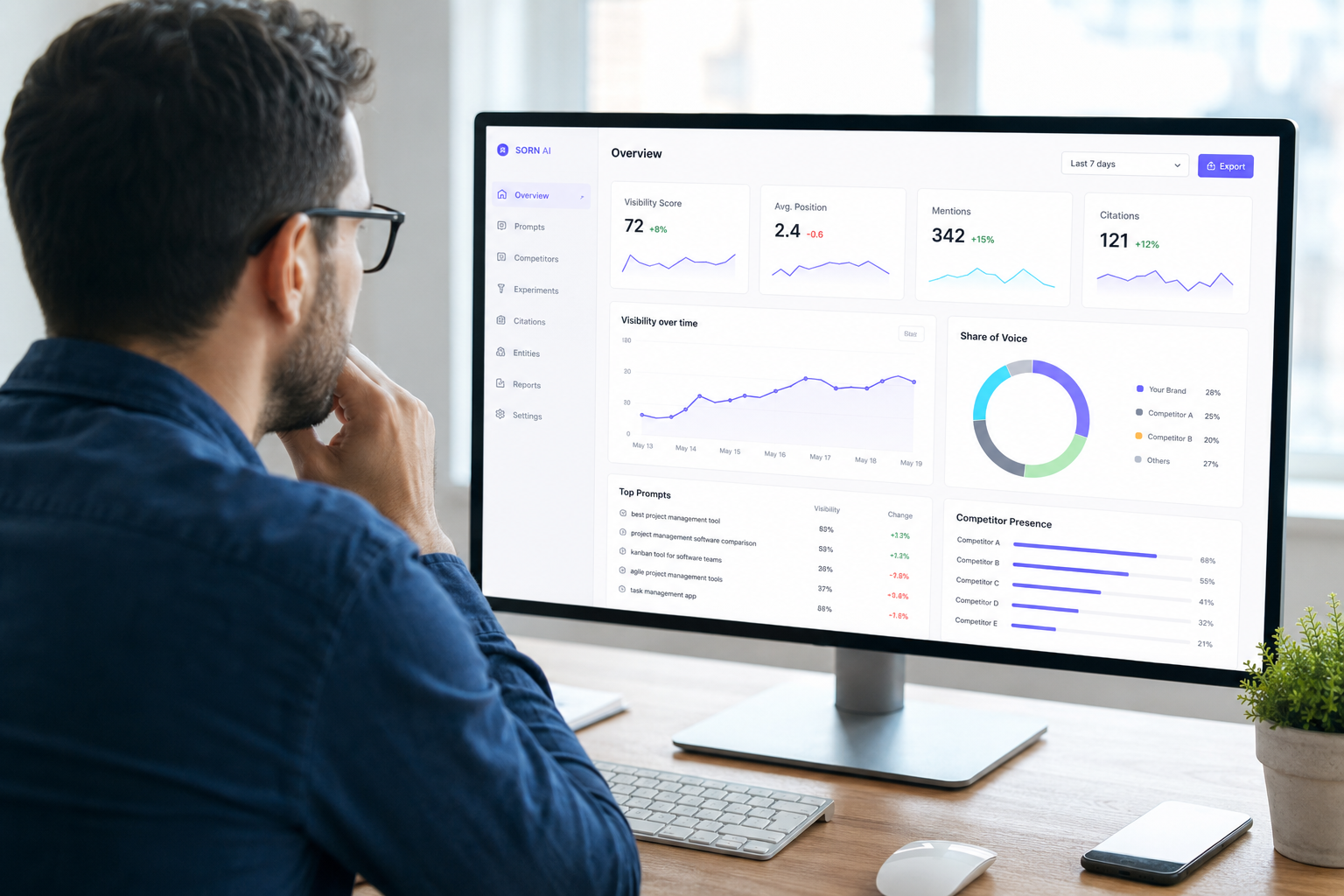
SORN AI monitors how businesses appear across ChatGPT, Gemini, Perplexity, and Claude.
Rather than treating AI visibility as a single score, SORN tracks the buyer prompts that surface a business and shows which competitors appear when that business does not. Teams can monitor changes in visibility, citations, competitor presence, and how AI systems describe their brand.
Its Experiment Engine adds another layer by testing prompt clusters and monitoring how visibility changes over time. That makes SORN particularly relevant for SaaS teams actively experimenting with AEO or GEO strategies rather than simply producing periodic visibility reports.
Key capabilities:
- Monitoring across ChatGPT, Gemini, Perplexity, and Claude
- Prompt-level AI rankings and visibility tracking
- Competitor monitoring
- Citation tracking
- Entity accuracy monitoring
- Experiment Engine for testing visibility changes
Good fit for: SaaS companies and agencies that want to understand why competitors are appearing in important AI answers and track changes systematically.
2. Profound
Best for: Enterprise AI search intelligence
Profound is one of the broader platforms in the category. Its Answer Engine Insights product measures visibility, citations, sentiment, share of voice, positioning, and competitors across major AI platforms.
Profound also offers Prompt Volumes, which helps teams research what people are asking AI systems, and Agent Analytics for understanding AI crawler and referral activity.
Its platform currently covers consumer experiences including ChatGPT, Perplexity, Claude, Gemini, Google AI Overviews, Google AI Mode, Copilot, Grok, and DeepSeek.
Good fit for: Larger SaaS organizations that need extensive research, regional analysis, AI visibility measurement, and enterprise workflows.
3. Peec AI
Best for: Straightforward AI search analytics
Peec AI focuses specifically on AI search analytics rather than trying to replace a full SEO or content stack.
Teams can create projects, track prompts daily, choose the AI models relevant to their audience, and compare brand performance over time. Its Starter offering currently supports 50 prompts, three selected models, one project, and unlimited users.
That focused approach can make Peec attractive to marketing teams primarily interested in monitoring rather than broader content production.
Good fit for: Marketing teams and agencies that want dedicated AI visibility analytics without a large traditional SEO suite.
4. OtterlyAI
Best for: Teams getting started with multi-engine AI monitoring
OtterlyAI tracks brand visibility across ChatGPT, Google AI Overviews, Google AI Mode, Gemini, Perplexity, Microsoft Copilot, and Claude.
It monitors brand mentions, citations, links, and AI search performance while also offering GEO-oriented content and crawlability analysis.
With entry-level pricing starting at $29 per month at the time of writing, it remains one of the more accessible options for smaller teams.
Good fit for: Startups, smaller SaaS companies, and agencies that want broad AI-engine coverage without immediately moving into enterprise software.
5. Scrunch AI
Best for: Brand presence and AI search optimization
Scrunch AI helps companies monitor how they appear across AI-generated answers.
Its monitoring tools cover metrics such as brand presence, position, sentiment, citations, and competitive presence. Teams can drill down from aggregate trends into individual topics and prompts to identify where competitors outperform them.
Scrunch also extends beyond monitoring with tools focused on AI accessibility and how content is delivered to AI agents.
Good fit for: Established brands that want both AI visibility measurement and tools for improving how AI systems access and interpret their content.
6. Writesonic
Best for: Connecting GEO monitoring with content execution
Writesonic has evolved beyond AI writing into a broader SEO and generative engine optimization platform.
Its GEO tools track brand visibility, citation share, competitive gaps, and prompts where competitors appear but the monitored brand does not. Teams can then use Writesonic’s content workflows to create or update content around those opportunities.
This makes it different from monitoring-first platforms where execution happens elsewhere.
Good fit for: SaaS marketing teams that want AI visibility analysis and content creation within the same ecosystem.
7. Semrush AI Visibility Toolkit
Best for: Existing SEO teams adding AI visibility measurement
Semrush brings AI search monitoring into a familiar marketing and SEO environment.
Its AI Visibility Toolkit tracks mentions across ChatGPT, Google AI, Gemini, and Perplexity and includes competitor research, prompt research, sentiment and share-of-voice analysis, daily prompt tracking, and AI-readiness auditing.
For organizations already using Semrush, this can reduce the need to introduce another standalone analytics platform.
Good fit for: SEO and content teams that want traditional search and AI visibility data within the same broader toolset.
8. Ahrefs Brand Radar
Best for: Large-scale AI visibility and citation research
Ahrefs Brand Radar takes a different approach from tools built primarily around user-created prompt lists.
Its AI Visibility Index analyzes hundreds of millions of search-backed prompts across major AI platforms, allowing teams to research brand mentions, citations, estimated impressions, and AI share of voice without first building a monitoring project.
Ahrefs also offers Custom Prompts for tracking specific buyer questions over time.
Good fit for: SaaS teams that want broad market-level visibility research alongside traditional SEO and citation analysis.
9. Conductor
Best for: Large enterprise SEO teams
Conductor combines established enterprise SEO workflows with AI Search Performance capabilities.
Teams can measure AI visibility, mentions, citations, share of voice, sentiment, competitors, and the topics influencing their performance. The platform is designed to connect strategic AI-search reporting with broader organic search execution.
Good fit for: Enterprises already operating sophisticated SEO programs that want AI search integrated into existing workflows.
How to Choose an AI Visibility Platform
The best platform depends on how your team plans to use the data.
If your priority is tracking buyer prompts and comparing your visibility directly with competitors, platforms such as SORN AI and Peec AI provide a focused monitoring approach.
If you need large-scale enterprise intelligence, Profound, Scrunch, and Conductor offer broader workflows.
Teams that want AI visibility combined with existing SEO data may prefer Semrush or Ahrefs, while Writesonic is particularly relevant when content creation and optimization are part of the same workflow.
OtterlyAI offers another option for teams that want broad AI-engine monitoring with a relatively accessible starting point.
The most important distinction is between simply knowing that your AI visibility changed and having enough detail to understand where that change occurred. For B2B SaaS companies, tracking commercial and comparison prompts can be especially useful because these are the questions most closely connected to software evaluation.
Frequently Asked Questions
What is an AI search visibility platform?
An AI search visibility platform tracks how often and how prominently a brand appears in answers generated by AI systems such as ChatGPT, Gemini, Claude, Perplexity, and Google AI search experiences. Depending on the platform, it may also track citations, competitors, sentiment, share of voice, prompts, and the sources influencing AI-generated answers.
What is the best AI visibility tool for B2B SaaS companies?
There is no single best platform for every SaaS company. SORN AI is suited to teams focused on prompt-level visibility, competitor monitoring, and experimentation. Profound is designed for broader enterprise AI search intelligence, while Peec AI and OtterlyAI offer more focused monitoring approaches. Semrush, Ahrefs, Writesonic, and Conductor may be better suited to teams that want AI visibility alongside existing SEO or content workflows.
What should B2B SaaS teams track in AI search?
B2B SaaS teams should generally monitor high-intent category, comparison, alternative, problem, and recommendation prompts relevant to their buyers. Useful metrics include brand mentions, visibility, competitor presence, citations, share of voice, sentiment or positioning, and changes in AI responses over time.
What is the difference between AI visibility tracking and traditional rank tracking?
Traditional rank tracking measures where webpages appear in search-engine results for specific keywords. AI visibility tracking measures whether and how brands appear within AI-generated answers. Instead of only tracking webpage positions, teams can evaluate brand mentions, recommendations, citations, competitors, and responses to specific prompts.
Can AI visibility platforms track citations?
Many AI visibility platforms track citations or sources used in AI-generated answers, although coverage varies by platform and AI engine. Citation tracking can help teams identify which third-party websites and owned pages are influencing AI responses in their category.
What is the difference between GEO and AI visibility monitoring?
Generative engine optimization (GEO) is the broader practice of improving a brand’s presence in AI-generated search and answer experiences. AI visibility monitoring is the measurement component: tracking where a brand appears, which competitors are present, what sources are cited, and how those patterns change over time.
Final Thoughts
AI search visibility is becoming a distinct part of organic discovery. Traditional rankings can show how a SaaS company performs on Google, but they do not fully reveal which vendors ChatGPT, Gemini, Claude, or Perplexity recommend when buyers ask category and comparison questions.
The platforms above approach that problem differently. The right choice depends on whether your team needs focused prompt monitoring, competitive intelligence, citation research, content execution, or an enterprise system combining AI search with traditional SEO.
For most teams, the starting point is simple: identify the AI platforms your buyers use, define the high-intent prompts that matter to your category, and choose a tool capable of measuring those consistently over time.