TL;DR
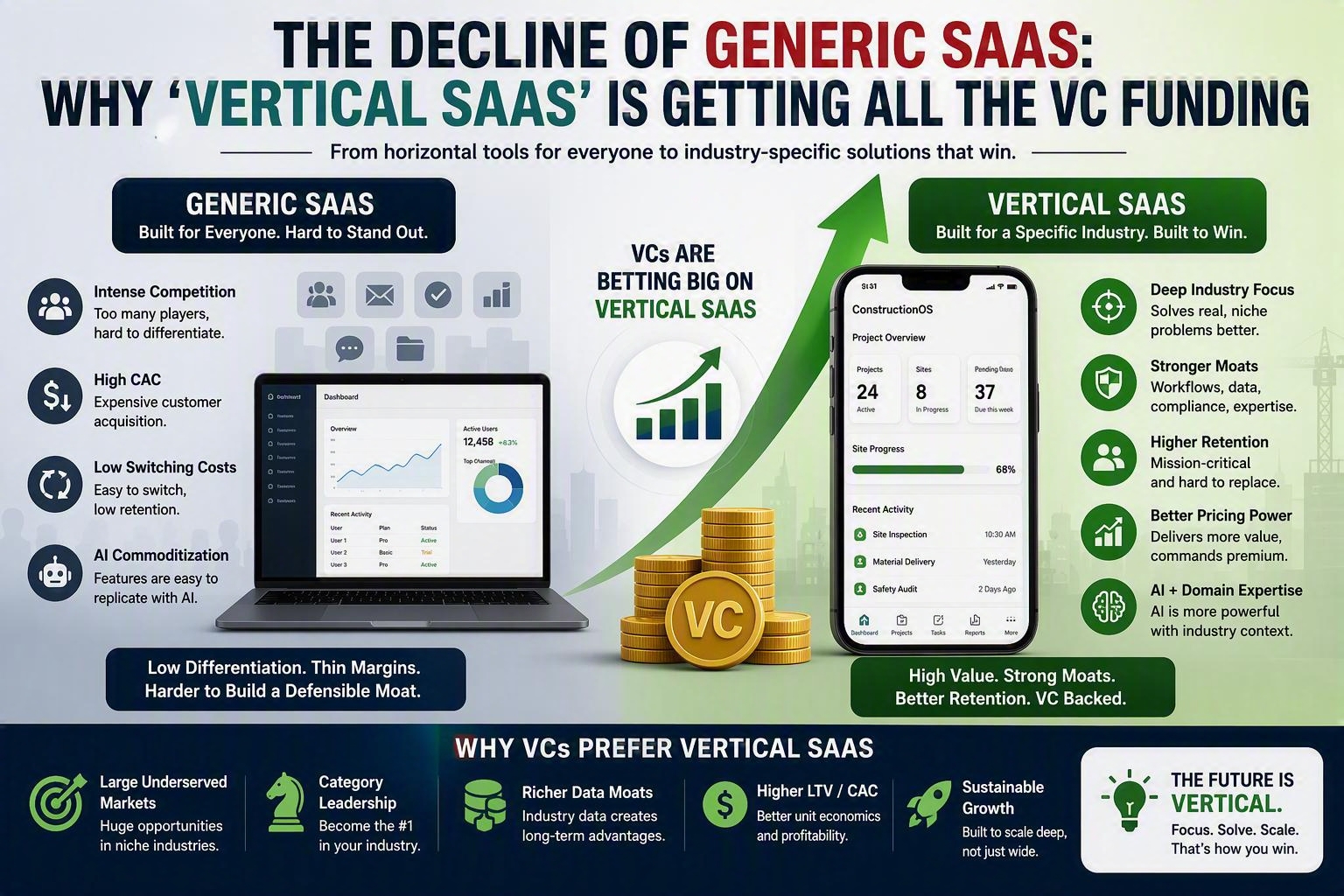
Generic SaaS is facing increasing pressure from AI, low-code tools, and intense competition. Meanwhile, Vertical SaaS, software built specifically for industries like healthcare, logistics, manufacturing, construction, legal services, and hospitality, is attracting growing investor attention. The reason is simple: vertical SaaS companies solve deeper industry-specific problems, command higher retention, face less competition, and create stronger moats. In 2026, many VCs are no longer asking whether a startup uses AI. They’re asking whether it owns a specific industry.
For more than a decade, generic SaaS dominated venture capital conversations.

Companies built tools for:
The playbook was straightforward.
Build software that works for almost every company, acquire users at scale, and grow through recurring subscriptions.
That strategy created giants worth billions.
But the market is changing.
Today, some of the most exciting venture-backed startups aren’t building software for everyone.
They’re building software for someone very specific.
And investors love it.
What Is Vertical SaaS?
Vertical SaaS refers to software designed specifically for a particular industry.
Instead of serving all businesses, vertical SaaS focuses on a single sector and deeply understands its workflows.
Examples include:
Healthcare
- Clinic management
- Patient scheduling
- Medical billing
- Telemedicine platforms
Logistics
- Fleet management
- Route optimization
- Warehouse operations
- Last-mile delivery software
Construction
- Project estimation
- Site management
- Compliance tracking
- Contractor coordination
Legal
- Case management
- Contract automation
- Legal research
- Document workflows
Unlike generic SaaS, these products are built around industry-specific needs.
Why Generic SaaS Is Losing Its Edge
The biggest challenge is saturation.
Every category now contains dozens or even hundreds of competitors.
For example:
- CRM software
- Team collaboration tools
- Marketing automation platforms
- Customer engagement platforms
Most offer similar functionality.
This creates three major problems.
1. Customer Acquisition Is Expensive
When everyone targets the same customers, marketing costs rise.
Startups end up spending heavily on:
- Ads
- Content marketing
- Sales teams
- Discounting
Growth becomes increasingly expensive.
2. Switching Costs Are Falling
Many generic products look almost identical.
If customers can switch after a free trial, retention suffers.
This erodes long-term value.
3. AI Is Commoditizing Features
AI can now generate reports, automate workflows, write content, summarize meetings, and handle customer service tasks.
Features that once differentiated SaaS products are becoming easier to replicate.
As a result, generic software categories are becoming crowded and commoditized.
Why Investors Love Vertical SaaS
Vertical SaaS solves a different problem.
Instead of chasing millions of businesses, it becomes indispensable to a specific industry.
That’s incredibly attractive from a venture capital perspective.
Deep Industry Expertise Creates Moats
Imagine two software companies.
Company A builds generic inventory software.
Company B builds inventory software specifically for pharmaceutical distributors.
Which one is harder to replace?
Usually Company B.
That’s because industry-specific knowledge creates barriers to entry.
Vertical SaaS companies often embed:
- Regulations
- Compliance requirements
- Industry workflows
- Specialized reporting
- Sector-specific analytics
These capabilities are difficult for generic competitors to replicate.
Higher Customer Retention
Retention is a major driver of SaaS valuation.
Vertical SaaS platforms often become deeply integrated into daily operations.
For example:
- Hospitals manage patient records.
- Logistics firms track fleets.
- Construction companies coordinate projects.
- Law firms manage legal workflows.
Replacing such systems is expensive and disruptive.
This leads to stronger retention and higher lifetime customer value.
Better Pricing Power
Generic products often compete on pricing.
Vertical SaaS competes on outcomes.
If software helps:
- Reduce compliance risks
- Improve operational efficiency
- Increase industry-specific revenue
customers are often willing to pay premium pricing.
This boosts margins and profitability.
AI Is Accelerating the Vertical SaaS Trend
Ironically, AI is helping vertical SaaS more than generic SaaS.
Most generic software companies use AI similarly:
- Chatbots
- Content generation
- Workflow automation
Vertical SaaS applies AI to specialized problems.
Examples include:
Healthcare
AI-assisted patient documentation.
Logistics
Predictive route optimization.
Construction
Project risk forecasting.
Manufacturing
Equipment failure prediction.
Legal
Contract analysis and compliance checks.
The value isn’t the AI itself.
The value is the industry expertise layered on top of AI.
Why India’s Startup Ecosystem Is Paying Attention
India provides a massive opportunity for vertical SaaS.
Many sectors remain underserved digitally, including:
- Manufacturing
- Healthcare
- Logistics
- Agriculture
- Real estate
- Education
- Hospitality
As digital adoption accelerates, startups that deeply understand these industries can build highly defensible businesses.
This is especially attractive because India often has unique regulatory, operational, and workflow requirements that global software companies don’t fully address.
The New VC Formula
A decade ago, founders pitched:
“We’re building the next CRM.”
Today, investors are more interested in:
“We’re building the operating system for logistics companies.”
Or:
“We’re building the AI-powered workflow platform for dental clinics.”
The difference is focus.
Investors increasingly reward companies that dominate a niche before expanding outward.
Does This Mean Generic SaaS Is Dead?
Not at all.
Large categories like CRM, communications, HR, and collaboration will continue to generate successful businesses.
However, the easy opportunities have largely disappeared.
New entrants face:
- Strong incumbents
- Rising acquisition costs
- Feature commoditization
- AI-driven competition
As a result, standalone generic SaaS companies must work significantly harder to differentiate themselves.
The Future: Industry Operating Systems
The next generation of SaaS winners may not be individual tools.
They may become complete operating systems for industries.
Imagine one platform managing:
- Operations
- Payments
- Compliance
- Analytics
- AI workflows
- Customer interactions
for a specific vertical.
That vision is precisely what many venture investors are betting on today.
Final Verdict
The SaaS landscape is evolving from horizontal scale to vertical depth. While generic SaaS categories are becoming increasingly crowded, vertical SaaS companies are creating stronger competitive advantages through industry expertise, superior retention, and deeper workflow integration.
For founders, the lesson is clear: solving a specific industry’s most painful problem may be more valuable than building another tool for everyone.
And for investors, vertical SaaS represents something increasingly rare in software today:
A defensible moat in an AI-powered world.
Ready to Build the Next Vertical SaaS Success Story?
Before launching another generic productivity tool, ask a different question: Which industry still relies on spreadsheets, manual processes, and outdated software? The biggest startup opportunities over the next decade may come from owning a niche, not appealing to everyone.