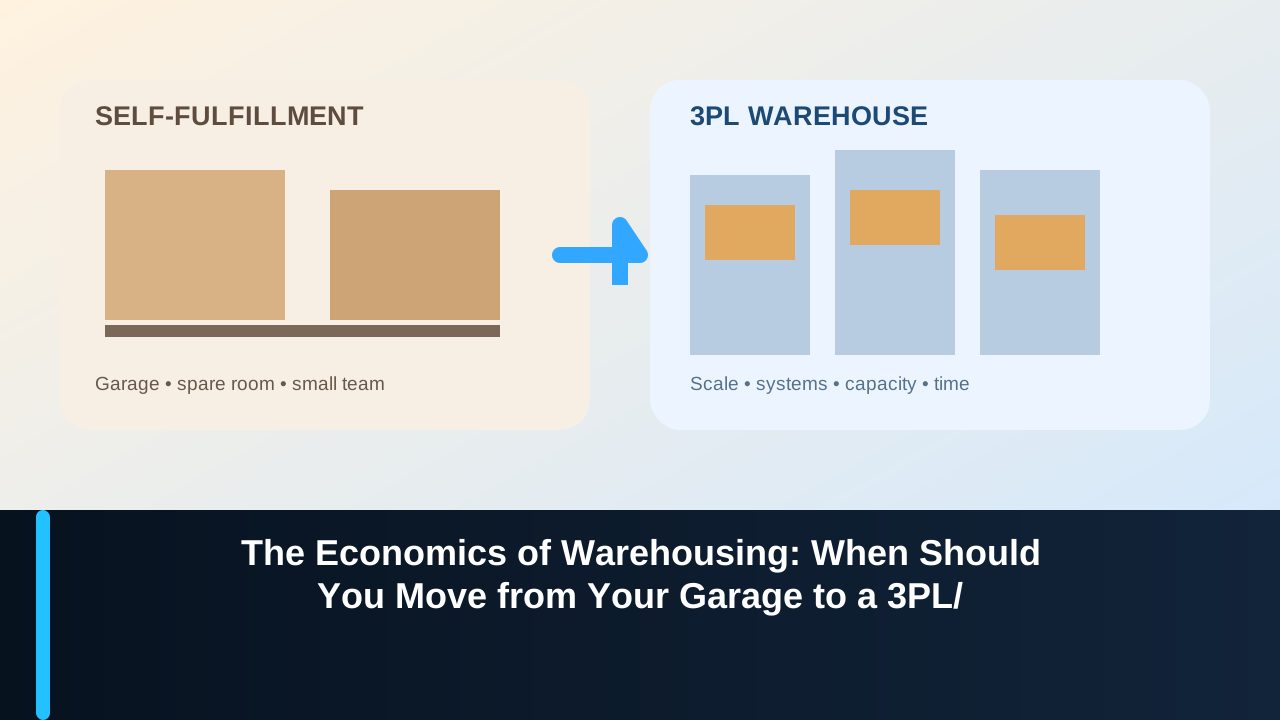
A garage, spare room or small office can be the perfect first warehouse for an e-commerce business. You control the shelves, packing process and customer experience, and there is no third-party fulfillment contract to manage.
The economics change when inventory expands, orders spike, picking becomes slow and the team spends too much time preparing parcels. Current 2026 fulfillment guides do not agree on one universal order threshold for moving to a 3PL; instead, they repeatedly point to operational complexity, true cost per order and capacity constraints as the more useful signals.

What a 3PL changes
A third-party logistics provider typically receives inventory, stores it, picks and packs orders, generates shipping labels and hands parcels to carriers. Depending on the provider, it may also support returns, multi-location fulfillment, inventory reporting and marketplace integrations.
The real cost of self-fulfillment
Many small businesses calculate only the courier charge and ignore the warehouse side of the equation. A better model is:
True fulfillment cost per order = labor + space + packaging + software + equipment + error cost + shipping management + founder/team time.
Your own labor is not free simply because you are not paying an outside fulfillment company.
The 8 numbers to calculate before moving
| Metric | Why it matters |
|---|---|
| Orders per month | Shows the baseline workload |
| Average pick-pack time | Reveals how much labor each order consumes |
| SKU count | More SKUs increase storage and picking complexity |
| Storage area used | Measures whether your current space is near capacity |
| Order error rate | Shows the hidden cost of mispicks and wrong shipments |
| Returns/RTO rate | Shows how much exception handling your team performs |
| Peak-day volume | Tests whether the system survives promotions and festivals |
| Team hours spent | Shows time that could be spent on sales, product or marketing |
Signs your garage is becoming a bottleneck
- Orders remain unshipped because packing capacity is limited.
- Inventory is difficult to count or locate.
- Wrong-SKU and wrong-size shipments are increasing.
- Promotional campaigns are delayed because the team cannot handle the expected volume.
- The founder is spending several hours each day on picking and packing instead of growth work.
- Adding another room or employee feels like a temporary fix rather than a scalable system.
Do not move to a 3PL just because the business is growing
Self-fulfillment still has advantages. If your catalog is small, products are easy to pack, volume is modest and you need tight control over packaging or quality checks, staying in-house may remain economically sensible.
A 3PL also introduces its own costs: onboarding, storage, pick-and-pack fees, special handling, returns, technology, minimums and sometimes long-term commitments. Compare the complete quote with your true internal cost.
How to compare a 3PL quote with your own warehouse
Ask the provider for an all-in cost model that includes storage, receiving, pick and pack, packaging materials, shipping integration, returns, kitting and any minimum monthly commitments.
Then compare that number with your fully loaded internal cost. Current 2026 industry guidance commonly recommends evaluating the total cost instead of comparing a 3PL pick-and-pack fee with only your employee’s salary.
Why SKU complexity can matter more than order volume
Imagine two stores each shipping 500 orders per month. Store A sells one standard product. Store B sells 150 SKUs, bundles products, handles returns and ships fragile items. Store B can hit an operational wall much earlier even with the same order count.
A practical migration plan
- Document your current receiving, storage, picking, packing and returns process.
- Calculate fully loaded fulfillment cost per order.
- Collect at least two or three comparable 3PL quotes.
- Run a small pilot before moving all inventory.
- Measure order accuracy, dispatch time, returns and customer complaints.
- Keep a clear process for stock reconciliation and damaged inventory.
Questions to ask a 3PL
- What is the minimum monthly commitment?
- How are storage units counted and charged?
- How are returns and RTOs handled?
- What inventory system and integrations are included?
- How are errors, shortages and damaged stock reconciled?
- Can the warehouse handle a sudden 2× or 3× increase in daily orders?
- What happens during festive peaks?
Bottom line
There is no universal “move to a 3PL at X orders” rule. The economic trigger is usually the point where the fully loaded cost and operational drag of self-fulfillment become less attractive than paying a specialist to do the same work with predictable service and scalable capacity.