
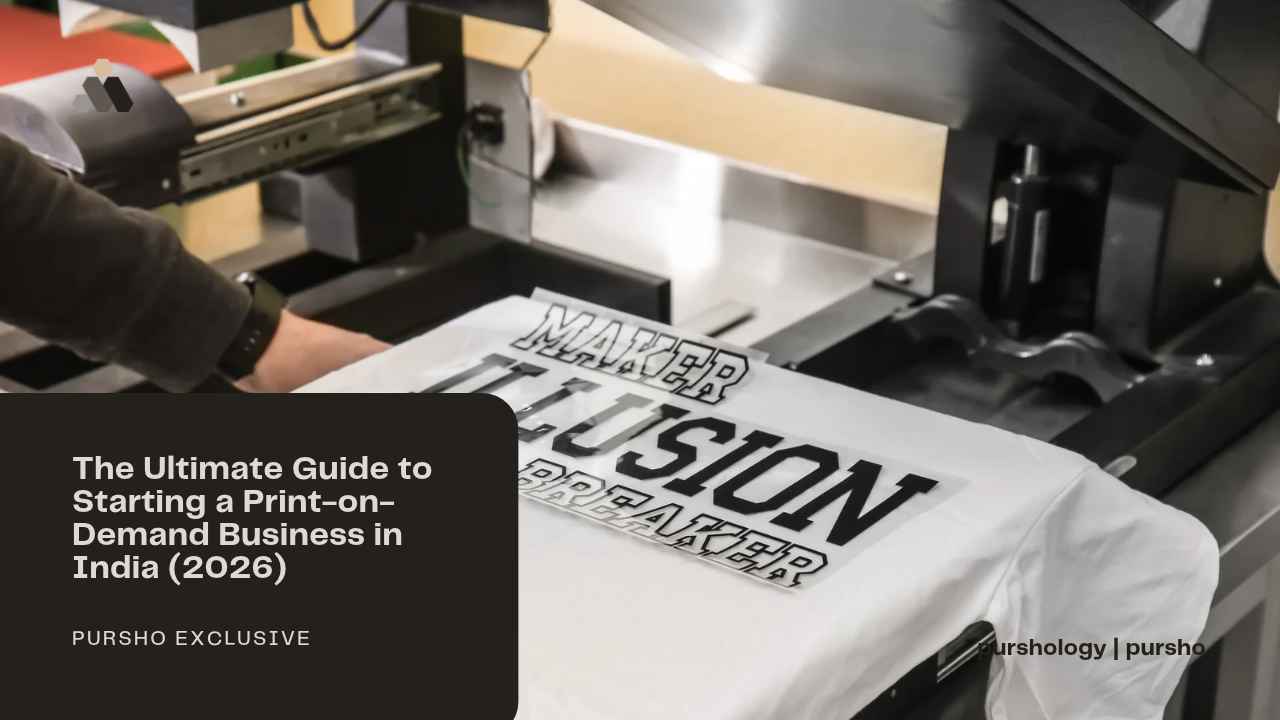
Direct answer: A print-on-demand (POD) business lets you sell customized products such as T-shirts, mugs, posters, phone cases or bags without buying a large batch of inventory first. A customer places an order, a POD provider prints the item, and the provider or your fulfillment partner ships it. The hard part is not uploading designs; it is finding a narrow demand pocket, creating products people actually want, calculating the complete landed cost and building a repeatable customer-acquisition system.
What print-on-demand actually changes
Traditional apparel or merchandise businesses usually buy stock before the customer buys. POD reverses that sequence. You create the design and product listing first, then production happens after an order. That reduces inventory risk, but it does not remove business risk. You can still lose money through weak designs, advertising costs, refunds, poor product quality, shipping charges, marketplace fees and low conversion rates.

Step 1: Pick a niche before you pick products
Do not start with “I will sell T-shirts.” Start with a buyer and a problem, identity or interest. Examples include regional-language humour, hobby communities, profession-based gifts, student culture, pet owners, local travel, sports fandom without infringing team or league rights, or practical desk merchandise for a specific profession.
- Can you describe the buyer in one sentence?
- Does the buyer repeatedly consume content around this interest?
- Can you create at least 20 genuinely different product concepts?
- Can the niche support gifts as well as self-purchases?
- Can you create original artwork rather than copying popular designs?
Step 2: Choose the product mix
Start with a small catalogue. One strong design can be tested on a T-shirt, hoodie, mug, poster or phone case, but do not automatically publish every design on every product. Different products have different production costs, return expectations, shipping risks and quality-control requirements.
| Product | Useful for | Main risk |
|---|---|---|
| T-shirts | Wearable identity and repeat designs | Size-related returns and fit expectations |
| Mugs | Gifts and office/home niches | Breakage and packaging quality |
| Posters | Art, education and decor | Print quality and packaging |
| Phone cases | Visual niches and personalization | Model compatibility and fast device turnover |
Step 3: Decide between local and cross-border fulfillment
Your fulfillment choice affects delivery speed, customer experience and the amount of operational complexity you inherit. Gelato currently describes a global production network with 250+ print providers across 32 countries and says 90% of orders are produced locally. It also offers integrations with major ecommerce platforms. These are provider claims, so compare the actual product, production location and delivery promise for the SKU you intend to sell.
For India-focused selling, test delivery to the cities where you expect your first customers. Do not assume that a provider’s global network means every product is produced locally in India. Product-level availability and manufacturing location can vary.
Step 4: Build the unit-economics sheet before launching
A POD price should be calculated backwards from your desired contribution margin, not copied from a competitor’s product page.
Contribution before tax = selling price − product cost − printing − shipping subsidy − payment/platform fees − expected refund/return cost − customer acquisition cost.
For example, if you sell a product for ₹899, your spreadsheet should not treat ₹899 as revenue you can freely spend. Record every cost that moves with the order. Keep a second scenario for paid advertising because a product that looks profitable organically can become unprofitable after customer acquisition.
Step 5: Create original designs and protect the business
Do not build a POD catalogue from copyrighted characters, brand logos, movie artwork, sports marks or artwork downloaded from the internet. Meta’s current copyright guidance likewise says Instagram and Threads users should post content they created themselves or have permission to use; adding credit or a disclaimer does not automatically make an unauthorized use acceptable.
Keep source files, licenses and design records. If you use AI tools during ideation, review the output for accidental resemblance, trademarks and platform-specific commercial-use restrictions before selling it.
Step 6: Build the storefront around buying decisions
- Show the product on a realistic mockup.
- Explain material, dimensions, fit or print area clearly.
- State the expected production and delivery window.
- Publish a simple return and exchange policy.
- Show care instructions where relevant.
- Use original product photography or properly licensed mockups.
- Answer the questions customers ask before they buy.
Step 7: Treat marketing as a testing system
Your first goal is not “go viral.” It is to discover which audience, creative angle and product combination generates qualified demand. Test a small number of concepts, measure product-page visits, add-to-cart rate, checkout rate, contribution margin and repeat purchases, then cut weak products quickly.
For organic marketing, create useful content around the niche rather than posting only product photos. For paid marketing, keep a clean record of spend by campaign and calculate acquisition cost from actual orders.
GST and India-specific compliance: what to verify
GST treatment can depend on how you sell, the platform involved, the type of supply and the current rules that apply to your business. CBIC’s sectoral FAQ states that suppliers selling through an electronic commerce operator that is required to collect tax at source can fall under registration requirements without the normal threshold exemption. That does not mean every POD seller has the same obligation; verify your exact structure with a qualified tax professional before scaling.
Also keep invoices, supplier records, payment records and advertising expenses organized from day one. A simple bookkeeping system is much easier to build before the order volume becomes large.
A lean 30-day launch plan
- Days 1–5: Choose a niche, interview potential buyers and collect 30 product ideas.
- Days 6–10: Create 10–15 original designs and reject anything that feels generic or legally risky.
- Days 11–15: Select suppliers, order samples and test quality and delivery.
- Days 16–20: Build the storefront, product pages, policies and tracking.
- Days 21–25: Publish the strongest products and start organic content.
- Days 26–30: Test a small paid campaign only if the unit economics work, then review conversion and contribution margin.
Common POD mistakes that quietly destroy margin
- Launching dozens of designs without validating a niche.
- Pricing from competitor screenshots instead of your own cost sheet.
- Ignoring shipping and payment costs.
- Using copyrighted or trademarked artwork.
- Skipping physical samples.
- Promising delivery dates that depend on a supplier you have not tested.
- Using discounts to compensate for weak product-market fit.
- Scaling ads before measuring contribution margin.
Final takeaway
The best print-on-demand business in India is not the one with the biggest catalogue. It is the one that understands a specific buyer, creates original products, controls fulfillment quality and knows its economics order by order. Start narrow, test with samples, document every cost and expand only after the first product family proves that customers will actually pay.