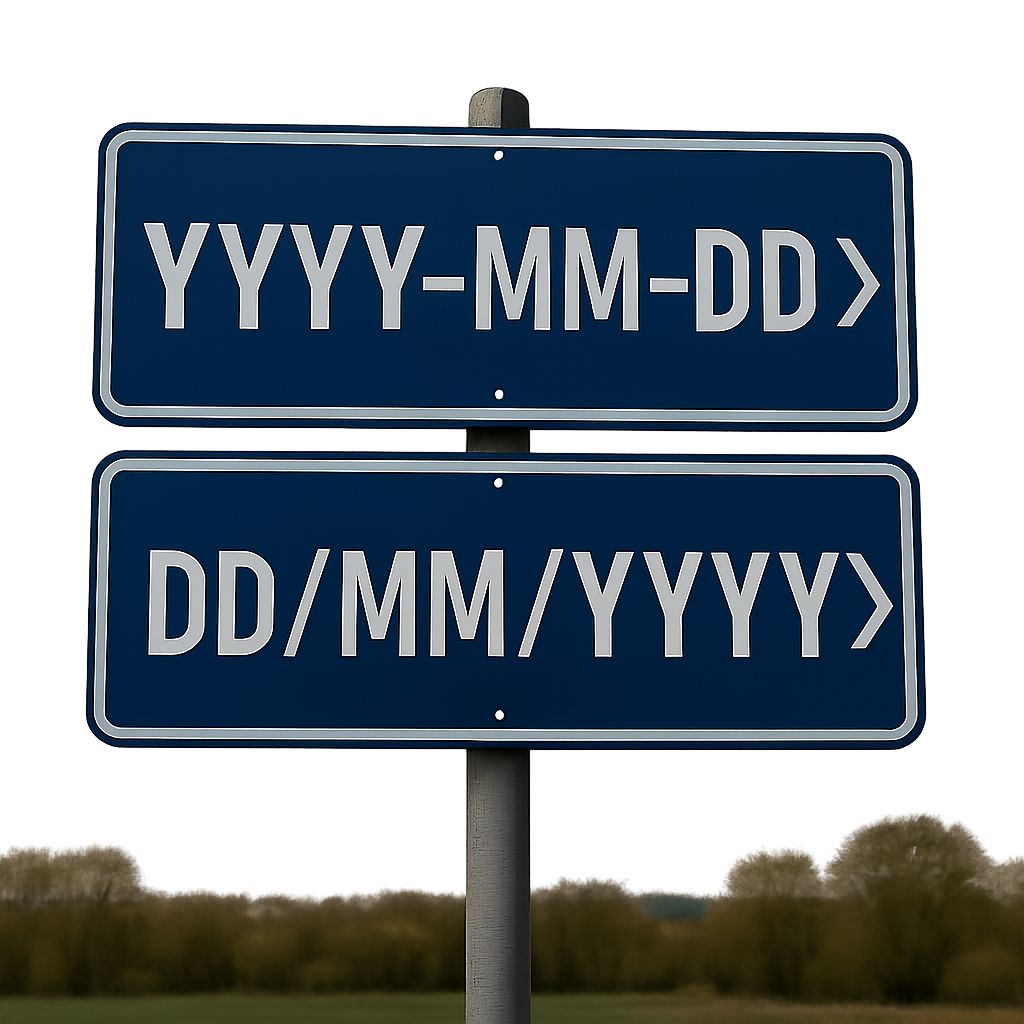
Have you ever wondered that a simple date written on paper can mean two completely different days just a couple of kilometers away? For millions of people living and working in border regions, this is not a hypothetical question, but a daily reality, full of confusion and annoying mistakes.
Developing our dtformat.com service, we asked ourselves a simple but global question: how is it that date, a seemingly universal concept, has become a source of such confusion in international communication? The answer was found at the intersection of cultures and borders, where simple numbers can lead to serious misunderstandings and even financial losses.

The problem is especially acute for those who live and work in border areas. Imagine a resident of Detroit, USA, making an appointment with a partner from Winsor, Canada, just a couple of kilometers across the river. To an American, the date 01/02/2025 means January 2, since the U.S. adopts the MM/DD/YYYYYYY format. But to a Canadian, using the DDD/MM/YYYYYYY format, it’s February 1. One day on paper is a whole month’s difference in reality.
And that’s not just an inconvenience, it’s a risk. We’ve studied dozens of such “calendar paradoxes” around the world:
- China (YYYYY-MM-DD) and Russia (DD.MM.YYYYY): completely different logic and dividers.
- Sweden (YYYYY-MM-DD) and Norway (DD.MM. YYYYY): confusion within a seemingly unified Scandinavian space.
- South Africa (YYYYY/MM/DD) and Namibia (DD/MM/YYYYY): another example of border chaos.
This “calendar schizophrenia” wreaks havoc on the most mundane things, from expiration dates on imported products to deadlines in international contracts and dates on tickets. An error in interpretation can derail a deal, cause an important flight to be missed or invalidate a legal document.
So how do professionals and ordinary people navigate this diversity? The solution lies in the use of universal standards and reliable conversion tools. For technical tasks, ISO 8601 or UNIX Time is often the standard of choice, but for everyday communication, a simpler and faster tool is needed.
This is where specialized web services that work as “date translators” come in handy. One such intuitive tool is dtformat.com. It allows you to convert any date from a local format to an international standard and back again in seconds, eliminating the risk of error and misunderstanding.
Rather than relying on memory or spending time searching for rules, you can get instant confidence. In a world where every detail matters, the ability to quickly check and agree a date is not just a convenience, it’s the key to clear and successful communication.