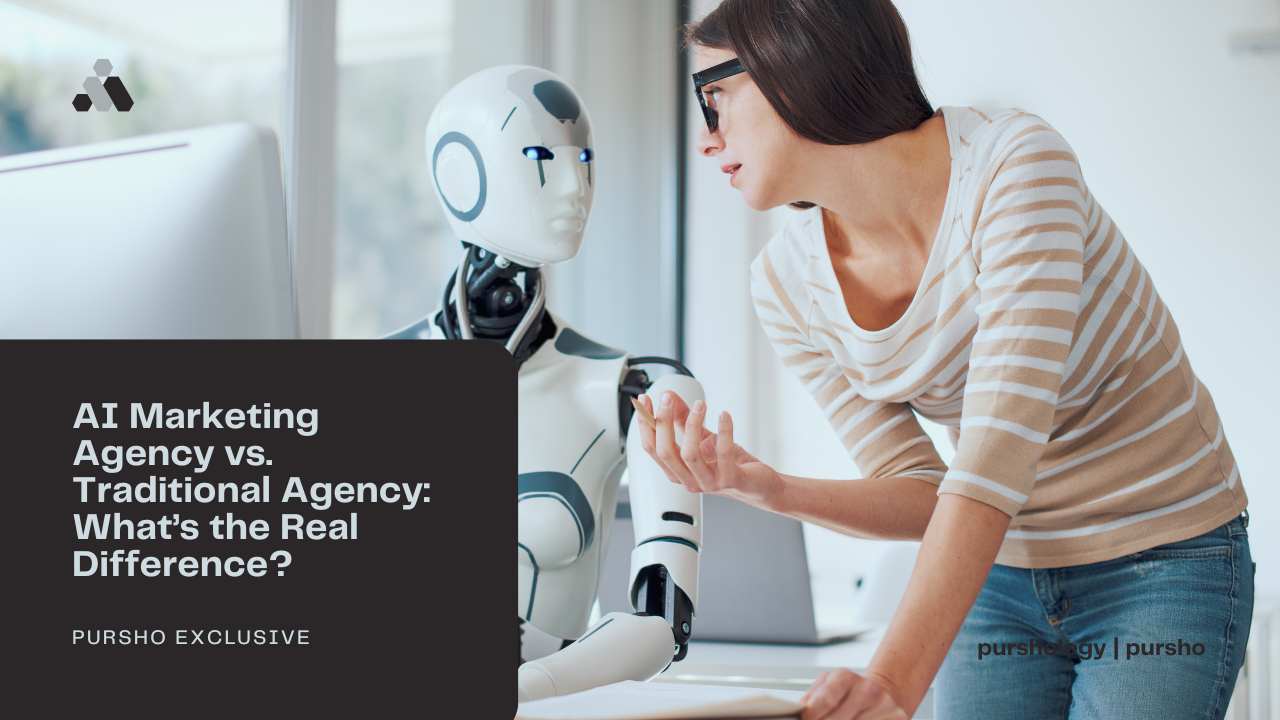
A clear breakdown of how automation, predictive data, and speed separate modern AI agencies from old-school marketing setups.
The traditional marketing playbook is officially gasping for air. For decades, the formula was simple. Hire an agency with a nice office, throw a massive budget at a broad demographic, and pray the creative “vibes” landed. If you got a flashy PowerPoint deck showing a spike in impressions, everyone called it a win.

But the internet moves way too fast for that slow-motion cadence now. Now, predictive algorithms can already run ten thousand micro-tests, automatically shift ad spend to what’s actually converting, and catch your target customer mid-scroll.
So, what actually changes when you trade human guesswork for algorithmic precision? Let’s get under the hood and look at how an AI-first approach completely flips the script on traditional marketing, starting with a direct, side-by-side breakdown.
AI Agency vs Traditional Agency: A Quick Comparison
The marketing world has shifted. It’s no longer just about who has the flashiest billboard or the biggest ad budget. Traditional agencies rely heavily on human intuition, manual labor, and long, drawn-out brainstorming sessions. On the flip side, an AI-first marketing agency runs on predictive algorithms, automated workflows, and real-time optimization.
Here is a quick look at how they stack up against each other:
| Feature | Traditional Marketing Agency | AI-First Marketing Agency |
| Turnaround Time | Weeks to months for full campaigns | Hours to days, thanks to automated pipelines |
| Data Utilization | Historical data and retrospective reports | Predictive analysis and real-time insights |
| Content Creation | Manual copywriting, design, and editing | AI-assisted hyper-personalized variations at scale |
| Scalability | Linear (requires more headcount to grow) | Exponential (software handles increased volume) |
| Optimization | Periodic manual A/B testing adjustments | Continuous, automated machine learning tweaks |
Key Differences Between AI and Traditional Marketing Agency
To truly understand why an AI-first approach is turning heads, we need to look under the hood. It’s not just about using cooler tools; it’s a fundamental shift in how marketing problems are solved.
1. Speed and Agility
Traditional agencies operate on human time. You pitch an idea, the creative team drafts it, the account managers review it, and a few weeks later, you finally see a live ad. If the market changes tomorrow, you’re stuck waiting for another creative cycle.
An AI agency operates on “internet time.” By leveraging machine learning models, agencies can generate ad copy, design variations, and audience segments almost instantly. If a trend pops off on social media, an AI-first setup allows you to capitalise on it before the day ends. This level of responsiveness is exactly why forward-thinking brands partner with cutting-edge partners like Appinventiv Digital to keep their campaigns moving at breakneck speed.
2. Cost Efficiency and Resource Allocation
With traditional setups, you are essentially paying for billable hours. A lot of your budget goes toward manual, repetitive tasks like sorting spreadsheets, formatting reports, and resizing ad banners for fifteen different platforms. That is a massive budget drain.
AI-first agencies automate the grunt work. Machine learning handles data cleaning, bidding adjustments, and minor creative tweaks. This doesn’t mean humans are out of the picture; it means the humans actually get to focus on high-level strategy, deep brand storytelling, and cultural relevance. You get way more bang for your buck because you aren’t paying premium rates for manual labor.
3. Scalability Without the Bloat
If you want to scale a campaign with a traditional agency-say, moving from targeting one city to fifty different regions-the agency usually needs to hire more account managers and creatives. The overhead shoots through the roof.
AI scales effortlessly. Once the data infrastructure is set up, running 500 hyper-targeted ad variations takes almost the same amount of effort as running five. AI systems can analyze millions of data points across multiple regions simultaneously, allowing your business to expand its reach without forcing the agency to scale its headcount (and your fees) linearly.
4. Hyper-Personalization vs. Broad Strokes
We’ve all experienced old fashioned marketing that is trying to cater for everyone but fail to engage anybody. It is based on Millennials’ general demographics, such as 25-34 year olds.
In contrast, AI changes the game by looking at what actions are intended. It analyzes what the user clicks on five minutes before they click on an ad, their browsing history, and the context in which they are viewing the ad to serve them an ad that is specific to them. This makes normal digital marketing campaigns very specialised engines. With an Appinventiv Digital marketing strategy, your audience feels that you’re speaking to them, not into a sea of noise.
5. Predictive Analytics vs. Hindsight Bias
Traditional agencies will do a wonderful job of telling you what has occurred in the past month. They create hugely large end of month PDFs of clicks and impressions. However, it’s not a wise move to drive looking only in the rearview mirror, and neither is it a wise move to look at past data.
AI-first frameworks employ predictive modelling to foresee your customer’s next actions. AI can be used to understand consumer behavior, predict trends, discern which ads work best and where your money will be best spent, among other things.
When to Go for a Traditional Marketing Agency and When to Go for an AI Agency
While AI is a formidable tool, it is not a magic bullet that can solve all business problems. There will be occasions when the old school approach is the only advantage and then there will be times when the heavy muscle of the algorithm is the only one you need to bring to the table.
Choose a Traditional Marketing Agency if:
- You need high-level brand reinvention: Human empathy and cultural intuition are priceless when a company is undergoing a massive cultural shift, a PR crisis, or needs a brand origin story that is emotional, and also story-centred.
- Your market relies heavily on face-to-face relationships: Heavy data automation will not really move the needle much for hyper-local B2B niches where business is done at golf games and handshakes.
- You are launching an entirely new product category: Without any historical data or patterns of consumer behavior, AI models will lack the basis for making accurate predictions.
Choose an AI-First Marketing Agency if:
- You want to dominate e-commerce and performance marketing: For those who rely on paid search, paid social, programmatic advertising, and direct conversions for success, AI will out-optimize humans day-in, day-out.
- You have tons of data but no insights: An AI framework will unveil those patterns if your business is resting on top of a mountain of data, but you have no idea how to leverage it to generate revenue.
- You need to move fast and stay lean: If you’re a startup that is growing quick or an enterprise that’s ambitious to launch, test and test and test again campaigns across various channels each day, without spending millions on agencies.
Conclusion
At the end of the day, pitting AI agencies against traditional ones is about understanding where the world is going. If you stick purely to old-school manual methods, you risk getting left in the dust by competitors who can optimize their budgets in milliseconds. But if you rely solely on soulless automation, your brand might lose its emotional heartbeat.
The real sweet spot? A hybrid approach. The future belongs to agencies that blend deep human empathy, creativity, and strategic vision with the raw, unstoppable processing power of artificial intelligence. Don’t just look for an agency that uses AI as a buzzword; look for a partner that bakes it directly into their DNA to supercharge human potential. The digital landscape isn’t waiting around-it’s time to decide how fast you want to run.
FAQs
What sets an AI marketing agency apart from a regular agency?
The machine learning and automation serve as the backbone of an AI marketing agency, enabling the analysis of data, prediction of trends, and optimization of campaigns in real-time. Traditional agencies have primarily been using manual processes, human intuition, and post reporting on a monthly basis.
Will adopting an AI marketing agency compromise the human approach?
Not at all. It actually liberates humans from tedious and mundane data entry and data formatting in spreadsheets. The team can focus on high-level creative strategy, cultural relevance and forge real emotional connection with your audience.
How can an AI-driven marketing agency boost the ROI of campaigns?
By continually experimenting with thousands of different ad versions, and automatically allocating budget to the best-performing channels. It removes the guesswork, reduces ad waste and reaches users based on their real-time actions, not on their outdated demographics.
Is an AI digital marketing strategy suitable for small businesses?
Yes, it is a game-changer for smaller budgets. Because AI automates heavy operational tasks, it lowers the cost of entry, allowing smaller brands to run highly targeted, sophisticated campaigns that can compete with massive corporations.
Can a traditional marketing agency be rapidly transformed into an AI agency?
No, honestly, it takes a complete overhaul of an agency’s data infrastructure, systems, and team mindset to integrate AI into the agency. It is not simply a matter of acquiring a handful of software licenses, but of creating an operational model that includes a lot of new elements.