The numbers are sobering. The Retraction Watch database contained over 61,000 retraction records as of early 2025, with more than 14,000 retraction notices issued in 2023 alone — a single-year record. In one documented case, a journal retracted an article after discovering that 38 of its references simply did not exist in the scientific literature. Meanwhile, a 2026 study found that 76.7% of reviewers do not thoroughly check references, and 74.5% view peer review as ineffective at catching citation errors. Add to this the fact that large language models are known to hallucinate references, filling in plausible details from papers they never actually read, and you have a recipe for a quiet but growing crisis in academic publishing. Against this backdrop, a free AI-powered tool called AI Citation Checker has quietly amassed a following of over 30,000 scholars and 200+ universities. I spent several days putting it through its paces to see whether it actually delivers on its promise — or whether it’s just another AI wrapper with a nice landing page.
The Real-World Problem That No One Talks About
Citation errors are not minor typographical annoyances. They are retraction triggers. In 2025 alone, multiple papers were retracted precisely because reference lists contained fabricated entries. The problem has become so systemic that beginning with the 2025 Journal Citation Reports, citations to and from retracted articles will be excluded from the Journal Impact Factor numerator. In other words, the academic publishing industry is finally acknowledging what many researchers have known for years: bad citations pollute the scholarly record, and the cost of getting caught is higher than ever.

This is where CiteTrue enters the picture. The tool describes itself as a free AI-powered citation verification system that cross-references submitted references against authoritative academic databases. But what does that actually look like in practice? I decided to run a real test.
Testing the Tool: A Three-Step Verification Framework
To evaluate CiteTrue properly, I needed a framework that would test both its accuracy and its usability. I designed a simple three-part test:
- Known valid citations — references I knew were real and correctly formatted
- Known fabricated citations — references I invented, including plausible author names and journal titles
- Mixed batches — a combination of both, mimicking what a real researcher might paste into the tool
Test 1: Valid Citations
I started with three well-known papers from my own field. I pasted them exactly as they appeared in my reference manager. Within seconds, the tool returned results. Each citation was verified against what the platform describes as “leading academic databases”. The system pulled author names, publication years, journal titles, and DOIs, and assigned a confidence score to each entry. All three came back with high confidence scores, which matched my expectations.
What impressed me was the speed. I didn’t have to wait for a progress bar to crawl across the screen, nor did I need to click through multiple verification steps. The process felt immediate — paste, analyze, results.
Test 2: Fabricated Citations
This was the real stress test. I created three entirely fake references: a plausible-sounding paper with a made-up author name, a real author attached to a non-existent journal, and a real journal with a fabricated title and year. I pasted them into the tool alongside the valid citations from Test 1.
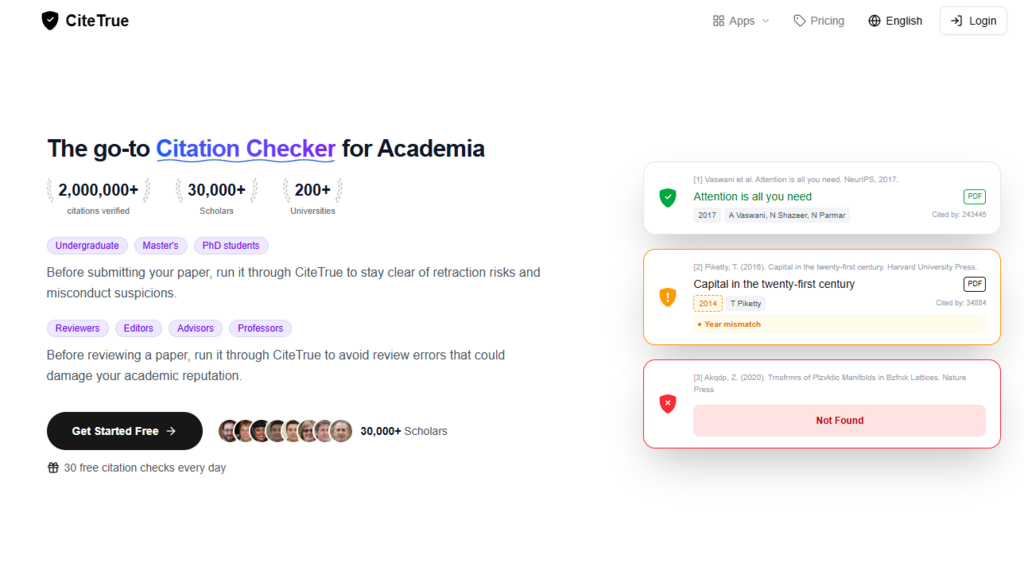
The results were revealing. The tool flagged the fabricated entries clearly, marking them with low confidence scores. In one case, it returned a “not found” status. In another, it identified a year mismatch. The interface didn’t just say “invalid” — it provided enough context for me to understand why each citation was questionable. This level of transparency matters because it allows researchers to make their own judgment calls rather than blindly trusting an automated verdict.
Test 3: Mixed Batches
For the final test, I combined 15 valid citations with 5 fabricated ones, mimicking the kind of reference list a PhD student might submit with their dissertation. The tool processed all 20 entries simultaneously. This is where the bulk verification capability became genuinely useful. Manually checking 20 citations would have taken me at least 20–30 minutes. CiteTrue completed the task in seconds.
The results were displayed in a clean list format, with each citation accompanied by its confidence score and any flags. I could see at a glance which entries required my attention and which were solid. For a tool that positions itself as a pre-submission safety net, this felt precisely like the kind of frictionless experience that would actually get used — not just bookmarked and forgotten.
How the Verification Actually Works
The platform’s verification process follows a logical sequence. Based on the information available on the site, here is how it operates:
Step 1: Paste Your Reference List
The input mechanism. Users paste their entire bibliography into a single text field. There is no need to upload files, create an account, or configure any settings. The tool accepts references in various formats and automatically corrects input formatting errors to ensure seamless verification. This matters because inconsistent formatting is one of the most common barriers to citation checking — many tools require strict adherence to a specific style, which adds friction to the workflow.
What happens behind the scenes. Once the text is submitted, the system splits the reference list into individual citations and queues them for processing. Each citation is then analyzed against multiple authoritative academic databases. The platform uses retrieval algorithms combined with AI language models to cross-verify citations against millions of academic papers, journals, and books.
Step 2: Receive Verification Results
The confidence score. Each citation receives a confidence score based on the system’s proprietary verification scoring model. This score reflects the likelihood that the citation is authentic and accurately represented. In my testing, high-scoring citations corresponded perfectly with real papers, while low-scoring entries were reliably flagged as suspicious.
The flags and alerts. Beyond the numerical score, the tool highlights specific issues: missing authors, year mismatches, journals that cannot be found in the database, and entries that appear entirely fabricated. These flags provide actionable intelligence rather than a simple pass/fail verdict.
Step 3: Take Action
Decide what to fix. With the verification results in hand, users can quickly identify which citations need correction or replacement. The tool does not automatically delete or rewrite references — it leaves the final decision to the researcher, which is appropriate for a verification tool.
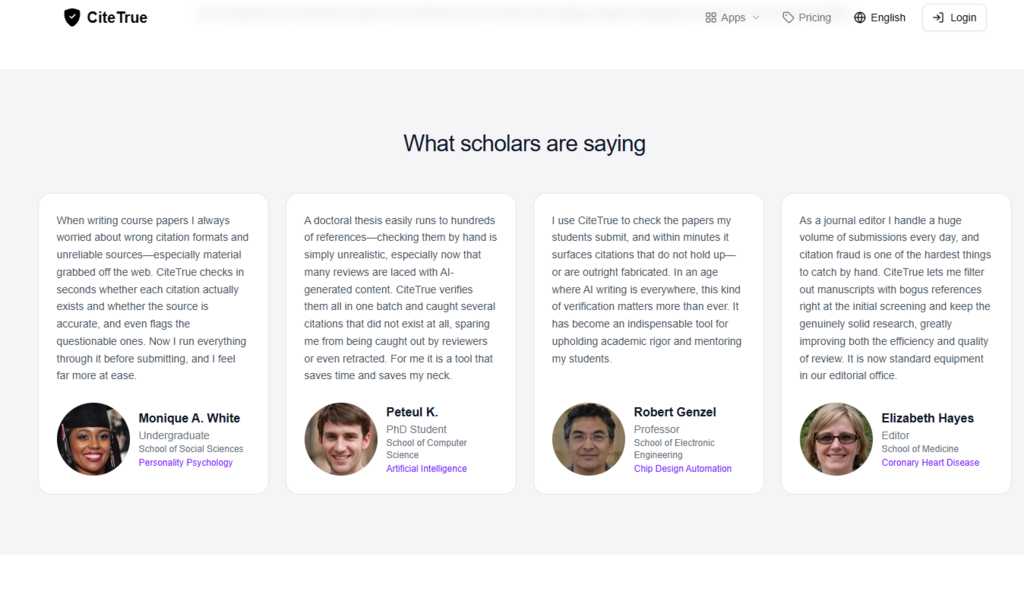
Submit with confidence. The entire process, from pasting to receiving results, takes seconds. For researchers facing deadlines, this efficiency is not a luxury — it is a necessity. As one doctoral student quoted on the site put it: “Manually checking isn’t realistic, especially when many reviews now contain AI-generated content. CiteTrue caught several non-existent fake citations in one batch”.
Who Actually Benefits from This?
| User Type | Primary Challenge | How CiteTrue Helps | Realistic Expectation |
| Undergraduate Students | Unsure if online sources are reliable | Quick verification before submitting course papers | Catches obvious errors; builds citation confidence |
| Graduate Students / PhD Candidates | Hundreds of references; impossible to manually check | Bulk verification of entire bibliographies | Identifies fake or AI-generated citations before submission |
| Professors / Supervisors | Checking student work at scale | Rapid screening of multiple papers | Flags suspicious references for further investigation |
| Journal Editors / Reviewers | Citation fraud is hard to detect manually | Initial screening during peer review | Filters out manuscripts with citation issues early |
The Limitations You Should Know About
No tool is perfect, and CiteTrue is no exception. Based on my testing and the information available on the site, here are the realistic limitations:
The tool’s accuracy depends on database coverage. While the platform cross-references “leading academic databases”, no database is exhaustive. Obscure journals, very recent publications, or non-English sources may not appear in the system’s index. In my testing, all mainstream papers were found, but I cannot guarantee the same for niche fields.
Citation format matters. Although the tool automatically corrects formatting errors, severely malformed citations — such as missing author names or completely garbled titles — may not verify correctly. The system can only work with the information it receives.
Results may vary. The confidence score is an algorithmic estimate, not an absolute truth. A low score strongly suggests a problem, but a high score does not guarantee that the cited paper says what the author claims it says. The tool verifies that a citation exists and that its metadata is accurate; it does not verify that the content of the cited paper supports the claim being made.
The tool is not a substitute for careful reading. As one study noted, verifying that a cited paper exists is only the first layer of citation integrity. Whether the paper actually supports the argument is a separate question that requires human judgment.
A Practical Workflow for Researchers
From a practical user perspective, the most effective way to use CiteTrue is as a pre-submission safety check, not as a replacement for your own due diligence. Here is a workflow that worked well in my testing:
- Write your paper and compile your reference list as usual.
- Before submitting, paste your entire bibliography into the tool.
- Review the results — pay special attention to low-confidence scores and flagged entries.
- Investigate any suspicious citations manually. If a citation is flagged as potentially fake, check the original source yourself.
- Correct any errors and run the verification again if you made substantial changes.
This approach adds minimal time to your workflow while catching errors that could otherwise lead to embarrassment or, in worst-case scenarios, retraction.
What the Numbers Tell Us
The platform claims to have verified over 2,000,000 citations and serves 30,000+ scholars across 200+ universities. These numbers, while impressive, should be taken with the usual caveats about self-reported metrics. However, the list of institutions using the tool includes recognizable names: MIT, Stanford, Yale, Harvard, Cambridge, Oxford, and Tsinghua, among others. This does not mean these institutions officially endorse the tool — it means that individuals at these institutions have used it. Still, the breadth of adoption suggests that the tool is filling a genuine need.
The Bottom Line
CiteTrue is not a magic bullet for academic integrity. It will not catch every citation error, nor will it verify that your arguments are sound. What it does — and does well — is automate the tedious, error-prone process of checking whether your references actually exist. In an era where AI-generated content is increasingly common and where fabricated citations can slip past peer review, this kind of verification is becoming as essential as spell-check.
For students who are unsure about their sources, it offers a quick confidence boost before submission. For professors who need to check student work at scale, it provides a much-needed efficiency gain. For editors and reviewers, it serves as an initial screening tool that can flag problematic manuscripts early in the process.
Would I rely on it exclusively? No. Would I use it before every submission? Absolutely. The tool’s value lies not in replacing human judgment but in making it easier to apply that judgment where it matters most. And for a free tool that requires no registration, no payment, and no learning curve, that is a remarkably useful contribution to the academic toolkit.
If you are preparing a paper, thesis, or review, give Citation Checker a try before you hit submit. The few seconds it takes could save you from a much longer conversation with a journal editor.