TL;DR
Most tech resumes waste valuable space by listing technologies in a long, unorganized block of keywords. A Skills Matrix groups your technical skills by category, proficiency, and practical usage, making it easier for recruiters, hiring managers, and ATS systems to evaluate your expertise. The result is a cleaner, more strategic resume that communicates both breadth and depth of technical knowledge.
The ‘Skills Matrix’ Approach: A Better Way to List Your Tech Stack
If you’re a software developer, data analyst, cloud engineer, DevOps professional, cybersecurity specialist, or data scientist, chances are your resume contains a lengthy list of technical skills.

It probably looks something like this:
Java, Python, JavaScript, React, AWS, Docker,
Kubernetes, MySQL, PostgreSQL, Git,
Azure, Jenkins, Linux, Terraform…
The problem?
Most recruiters spend only a few seconds scanning resumes. A massive wall of technologies makes it difficult to quickly understand what you’re truly good at.
This is where the Skills Matrix Approach can dramatically improve your resume.
Instead of presenting an unstructured list of tools and technologies, a skills matrix organizes your tech stack into meaningful categories that highlight expertise, improve readability, and strengthen ATS performance.
What Is a Skills Matrix?
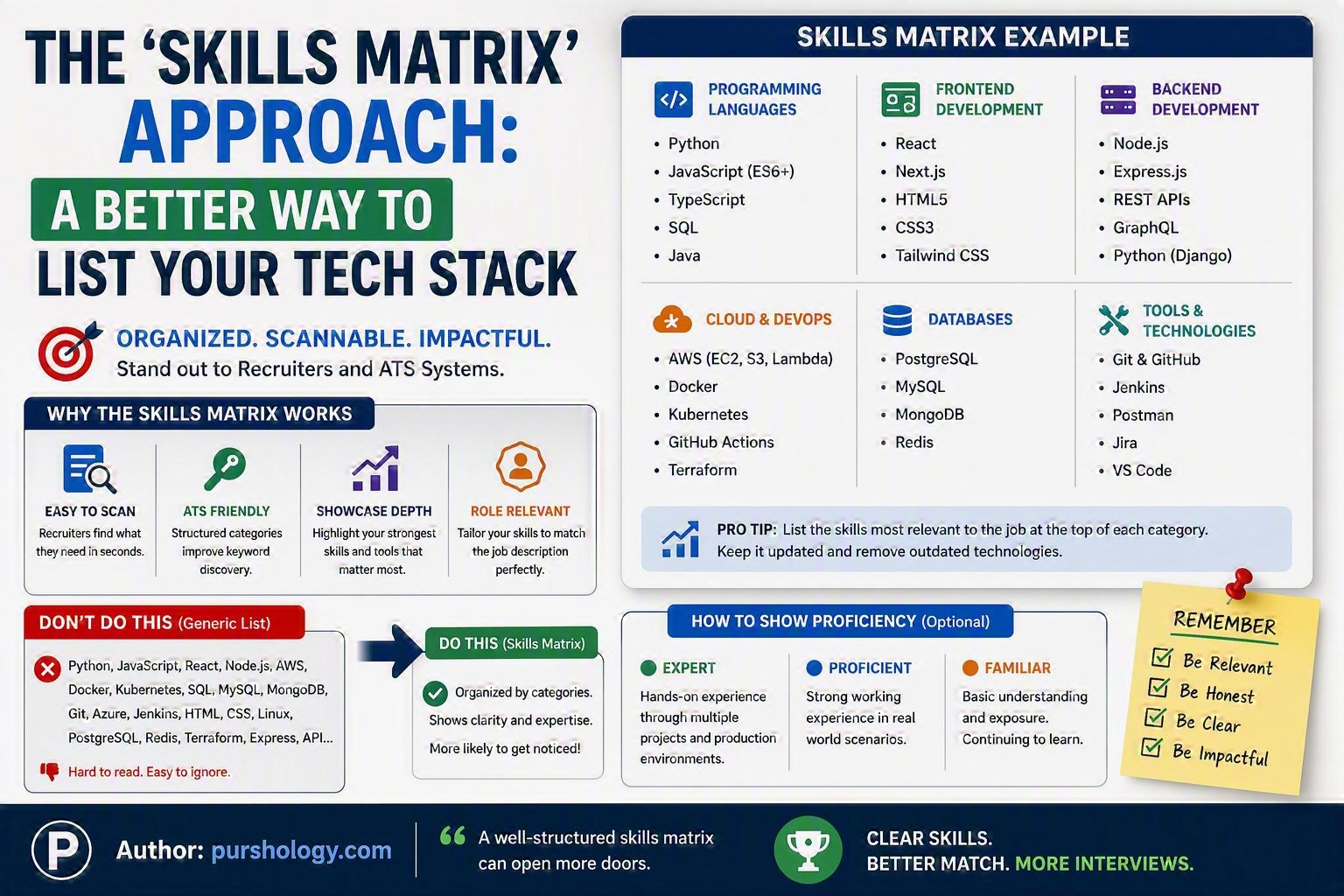
A Skills Matrix is a structured framework that groups technical skills into relevant categories.
Rather than listing technologies randomly, you organize them by function or domain.
Traditional Skills Section
Python, JavaScript, AWS, React, Docker,
PostgreSQL, Git, Linux, Kubernetes, Azure
Skills Matrix
Programming Languages
• Python
• JavaScript
• TypeScript
Frontend Technologies
• React
• Next.js
• HTML
• CSS
Cloud & Infrastructure
• AWS
• Azure
• Docker
• Kubernetes
Databases
• PostgreSQL
• MySQL
• MongoDB
The second format immediately communicates expertise.
Why Recruiters Prefer Skills Matrices
Recruiters aren’t just checking whether you know a technology.
They want answers to questions like:
- What’s your strongest area?
- How broad is your experience?
- Do your skills align with the role?
- Are you a backend specialist or full-stack engineer?
- Have you worked with cloud technologies?
- Are you experienced in modern development practices?
A skills matrix answers these questions quickly.
Why ATS Systems Like Structured Skills
Applicant Tracking Systems scan resumes for relevant keywords.
A well-organized skills section helps ATS software identify:
- Programming languages
- Frameworks
- Tools
- Platforms
- Certifications
- Technical expertise
Example:
Cloud Technologies:
AWS, Azure, Google Cloud Platform
Programming:
Python, Java, JavaScript
This structure improves keyword visibility without appearing cluttered.
How to Build an Effective Skills Matrix
Step 1: Categorize Your Skills
Common technology categories include:
Programming Languages
Python
Java
JavaScript
TypeScript
Go
C#
Frontend Development
React
Next.js
Angular
HTML
CSS
Tailwind CSS
Backend Development
Node.js
Express
Spring Boot
Django
FastAPI
Databases
PostgreSQL
MySQL
MongoDB
Redis
DevOps & Cloud
AWS
Azure
Docker
Kubernetes
Terraform
Jenkins
Tools & Collaboration
Git
GitHub
Jira
Confluence
Slack
This organization creates instant clarity.
Step 2: Prioritize Relevant Skills
Don’t list every technology you’ve ever touched.
Focus on skills relevant to your target position.
For example:
Applying for a DevOps Role?
Lead with:
AWS
Azure
Docker
Kubernetes
Terraform
CI/CD
Applying for a Frontend Role?
Lead with:
React
TypeScript
Next.js
HTML
CSS
UI Development
Customize the matrix for each application.
Step 3: Reflect Real Experience
A common mistake is listing technologies with minimal experience.
Recruiters often verify technical skills during interviews.
Instead, focus on technologies you’ve actually used professionally.
A smaller, credible skills matrix is stronger than an inflated one.
The Advanced Skills Matrix
Experienced professionals can go a step further by organizing skills based on proficiency.
Example
Advanced
• Python
• React
• AWS
• PostgreSQL
Intermediate
• TypeScript
• Docker
• Kubernetes
Working Knowledge
• Go
• Terraform
• Azure
This creates realistic expectations and strengthens credibility.
Connect Skills to Experience
Your resume should not stop at listing technologies.
Those skills must appear throughout your work experience section.
Weak Example
Skills:
React
Node.js
AWS
Strong Example
• Built React-based customer portals serving 100,000+ users.
• Developed Node.js APIs reducing processing times by 35%.
• Deployed cloud infrastructure on AWS, reducing operational costs by 20%.
Now recruiters can see evidence of expertise.
Skills Matrix Example for Software Engineers
TECHNICAL SKILLS
Programming Languages
• Python • JavaScript • TypeScript • SQL
Frontend
• React • Next.js • HTML • CSS • Tailwind CSS
Backend
• Node.js • Express • REST APIs
Cloud & DevOps
• AWS • Docker • Kubernetes • GitHub Actions
Databases
• PostgreSQL • MongoDB • Redis
Tools
• Git • Jira • Postman
This format is clean, ATS-friendly, and recruiter-friendly.
Skills Matrix Example for Data Analysts
DATA & ANALYTICS SKILLS
Data Analysis
• SQL • Python • Pandas • NumPy
Visualization
• Power BI • Tableau • Excel
Databases
• SQL Server • PostgreSQL • MySQL
Cloud Platforms
• Azure Data Services • AWS Analytics
Tools
• Jupyter Notebook • Git • Power Query
Immediately, the reader understands the candidate’s core strengths.
Common Mistakes to Avoid
Creating a Giant Keyword Dump
Avoid this:
Java, Python, JavaScript, React, Docker, AWS,
Azure, Git, Kubernetes, CSS, HTML,
Terraform, Jenkins…
Listing Outdated Technologies
Keep your matrix relevant to current roles.
Including Skills You Can’t Explain
If you can’t discuss a technology confidently in an interview, don’t include it.
Ignoring Job Descriptions
Your skills matrix should align with the role you’re pursuing.
Ranking Yourself With Stars
Avoid:
Python ★★★★★
Java ★★★★☆
These ratings are subjective and often add little value.
Before and After
Before
Skills
Python, SQL, AWS, Tableau, Power BI,
Excel, Git, PostgreSQL, Docker,
Linux, Azure, Pandas
After
DATA ANALYTICS SKILLS
Programming & Analysis
• Python • SQL • Pandas
Visualization
• Power BI • Tableau • Excel
Databases
• PostgreSQL
Cloud Platforms
• AWS • Azure
Tools
• Git • Docker • Linux
The second version is faster to scan and more professional.
Final Thoughts
Your tech stack is one of the most important sections of your resume. A Skills Matrix transforms a cluttered keyword list into a strategic snapshot of your expertise.
By grouping technologies into logical categories, emphasizing relevant skills, and linking tools to measurable achievements, you make it easier for both ATS systems and recruiters to understand your value.
Remember: the best resumes don’t just list technologies—they tell a clear story about how you use them to solve real business problems.
Ready to Upgrade Your Technical Resume?
A well-structured Skills Matrix can instantly improve readability, ATS compatibility, and recruiter engagement. Showcase your technical expertise with clarity and confidence.
Need help creating an ATS-optimized tech resume that highlights your skills effectively? Contact Purshology today and position yourself for more interviews and better opportunities.