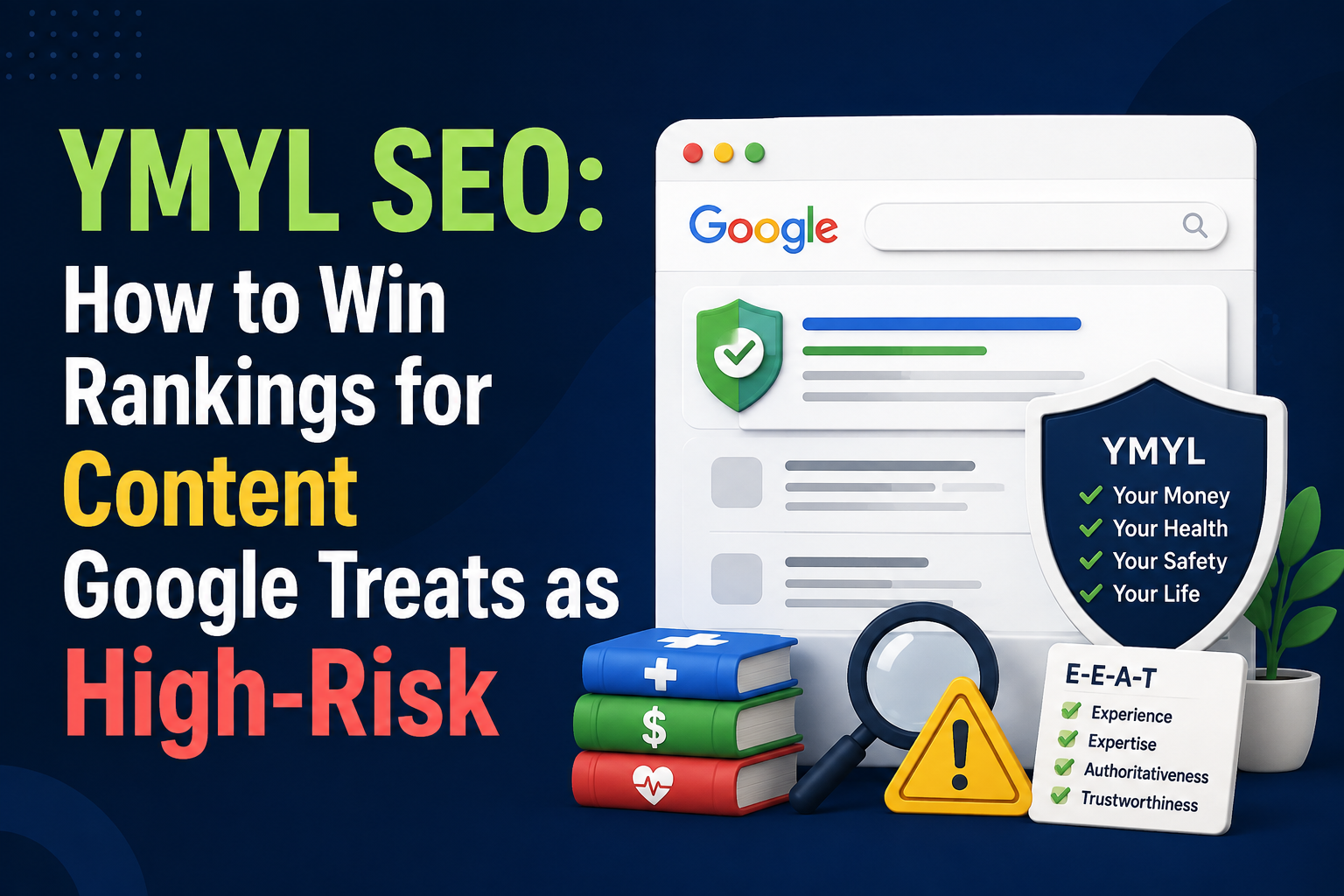
Most SEO advice assumes every page competes on the same terms. It doesn’t. Google quietly sorts the web into two buckets: pages where a bad answer is an inconvenience, and pages where a bad answer can wreck someone’s health, savings, or safety. The second bucket is called YMYL, and if your content lives there, the rules are harder, the bar is higher, and the usual on-page tricks won’t save you.
If you publish about money, medicine, law, or anything with real-world stakes, this is the single most important framing to get right.

What YMYL actually means
YMYL stands for “Your Money or Your Life.” It’s Google’s label for topics that could affect a person’s financial stability, health, safety, or general wellbeing. The term comes from Google’s Search Quality Rater Guidelines , the roughly 182-page manual that around 16,000 human contractors use to score search results. Those raters don’t touch your rankings directly; their scores are training data that shapes Google’s ranking systems over time.
The classic YMYL categories are:
- Financial security — investing, loans, taxes, payments, major purchases, anything that moves someone’s money.
- Health and safety — medical conditions, treatments, drugs, nutrition, dangerous activities.
- Government, civics, and society — this was expanded in the September 2025 guideline update to explicitly include elections, voting information, and content that affects trust in public institutions.
One nuance people miss: YMYL isn’t only about whole sites. Individual pages can be YMYL even when your brand isn’t. A “best space heater” roundup edges into safety. A “how we cut our tax bill” post edges into finance. When any page crosses that line, you raise the quality bar on that page specifically.
Why YMYL changes the SEO game
For a normal topic, Google tolerates a decent-but-imperfect page. For YMYL, the tolerance drops close to zero, because the guidelines treat a wrong or misleading answer as a genuine risk of harm rather than an editorial slip. That single shift cascades into everything:
Trust becomes the foundation, not a bonus. Google’s quality framework is E-E-A-T — Experience, Expertise, Authoritativeness, and Trust, and Trust is explicitly the base that holds up the other three. For YMYL, raters apply the strictest version of this. Anonymous, credential-free “advice” doesn’t survive review no matter how well it’s optimized.
Who wrote it matters as much as what it says. Money advice is expected to come from qualified people or organizations. Medical pages are expected to involve clinicians. Legal pages are expected to be written or checked by actual lawyers. Vague copy from a nameless author is a liability on a YMYL page.
AI-generated filler is now an active risk. The 2025 guideline updates added explicit rules against mass-produced, low-effort scaled content and introduced rating criteria for AI Overviews. For YMYL specifically, the evidentiary bar rose: raters want proof of credentials, primary sources, and recent review dates. If you’re using AI to draft, a human review-and-verify step is no longer optional.
Experience is the newest edge. The first “E” – Experience , rewards proof that you actually did the thing: original data, first-hand testing, specific dated results, your own screenshots. On a crowded YMYL topic, first-hand evidence is often what separates a page that ranks from one that gets buried as generic.
Which topics count as YMYL, and what they look like in practice
Google keeps no fixed list of YMYL subjects. It instead asks whether a page could sway decisions tied to health, financial security, safety, or well-being. The higher the stakes, the more it expects accuracy, transparency, and trust. The thread running through every YMYL topic isn’t the sector, it’s the potential to cause harm. If a reader could lose money, damage their health, endanger their safety, or make a consequential life call based on what you’ve published, expect Google to raise the bar.
- Healthcare
Healthcare is the most obvious example. Pages on symptoms, medication, treatments, mental health, nutrition, or pregnancy feed directly into medical choices, so Google wants them factually sound, backed by reliable sources, and refreshed on a regular basis. A site like Healthline sits squarely here, because advice on treatment and conditions can affect a reader’s health directly.
- Finance
Finance works on the same logic. Guidance on investing, banking, tax, insurance, loans, retirement, cryptocurrency, or cross-border payments changes how people and businesses handle their money, so the emphasis should be on helping readers weigh their options rather than pushing a product. A finance infrastructure company such as Fuze Finance is a fair example, since its content on crypto OTC desks, cross-border payments, digital assets, and payment rails can steer real business and financial decisions.
- Legal and Government
Legal and government content also lands in YMYL territory because it touches people’s rights, obligations, and access to public services. Immigration advice, tax duties, employment law, voting details, and benefits information all demand a high level of accuracy, since anything outdated or wrong can prove costly. A legal resource like FindLaw helps readers grasp their rights and obligations, while a civic tracker such as GovTrack shapes how people understand legislation and how they vote, both of which carry weight.
- Shopping and News
Some shopping and news content qualifies too, depending on context. Picking up a phone case or skimming a film review rarely has lasting consequences. Choosing a mortgage lender, weighing insurance policies, or following reporting on public health or the markets is a different matter. Comparing a home or a mortgage on a platform like Zillow involves a serious financial commitment, and a newswire such as Reuters reporting on elections, public health, or financial markets can inform major decisions.
None of this means Google simply rewards the biggest names. Smaller publishers can rank well on YMYL queries too, as long as they show real expertise, publish accurate information, and build trust with readers over time.
The YMYL SEO checklist
Here’s what “raising the bar” looks like in practice:
- Put a real, credentialed author on every YMYL page. Named byline, genuine bio, relevant qualifications, and ideally a linked author profile with structured data (Person / author schema). “Team” bylines are weak signals here.
- Cite primary sources. Regulators, official registries, peer-reviewed research, government data. Link out to them. On YMYL topics, provenance beats prose.
- Show the review trail. Publish dates, “last updated” dates, and, where relevant, an “expert reviewed by” line with a real person attached.
- Make trust verifiable off-page too. Licenses, registrations, physical address, real company information, and a reputation that holds up when someone searches your brand. Raters check what the wider web says about you, not just your own claims.
- Add structured data that reinforces identity and answers. Organization, WebPage, FAQPage, and BreadcrumbList schema help both classic results and AI summaries understand who you are and what you’re answering.
- Bring first-hand experience. Original screenshots, your own numbers, worked examples, specific outcomes with dates. This is your strongest defense against being flagged as low-effort AI content.
- Keep it accurate and current. On YMYL, a stale figure or an outdated rule isn’t a minor error, it’s the kind of mistake the whole framework is built to catch. Schedule reviews.
Conclusion
YMYL SEO isn’t a separate discipline, it’s normal SEO with the trust dial turned all the way up. If your topic can affect someone’s money, health, or safety, assume Google is holding you to the strictest version of its quality standards, and build accordingly: real authors, verifiable credentials, primary sources, first-hand evidence, and current information. For regulated finance brands especially, the fastest trust win is the one you already have, put your license, your registration, and your real identity front and centre, and let the algorithm confirm what your users already need to know.
Frequently Asked Questions
Is YMYL a Google ranking factor?
No. YMYL isn’t a direct ranking factor. It flags the topics where Google applies a higher quality bar. On YMYL queries, Google’s systems lean harder on signals like accuracy, trust, expertise, and transparency.
What kinds of content are considered YMYL?
Anything that can shape a person’s health, financial security, safety, or a major life decision. Common examples include medical advice, financial planning, legal guidance, government information, insurance, investing, and public safety content.
What’s the difference between YMYL and E-E-A-T?
YMYL sets out which topics get extra scrutiny; E-E-A-T (Experience, Expertise, Authoritativeness, and Trust) describes the quality signals Google looks for. YMYL names the topic, E-E-A-T helps decide whether the content is trustworthy enough to rank.
Is cryptocurrency content considered YMYL?
Often, yes. Content on crypto investing, trading, tax, wallets, stablecoins,digital asset payments, or cross border payments, can shape financial decisions, which makes it YMYL. Educational pieces should stay accurate, transparent, and regularly updated so readers can decide with confidence.
Can AI-generated YMYL content rank on Google?
Yes, as long as it clears Google’s quality bar. AI content isn’t penalised simply for being AI-made. But YMYL pages should always be reviewed by someone knowledgeable, fact-checked against reliable sources, and kept up to date.