For small businesses, having a strong online presence is essential for reaching potential customers. SEO strategies for small businesses can help improve search visibility, attract relevant visitors, and create more opportunities to generate leads and sales. Today, people use search engines to discover local businesses, compare products and services, read reviews, and make purchasing decisions. However, simply having a website is not enough. Businesses need a structured SEO strategy to make sure their website can be discovered by the right audience.
Search Engine Optimization (SEO) involves improving different aspects of a website so that search engines can better understand its content while providing users with useful information. For small businesses with limited budgets, SEO can be an effective way to build long-term online visibility and attract potential customers organically.

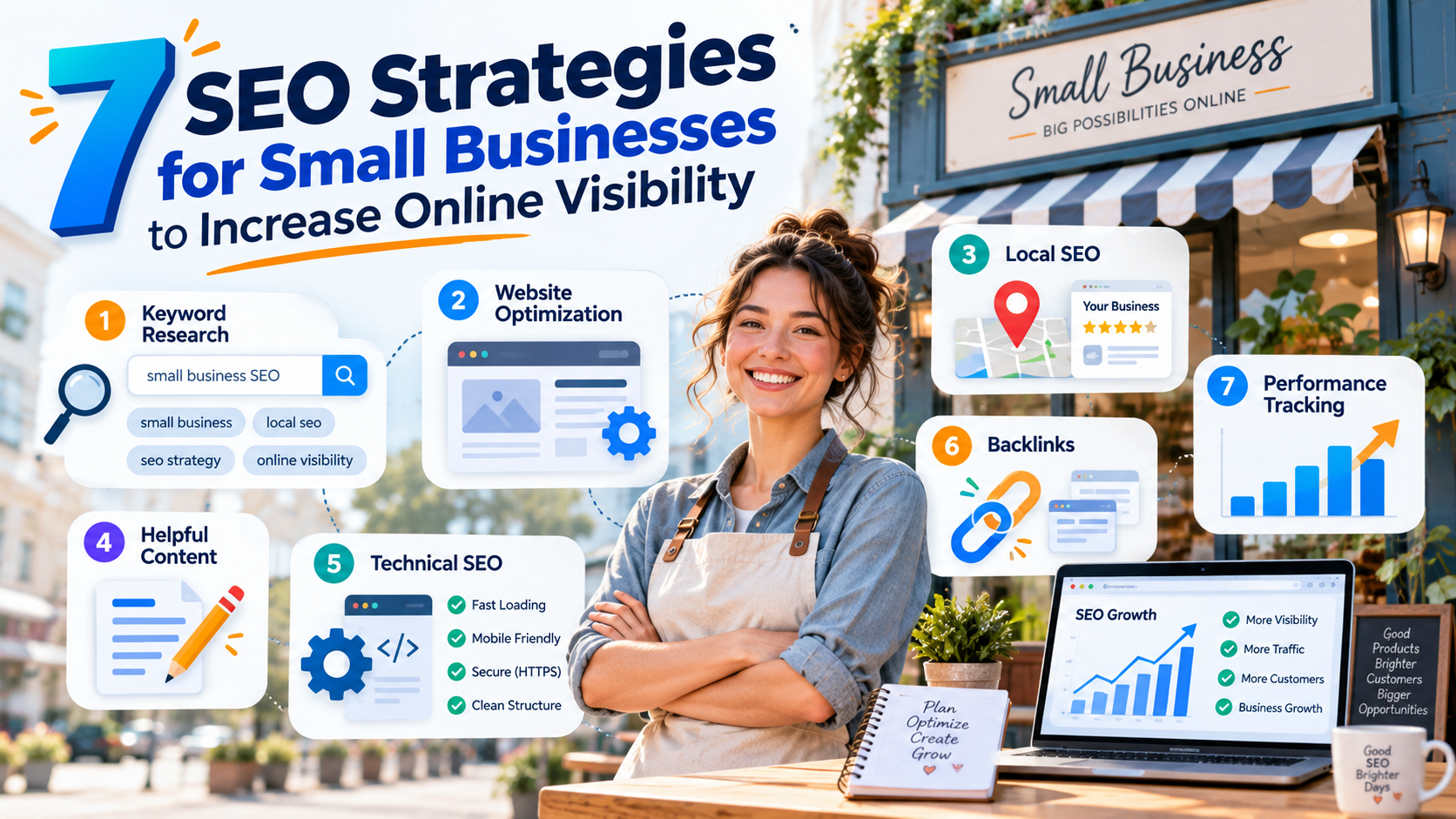
Here are seven practical SEO strategies for small businesses that can help improve online visibility and reach the right audience.
1. Conduct Effective Keyword Research
Keyword research is one of the most important parts of SEO strategies for small businesses. It helps businesses understand what their potential customers are searching for and what terms they use when looking for particular products or services.
Instead of targeting only highly competitive keywords, small businesses should identify specific and relevant search terms related to their products, services, and location.
For example, a bakery in Delhi could target keywords such as:
- Bakery in Delhi
- Birthday cake delivery in Delhi
- Custom cakes near me
- Wedding cake shop in Delhi
When selecting keywords, businesses should consider search intent, relevance, competition, and potential customer value.
Once relevant keywords have been identified, they can be naturally incorporated into website content, headings, page titles, URLs, and other important elements.
2. Optimize Your Website
Website optimization is another important part of SEO strategies for small businesses. A well-optimized website helps search engines understand the purpose of individual pages and makes it easier for visitors to find the information they need.
Important areas to optimize include:
- Page titles
- Meta descriptions
- Heading tags
- URLs
- Internal links
- Image alt text
- Website content
- Keyword placement
For example, a URL such as website.com/page123 provides very little information about a page. A descriptive URL such as website.com/local-seo-services gives users and search engines a clearer understanding of the page.
Businesses should also make sure their content addresses the questions and needs of their target audience rather than focusing only on keywords.
For businesses that need professional assistance with website optimization, working with an experienced SEO services provider can help with keyword research, on-page optimization, technical SEO, and content strategy.
3. Focus on Local SEO
Local SEO is particularly important for businesses that serve customers in a specific city or geographic area. It should be an important component of SEO strategies for small businesses, especially for companies that depend on local customers.
When people search for terms such as “restaurant near me,” “digital marketing agency in Delhi,” or “dentist near me,” search engines use location-related information to provide relevant results.
Small businesses can improve their local visibility by maintaining an accurate Google Business Profile and providing important information such as:
- Business name
- Address
- Phone number
- Website
- Business category
- Opening hours
- Services
- Photos
Businesses should also encourage genuine customers to leave reviews and make sure their business information is consistent across relevant online platforms.
Creating useful location-specific content can also help businesses target searches related to their service area.
4. Create Helpful and Relevant Content
Content marketing plays an important role in SEO strategies for small businesses because it gives companies an opportunity to answer questions and provide useful information to potential customers.
Instead of creating articles solely to include keywords, businesses should focus on topics that are genuinely useful to their target audience.
For example, an accounting firm could publish articles such as:
- How to Choose an Accountant for Your Small Business
- Common Accounting Mistakes Small Businesses Make
- Basic Bookkeeping Tips for New Businesses
Helpful content can attract people who are researching a particular problem or service. It can also help businesses demonstrate their expertise and create additional opportunities to appear in search results.
Businesses should focus on creating original, informative, easy-to-understand content that matches the needs and search intent of their audience.
5. Improve Technical SEO
Technical SEO is another essential element of SEO strategies for small businesses. It focuses on improving the technical aspects of a website so that search engines can efficiently crawl, understand, and index its pages.
Small businesses should regularly check their websites for issues such as:
- Slow-loading pages
- Mobile usability problems
- Broken links
- Indexing issues
- Duplicate content
- Incorrect redirects
- XML sitemap issues
- HTTPS and security problems
Website performance is also important for visitors. A website that loads properly on mobile devices and provides a smooth browsing experience can make it easier for users to find information and take action.
Regular technical SEO audits can help identify problems that may affect website performance and search visibility.
6. Build Relevant Backlinks
Backlinks are links from other websites to your website. Building relevant backlinks is one of the commonly used SEO strategies for small businesses because links from relevant and trustworthy websites can help users discover a business and may contribute to its overall online authority.
However, businesses should not focus simply on obtaining as many backlinks as possible. Relevance and quality are important considerations.
Some potential link-building opportunities include:
- Industry publications
- Relevant guest posts
- Local business directories
- Professional associations
- Industry resources
- Local organizations
For example, a web development company may benefit from being mentioned on a relevant technology, business, or entrepreneurship website.
Guest posting can also be useful when the content provides genuine value to the host website’s audience and the backlink is placed naturally within relevant content.
7. Track and Measure SEO Performance
Tracking results should be a regular part of SEO strategies for small businesses. SEO is an ongoing process, so businesses should monitor their performance rather than treating optimization as a one-time activity.
Some useful metrics to track include:
- Organic traffic
- Search impressions
- Click-through rate
- Keyword visibility
- Landing-page performance
- Leads
- Conversions
Google Search Console and Google Analytics can provide useful insights into how people discover and interact with a website.
For example, if a page receives many search impressions but very few clicks, the business may want to review its page title and meta description. If a page receives traffic but generates few enquiries, the content or conversion elements may need improvement.
Regular monitoring allows businesses to identify opportunities, address problems, and refine their SEO strategy over time.
Why SEO Strategies for Small Businesses Matter
The right SEO strategies for small businesses can help companies compete for visibility without depending entirely on paid advertising. Unlike short-term promotional campaigns, SEO can continue generating organic visibility when a website consistently provides useful content and follows good optimization practices.
Small businesses can start with the fundamentals, such as keyword research, on-page optimization, local SEO, technical improvements, content creation, and relevant link building. As the website grows, businesses can expand their SEO efforts based on performance data and customer behavior.
The key is to focus on sustainable optimization rather than trying to achieve immediate results.
Conclusion
Implementing effective SEO strategies for small businesses requires consistency, planning, and a clear understanding of the target audience. From conducting keyword research and optimizing website pages to improving local SEO, creating helpful content, addressing technical issues, building relevant backlinks, and monitoring performance, each element can contribute to a stronger online presence.
Small businesses do not necessarily need to target every possible search term. Instead, they should focus on reaching the right audience with relevant information and providing a website experience that makes it easy for visitors to take action.
By consistently applying these SEO strategies for small businesses, companies can build a stronger foundation for organic visibility, attract relevant website traffic, and create more opportunities for long-term digital growth.