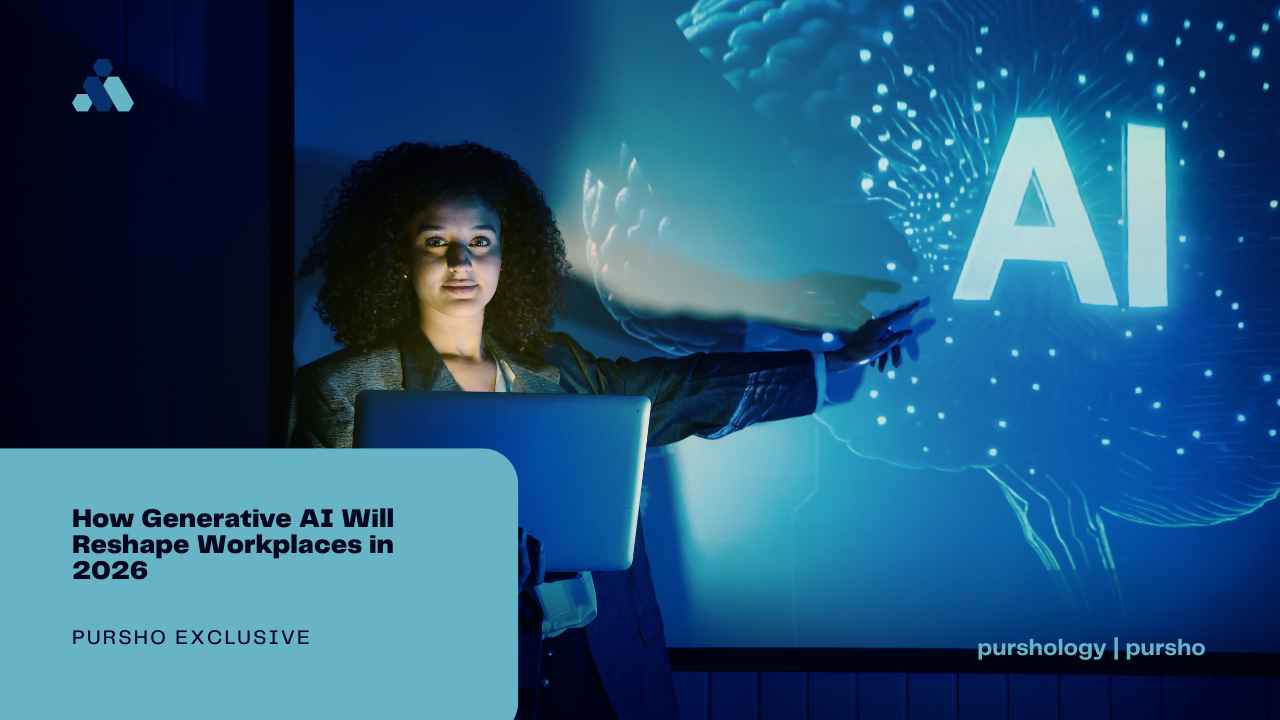
By 2026, generative AI has moved well beyond experimental tools and novelty applications. It is now deeply embedded in how organizations operate, collaborate, and innovate. From automating knowledge work to redefining employee roles, generative AI is reshaping workplaces in ways that are both transformative and enduring. Rather than simply replacing tasks, it is fundamentally changing how work gets done, how teams interact, and how value is created across industries.
1. Knowledge Work Becomes Faster and More Strategic
One of the most significant changes generative AI brings to workplaces in 2026 is the acceleration of knowledge-based work. Tasks such as drafting reports, analyzing data, creating presentations, summarizing meetings, and producing marketing content are increasingly supported by AI assistants.

Employees no longer start from a blank page. Instead, AI generates first drafts, insights, or frameworks that workers refine and contextualize. This dramatically reduces time spent on routine cognitive tasks and allows employees to focus on higher-level thinking, decision-making, and creativity. As a result, productivity increases without demanding longer working hours.
2. AI as a Collaborative Teammate
In 2026, generative AI is no longer viewed as a tool but as a collaborative digital coworker. AI systems participate in brainstorming sessions, propose ideas, simulate scenarios, and challenge assumptions. Teams use AI to explore multiple approaches quickly, test strategies, and uncover insights that may not emerge through human discussion alone.
This collaborative dynamic enhances creativity and problem-solving across departments—from product design and marketing to finance and operations. The workplace becomes more idea-rich and iterative, with AI enabling faster experimentation and learning.
3. Personalized Workflows and Employee Support
Generative AI enables highly personalized work experiences. In 2026, employees increasingly rely on AI systems that adapt to their roles, preferences, and working styles. AI assistants can prioritize tasks, manage schedules, draft communications in a user’s preferred tone, and provide context-aware recommendations.
In learning and development, AI delivers personalized training content, coaching, and skill-building resources based on individual performance and career goals. This shift supports continuous learning and helps employees remain relevant in rapidly changing job markets.
4. Redefining Roles Rather Than Eliminating Jobs
While concerns about job displacement persist, the dominant impact of generative AI in 2026 is role transformation rather than mass replacement. Many jobs are being redesigned to combine human judgment with AI capability. Employees are expected to develop skills in prompting, reviewing, validating, and guiding AI outputs. Critical thinking, domain expertise, ethical judgment, and emotional intelligence become more valuable as AI handles routine execution. New roles—such as AI workflow designers, AI ethics specialists, and human-AI collaboration managers—are emerging across industries. At the same time, AI-driven ecosystems are influencing adjacent digital experiences, including automation-supported platforms and entertainment applications accessible through tools like an APK download, highlighting how AI integration extends beyond the workplace into everyday digital interactions.
5. Smarter Communication and Collaboration
Generative AI is significantly improving workplace communication. AI-powered tools summarize meetings, translate languages in real time, and generate follow-up action items automatically. Remote and hybrid teams benefit from AI that bridges communication gaps, reduces misunderstandings, and ensures alignment across time zones.
In 2026, collaboration platforms integrate generative AI to surface relevant information during discussions, suggest next steps, and keep projects moving forward without constant manual coordination. This reduces meeting fatigue and enhances clarity and accountability.
6. Enhanced Decision-Making and Strategic Planning
Generative AI supports leadership by synthesizing complex information into clear insights. Executives and managers use AI to analyze market trends, simulate business scenarios, and assess risks before making decisions. AI-generated models allow organizations to test strategies virtually, reducing uncertainty and improving outcomes.
This capability democratizes strategic thinking, giving managers at all levels access to advanced analytical support. Decisions become more data-informed, agile, and responsive to change.
7. Ethical Governance and Trust Become Central
As generative AI becomes integral to daily work, organizations in 2026 place greater emphasis on ethics, transparency, and governance. Companies establish clear guidelines for responsible AI use, data privacy, bias mitigation, and human oversight.
Trust becomes a competitive advantage. Employees and customers expect organizations to use AI in ways that are fair, explainable, and aligned with human values. Businesses that proactively address ethical concerns foster stronger workplace culture and long-term credibility.
8. Workplace Culture Evolves Toward Augmentation
Perhaps the most profound shift generative AI brings is cultural. In 2026, successful organizations promote a mindset of augmentation rather than replacement. Employees are encouraged to see AI as a partner that amplifies their capabilities, not a threat to their roles.
This cultural shift requires leadership commitment, transparent communication, and continuous upskilling. Organizations that invest in helping employees adapt to AI-driven work environments see higher engagement, innovation, and resilience.
Conclusion
In 2026, generative AI is reshaping workplaces by accelerating productivity, enhancing collaboration, and redefining how humans create value. Rather than eliminating the need for people, it elevates the importance of human judgment, creativity, and ethical responsibility.
The workplaces that thrive are those that integrate generative AI thoughtfully—balancing technological power with human insight. By embracing AI as a collaborative force, organizations can build smarter, more adaptive, and more fulfilling work environments prepared for the future.