
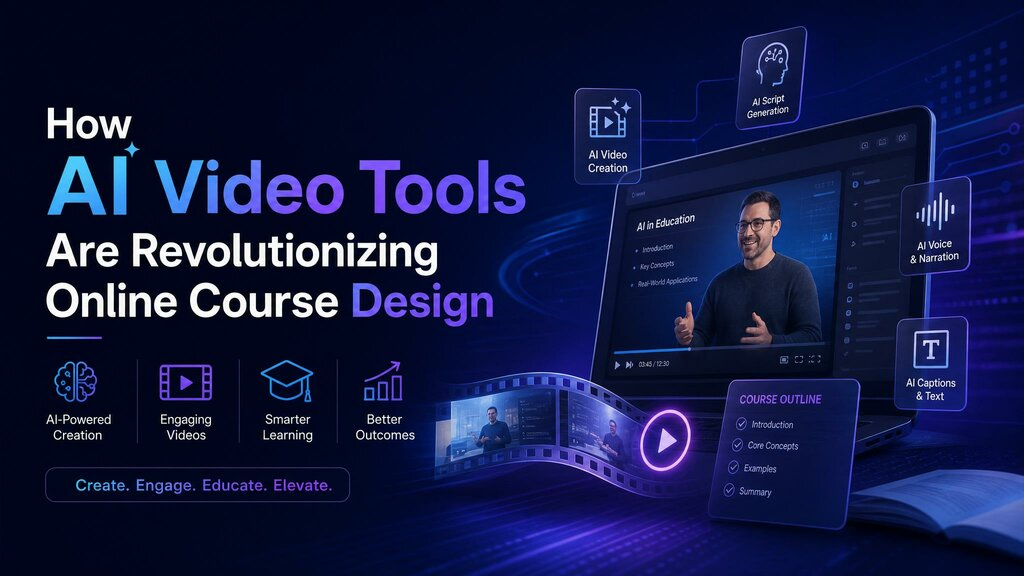
Online course design has always been a balancing act between instructional quality and production feasibility. The ideal course features professionally produced video lectures, interactive assessments, diverse media formats, and personalized learning paths. The reality for most course creators — whether they work at universities, training companies, or as independent educators — is that budget and time constraints force compromises that reduce the learning experience.
AI educational video tools are shifting this balance by automating the most resource-intensive aspects of course video production. The result is not perfect courses — but it is meaningfully better courses, produced faster and at lower cost than was previously possible.

The Course Design Challenge
Creating a high-quality online course involves several production-intensive steps: content development (what to teach), instructional design (how to structure the learning experience), media production (creating video, audio, and visual assets), assessment design (measuring learning outcomes), and platform integration (deploying content in an LMS or course platform).
Of these steps, media production is typically the most expensive and time-consuming. It is also the step where quality most directly impacts learner experience. Students judge course quality significantly by video production quality — and courses with amateur-looking video experience higher dropout rates than those with professional production, even when the content itself is identical.
How AI Changes Course Video Production
From Production-Constrained to Content-Constrained
When video production is expensive and slow, course designers make decisions based on production constraints rather than instructional merit. They limit the number of video lectures to what the budget allows. They reuse footage rather than creating topic-specific visuals. They batch-record multiple lectures in a single session to minimize studio time, even though this approach reduces quality.
An AI educational video tool eliminates most production constraints. When generating a video lecture takes minutes rather than days, course designers can make decisions based on what produces the best learning outcomes rather than what fits within the production budget. More topics get video treatment. More visual variety is possible. More updates can be incorporated throughout the course lifecycle.
Modular Course Architecture
AI video generation naturally supports modular course design — breaking courses into small, self-contained learning modules rather than long, monolithic lectures. Because each module is generated independently, the production cost per module is low enough to justify the granular approach.
Modular architecture aligns with learning science. Research consistently shows that learners perform better with shorter, focused learning sessions than with extended lectures. Modules of 5-10 minutes covering a single concept produce higher completion rates, better assessment scores, and lower cognitive fatigue than 45-minute lecture recordings.
Practical Applications in Course Design
Rapid Course Prototyping
Before investing in full course production, designers can use AI video tools to create a complete course prototype in days rather than months. Upload the course outline, generate sample lectures for each module, and test the prototype with a small learner group. Feedback from the prototype informs revisions before final production — an iterative design approach that is too expensive with traditional video production.
Supplementary Content Generation
Every course has topics that some students understand quickly and others need additional support with. AI video tools make it practical to create supplementary content — additional explanations, worked examples, review summaries — for the topics that generate the most questions or lowest assessment scores. This supplementary content serves as a safety net that catches learners who would otherwise fall behind.
Localized Course Versions
Global institutions and training companies need courses in multiple languages. AI video generation with multilingual support enables creation of localized course versions from a single set of source materials. Each language version maintains the same quality and structure as the original, with natural-sounding localized narration. The cost of supporting additional languages becomes marginal rather than multiplicative.
Just-in-Time Content Updates
In fields where knowledge evolves rapidly — technology, medicine, regulatory compliance — courses need regular updates. Traditional video production makes updates expensive and slow, so courses often contain outdated content for months or years. AI generation enables just-in-time updates: when the underlying information changes, the affected video modules can be regenerated with updated content within hours.
Integrating AI Video into Instructional Design Workflows
Content-First Design
Start with comprehensive written content for each module — the learning objectives, key concepts, explanations, and examples. This written content serves as the source material for AI video generation and also provides the text-based alternative that accessibility standards require. Design the content for clarity and completeness, knowing that the AI will translate it into video format.
Review and Refinement
After generating videos, conduct a review cycle that evaluates both content accuracy and pedagogical effectiveness. Does the narration explain concepts in the right sequence? Are key terms defined before being used? Are complex ideas broken into progressive steps? The AI handles production quality; the instructional designer ensures learning quality.
Assessment Alignment
Design assessments in parallel with video content, ensuring that each assessment question maps to specific content within a video module. This alignment makes it possible to identify not just which students are struggling, but which specific content segments are not effectively communicating their intended concepts.
Measuring Course Effectiveness
AI-generated courses should be evaluated using the same metrics as traditionally produced courses: completion rates, assessment scores, learner satisfaction, knowledge retention (measured through delayed assessments), and behavioral change (measured through on-the-job performance, where applicable).
The advantage of AI-generated video is not that it produces inherently better courses — it is that it enables faster iteration. When courses can be updated quickly and affordably, course designers can respond to performance data in near-real-time, creating a continuous improvement cycle that traditional production timelines make impractical.
The Future of Course Design
AI video tools are not replacing instructional designers — they are amplifying their impact. The creative and pedagogical work that defines great course design — understanding learner needs, structuring knowledge for effective transfer, designing meaningful assessments — remains fundamentally human work. AI handles the production mechanics that previously consumed the majority of the course creation timeline and budget. The result is not just faster and cheaper courses. It is better courses, produced by designers who can focus their expertise on the work that matters most.