
For a growing number of brands, the real value of an influencer program is not the sponsored post itself – it is the library of authentic creator content that the program generates. User-generated content now fuels paid ads, product pages, email, organic social, and creator storefronts. The brands winning with it treat UGC as an asset to be captured, scored, organized, and reused, not a one-time deliverable that disappears into a creator’s feed.
That shift changes what you need from a platform. Capturing tagged content automatically, scoring it for quality, finding the right clip by theme months later, and tracking usage rights all become core requirements rather than nice-to-haves. Upfluence handles campaign execution well, but it was not built as a content engine – so brands whose programs revolve around UGC at scale often find themselves bolting on separate tools to manage the content their campaigns produce.

If UGC and creator content are central to your strategy, these ten platforms each approach the content layer differently. Influencer Hero leads the list with an AI-driven content library, but several tools here bring distinct strengths to capturing and reusing creator content.
- Influencer Hero
- Later
- Aspire
- GRIN
- CreatorIQ
- Storyclash
- SocialLadder
- Modash
- Sprout Social
- Heepsy
Why Content-Led Programs Outgrow Upfluence
Upfluence is built around discovery, outreach, and affiliate tracking. For programs whose center of gravity is creator content, a few gaps become hard to ignore:
- No Automated Content Capture: When dozens of creators post tagged content every week, manually collecting it is unsustainable. Content-led programs need automatic detection and capture of tagged posts, so nothing valuable is lost in the feed.
- No Quality Scoring or Semantic Search: A library is only useful if you can find the right asset fast. Visual quality scoring and search by theme turn a pile of clips into a usable content system – capabilities a campaign-execution tool typically lacks.
- Limited Reuse Workflows: The payoff of UGC is reuse across ads, product pages, and storefronts. Without a content library tied into the rest of the platform, that content sits idle or gets managed in disconnected drives and spreadsheets.
- Contract Weight on Top of a Tooling Gap: Paying $24,000+ on a mandatory annual contract for a platform that still needs a separate content tool stacks cost on top of a workflow gap.
Best Upfluence Alternatives for UGC and Creator Content in 2026
1. Influencer Hero
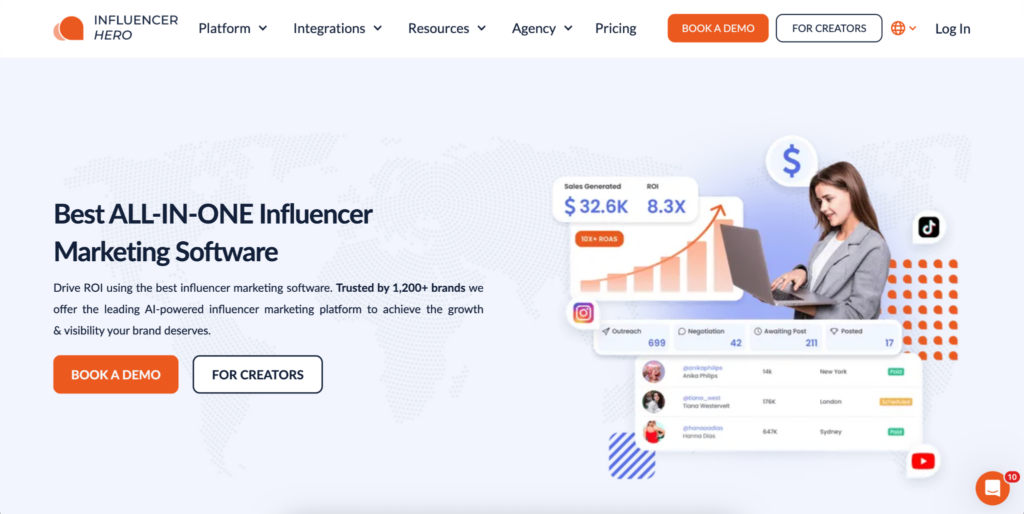
Influencer Hero treats creator content as a first-class asset through a UGC Content Library built for scale. An AI Post Detector automatically captures content when creators tag your brand, so the library fills itself rather than relying on manual collection. Each piece gets Visual Quality Scoring (0-10), and semantic search lets you find content by theme months later – turning a growing archive into a system you can actually use.
The depth goes further than capture. AI video audio analysis (on higher tiers), aspect-ratio filtering, and product-visibility detection help you pull exactly the right clip for a given placement, and the library supports Instagram Feed, Reels, and Stories, plus TikTok and YouTube. Because the library connects to the rest of the platform – a 450M+ creator database, AI outreach at a 43% response rate, the three-layer CRM, and creator storefronts that can drive up to 8x ROI – content flows directly from campaigns into ads, product pages, and storefronts without leaving the system.
Best for: Brands that run content-led programs and want automatic UGC capture, quality scoring, and semantic search tied into discovery, outreach, and storefronts.
Pricing:
- Standard: $649/month (1 seat, 200 UGC tracking, 1,000 outreach/mo)
- Pro: $1,049/month (3 seats, 500 UGC tracking, 5,000 outreach/mo)
- Business: $2,490/month (8 seats, 1,500 UGC tracking, 10,000 outreach/mo)
- Custom & Agency plans available with unlimited outreach
Standout features:
- AI Post Detector: Automatically captures content when creators tag your brand, so the library fills itself.
- Visual Quality Scoring (0-10): Every piece of content is scored, making it easy to surface the strongest assets.
- Semantic Search by Theme: Find the right clip months later by searching themes, with aspect-ratio and product-visibility filtering.
- Multi-Format Coverage: Instagram Feed, Reels, and Stories, plus TikTok and YouTube, with AI video audio analysis on higher tiers.
- Creator Storefronts (Up to 8x ROI): Reuse captured content in branded storefronts that drive measurable returns.
- Connected to Discovery and CRM: Content flows from a 450M+ database and AI outreach straight into the library and out to placements.
UGC tracking volume is tiered (200 on Standard, 500 on Pro, 1,500 on Business), so very high-volume content programs should size their plan accordingly. Rights for captured content are managed manually rather than auto-licensed, so teams still need a clear usage-rights process as the library grows.
2. Later
Later’s roots in social media management make it genuinely strong on the content side. Its UGC library pairs with Linkin.bio and content-repurposing tools that push creator content across ads and storefronts, and content-planning synergy lets you align influencer deliverables with your scheduled brand calendar – a natural fit for brands that think in content first.
AI-driven brand-safety and content-review tools screen creator content before it goes live, 15M contactable creators come with verified emails, and custom application pages bring in creators whose content style fits your brand. For teams already living in a content calendar, Later’s workflow feels familiar.
Best for: Brands that want a UGC library and content repurposing tightly integrated with social content planning.
Pricing:
- Social management: Starter $25/mo, Growth $50/mo, Scale $110/mo
- Influencer marketing plans: ~$28,500-$60,000/year
Standout features:
- UGC Library With Repurposing: Push creator content across ads and storefronts via Linkin.bio and repurposing tools.
- Content-Planning Synergy: Align creator deliverables with your scheduled brand content calendar.
- Brand-Safety Content Review: AI scanning screens creator content before it publishes.
- 15M Contactable Creators: Verified emails simplify recruiting creators whose content fits your brand.
Later’s full content and influencer feature set lives in plans starting around $28,500/year, well above its affordable social tiers, and it lacks automated tagged-content capture with quality scoring of the kind purpose-built content libraries offer. Brands that want content captured and scored automatically may find a platform like Influencer Hero more complete on that specific workflow.
3. Aspire
Aspire’s inbound marketplace – over a million creators applying to campaigns – is a content advantage in itself: you can select creators whose existing content style already matches your brand, rather than hoping cold prospects deliver the right aesthetic. Its asset library archives the UGC campaigns generate and ties it to ROI reporting, so content and performance stay connected.
First-party data integrations with Meta, TikTok, and Pinterest support reliable content and audience evaluation, and the end-to-end workflow covers briefs, approvals, and tracking – so the content a campaign produces is governed from brief to delivery.
Best for: Recognized brands that want to source creators by content fit through an inbound marketplace and archive UGC tied to ROI.
Pricing:
- Custom; mid-tier packages quoted around $2,300/month
Standout features:
- Content-Fit Sourcing: 1M+ inbound applicants let you select creators by existing content style.
- UGC Asset Library: Archives campaign content and ties it to ROI reporting.
- First-Party Social Data: Meta, TikTok, and Pinterest integrations for reliable content and audience evaluation.
- End-to-End Content Governance: Briefs, approvals, and tracking keep content managed from brief to delivery.
Custom pricing limits transparency until a sales call, and the inbound model favors brands with existing recognition. Aspire’s asset library archives content well but does not offer automated tagged-content detection, quality scoring, or semantic search, so brands that want an AI-driven content engine will find the content layer lighter than dedicated libraries provide.
4. GRIN
GRIN includes a centralized, auto-collected, searchable UGC library that captures creator content – including Stories – as a genuine strength of its all-in-one workflow. Combined with automatic media rights management, where reuse rights are granted when creators are booked, GRIN handles a content pain point many tools leave to manual negotiation.
The library sits inside a unified lifecycle dashboard alongside native eCommerce integrations, creator portals, and real-time ROI tracking, so content connects to commerce. GRIN manages campaigns across 100,000+ creators and is trusted by 1,500+ brands.
Best for: Enterprise eCommerce brands that want auto-collected UGC with media rights handled at booking.
Pricing:
- Custom; entry tier typically starts around $2,500/month
- 12-month minimum; $25,000+/year
Standout features:
- Auto-Collected UGC Library: Centralized, searchable archive that captures creator content including Stories.
- Automatic Media Rights: Reuse rights granted at booking, removing separate licensing negotiations.
- Unified Lifecycle Dashboard: Content connected to discovery, outreach, gifting, and ROI tracking.
- Real-Time ROI Tracking: Tie content and creator activity to clicks, conversions, and revenue.
GRIN’s media rights handling is a real edge, but its $25,000+/year minimum and 12-month contract are a heavy commitment for a content-led program, and the interface can slow under heavy use. Brands that want automatic content capture with AI quality scoring at a fraction of the cost often weigh a platform like Influencer Hero against it.
5. CreatorIQ
CreatorIQ approaches creator content from the enterprise governance side, with UGC rights management that lets large organizations request, track, and manage content usage rights at scale. For brands where the legal and compliance side of reusing creator content is as important as the content itself, this structured approach is the draw.
An auto-generated UGC library captures content, enterprise reporting runs on live API-powered dashboards, and advanced CRM with creator one-sheets supports the stakeholder review that distributed teams require before content is approved for reuse.
Best for: Enterprise brands that need rigorous UGC rights management and governance across large content programs.
Pricing:
- Starts at $35,000/year
- Enterprise tiers up to $200,000/year
Standout features:
- UGC Rights Management: Request, track, and manage content usage rights at enterprise scale.
- Auto-Generated UGC Library: Captures creator content for centralized access.
- Live API-Powered Dashboards: Accurate reporting on content and creator performance.
- Advanced CRM and One-Sheets: Structured review and approval before content reuse.
CreatorIQ’s pricing, from $35,000/year up to $200,000/year, puts it out of reach for most brands, and it is governance-heavy rather than built for fast, creative content reuse. Mid-market content teams usually find it oversized for their needs relative to platforms that combine content capture with execution at a lower price.
6. Storyclash
Storyclash is built around content performance, which makes it a strong fit for content-led programs that want to learn what works. It tracks creator content over time – including historical data on expired Stories – across a 183M database, revealing which content types and formats consistently drive results so you can brief future content more effectively.
AI-driven discovery (keyword, image recognition, AI prompts, lookalike) surfaces creators by content style, competitive benchmarking shows how competitor content performs, and a Shopify integration ties content to ROAS, CAC, and AOV.
Best for: Content-focused teams that want performance intelligence to guide what creator content to produce.
Pricing:
- Business plan starts at $870/month
- Enterprise plans available
Standout features:
- Historical Content Tracking: Performance data including expired Stories to learn what content works.
- AI Discovery by Content Style: Keyword, image, prompt, and lookalike search across 183M creators.
- Competitive Content Benchmarking: See how competitor creator content performs.
- Shopify ROAS Tracking: Connect content to ROAS, CAC, and AOV.
Storyclash analyzes content performance but is not a content library or reuse engine – it does not capture, score, and organize your owned UGC for redeployment, and with no built-in licensing, rights are handled separately. It works best as an intelligence layer alongside a platform that actually manages and reuses the content.
7. SocialLadder

SocialLadder generates content volume by turning customers and followers into brand ambassadors who post consistently. Its gamified UGC challenges award points for posting, redeemed for rewards, which keeps a steady stream of authentic content flowing – and because content usage rights are agreed when ambassadors join, that content is cleared for reuse from the start.
eCommerce integration auto-invites new customers post-purchase to keep the content pipeline full, and leaderboards sustain participation. For brands that want a high volume of rights-cleared, community-driven UGC, the model is distinctive.
Best for: Brands that want a steady stream of rights-cleared UGC from a customer-driven ambassador community.
Pricing:
- Typically under $2,000/month
- 6-12 month commitment recommended
Standout features:
- Gamified UGC Challenges: Points-for-posting mechanics generate a steady content stream.
- Built-In Content Rights: Usage rights agreed on join, so UGC is cleared for reuse upfront.
- Post-Purchase Auto-Invite: eCommerce integration keeps the content pipeline refilling.
- Leaderboards: Sustain ambassador participation and content volume over time.
Community-driven content volume is less predictable than paid partnerships, and the program takes time to build, so it is a long-game tactic. It also depends on an existing customer base, and the resulting UGC tends toward authentic-but-casual rather than the polished content some placements require.
8. Modash
Modash supports content programs primarily through discovery and campaign tracking. Its 350M+ database and AI visual discovery – describe a “vibe” or upload a reference image – are well suited to finding creators whose content aesthetic matches your brand, and campaign tracking monitors mentions, hashtags, and event-mode content as creators post.
Shopify-native affiliate workflows tie content to sales, and built-in outreach with Gmail and Outlook sync keeps communication organized. It is a strong, affordable engine for sourcing content-aligned creators.
Best for: Shopify brands that want to discover content-aligned creators and track their posts affordably.
Pricing:
- Essentials: $199-$299/month
- Performance: $499-$599/month
- Enterprise: Custom (annual billing)
Standout features:
- AI Visual Discovery: Find creators by content aesthetic via vibe description or reference image.
- Campaign Content Tracking: Monitor mentions, hashtags, and event-mode content as creators post.
- 350M+ Creator Database: Broad pool for sourcing content-aligned creators.
- Shopify Affiliate Workflows: Tie creator content to sales with codes and UTMs.
Modash tracks content as it is posted but does not provide a UGC library with automated capture, quality scoring, or semantic search for reuse, and its deep integration is Shopify-only. Brands that want to capture and redeploy owned content at scale typically need a dedicated content library alongside it.
9. Sprout Social
Sprout Social brings content governance from its social media suite into influencer marketing. Content-approval workflows let creators submit deliverables for brand review before publishing, which matters for content-led programs in regulated or brand-sensitive categories, and its AI Brand Fit Score helps ensure creator content aligns with brand standards.
Advanced brand-safety filters screen content for risky topics, EMV reporting measures the earned value of creator content, and client-ready exportable dashboards make it easy to report content performance to stakeholders.
Best for: Brands that need strict content approval and brand-safety governance over creator content.
Pricing:
- $1,599/user/month (annual billing)
- 12-month minimum; additional seats $600/month
Standout features:
- Content-Approval Workflows: Creators submit content for brand review before publishing.
- AI Brand Fit Score: Helps ensure creator content aligns with brand standards.
- Advanced Brand-Safety Filters: Screen content for risky topics before approval.
- EMV Reporting: Measure the earned media value of creator content.
Per-user pricing escalates quickly, and Sprout Social manages content approval but does not offer a reusable UGC library with automated capture and quality scoring, nor vibe-based visual search. Content-led teams focused on capturing and redeploying UGC at scale usually pair it with a dedicated content platform.
10. Heepsy
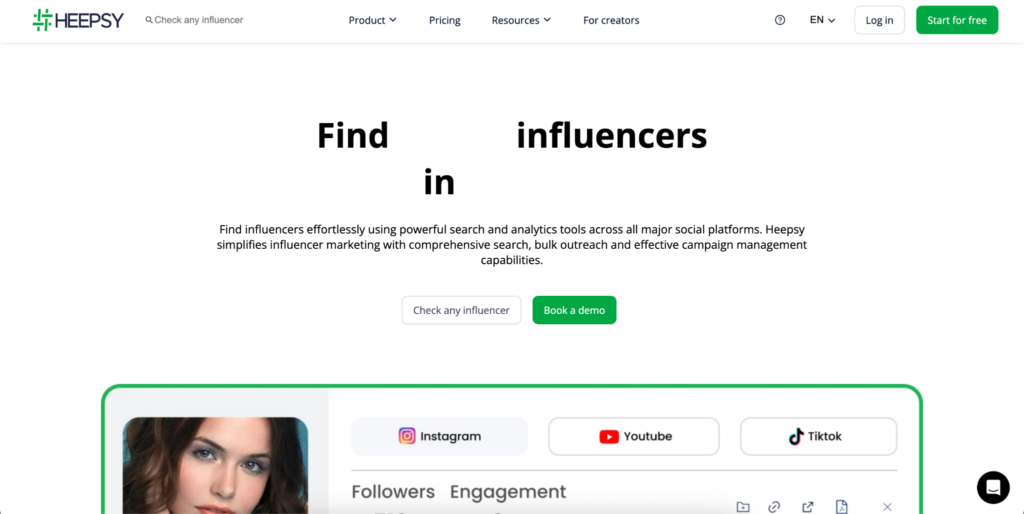
Heepsy makes content-aligned creator sourcing accessible to smaller brands. A 50M+ database with authenticity filters helps find creators with genuine engagement, the Kanban-style CRM tracks them through campaign stages, and bulk email outreach (up to 3,000 emails per month with follow-ups) coordinates content campaigns. A free plan lets teams test the workflow first.
Media monitoring and campaign reporting track the content creators produce, and Shopify and WooCommerce integrations (on advanced plans) connect content-driven campaigns to sales.
Best for: Small to mid-sized brands that want affordable content-aligned sourcing and basic campaign tracking.
Pricing:
- Free plan available
- Starter: $89/month
- Plus: $249/month
- Advanced: $369/month (required for Shopify sales tracking)
Standout features:
- Authenticity Filters: Find creators with genuine engagement for credible content.
- Kanban CRM: Track content-campaign creators through visual pipeline stages.
- Bulk Email Outreach: Up to 3,000 emails per month with follow-ups for content campaigns.
- Free Entry Plan: Test the workflow at zero cost before committing.
Heepsy is a discovery and outreach tool, not a content engine – it offers no UGC library with automated capture, quality scoring, or semantic search, and the best features require the $369/month Advanced plan. Brands whose programs revolve around capturing and reusing creator content will quickly need more dedicated content tooling.
Final Thoughts
As UGC becomes the fuel for ads, product pages, and storefronts, the platforms that win are the ones that treat creator content as an asset to capture, organize, and reuse – not a one-off deliverable. Where your program sits on that spectrum should drive the choice.
For brands that want automatic capture, AI quality scoring, and semantic search wired into discovery, outreach, and storefronts, Influencer Hero offers the most complete content engine on this list. Later excels when UGC needs to live inside a content calendar, GRIN pairs an auto-collected library with media rights at booking, and CreatorIQ governs rights at enterprise scale. Storyclash sharpens what content to produce, SocialLadder generates rights-cleared community UGC, and Aspire sources creators by content fit. Modash, Sprout Social, and Heepsy bring discovery, governance, and affordability respectively, though each leans on separate tooling for content capture and reuse.
The brands getting the most from creator content are the ones whose platform turns every campaign into reusable assets automatically. Decide whether your priority is capture, governance, or creative reuse, and the right fit becomes clear.
FAQs
What should a UGC-focused influencer platform be able to do?
Beyond running campaigns, it should automatically capture content creators post (so nothing is lost), score or organize that content for quick retrieval, let you search the library by theme or attribute, and connect content to where it gets reused – ads, product pages, and storefronts. Influencer Hero’s content library, with its AI Post Detector, quality scoring, and semantic search, is built around exactly this workflow.
Why is Upfluence limiting for content-led programs?
Upfluence is built around discovery, outreach, and affiliate tracking rather than content management. It lacks automated tagged-content capture, quality scoring, and semantic search, so brands whose programs revolve around UGC often bolt on a separate content tool – adding cost and complexity on top of a mandatory annual contract.
How do platforms handle content usage rights?
Approaches vary. GRIN auto-grants media rights when creators are booked, CreatorIQ offers structured UGC rights management for enterprise programs, and SocialLadder secures usage rights when ambassadors join. Influencer Hero captures and organizes content automatically but manages rights manually, so teams should maintain a clear usage-rights process as the library grows.
Which platform is best for reusing creator content in ads and storefronts?
Influencer Hero connects its content library directly to creator storefronts (which can drive up to 8x ROI) and the rest of the platform, and Later offers strong repurposing across ads and storefronts via Linkin.bio. The best fit depends on whether you want content capture and reuse in one system or content reuse tied to a social scheduling workflow.
Can I track which creator content actually performs?
Yes. Storyclash specializes in content-performance intelligence including historical data, Sprout Social reports earned media value, and Influencer Hero scores content quality and attributes performance through its analytics. The right choice depends on whether you want to learn what content to produce or measure the content you already have.
Do I need a dedicated content library or is campaign tracking enough?
Campaign tracking tells you when a creator posts; a content library captures, scores, and organizes that content so you can reuse it later. If UGC fuels your ads, emails, and product pages, a dedicated library (such as Influencer Hero’s or GRIN’s auto-collected archive) saves significant manual work compared with tracking-only tools like Modash or Heepsy.