TL;DR
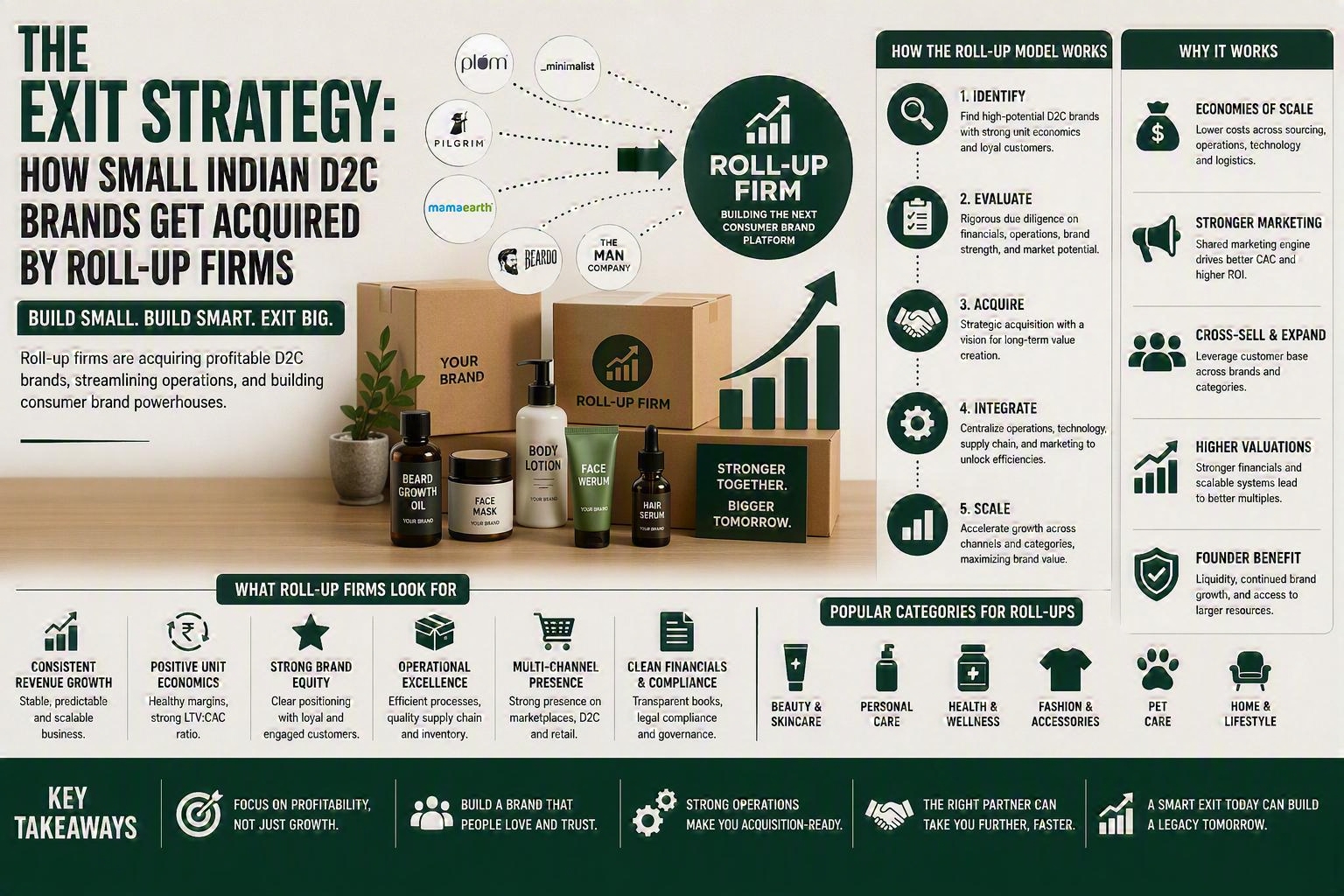
As India’s D2C ecosystem matures, many founders are discovering that their most realistic exit isn’t an IPO—it’s an acquisition by a roll-up firm. These firms acquire profitable niche brands, improve operations, centralize resources, and build larger consumer conglomerates. For D2C founders, strong unit economics, loyal customers, and operational efficiency are becoming the key ingredients for a successful exit.
Introduction: The New Playbook for D2C Exits
Over the past decade, India witnessed an explosion of direct-to-consumer (D2C) brands across categories such as beauty, personal care, nutrition, fashion, pet care, and home essentials.

While many founders once dreamed of becoming the next unicorn, market realities have shifted. Rising customer acquisition costs, funding slowdowns, and intense competition have made scale harder than ever.
Enter the roll-up model.
Instead of building one giant brand, roll-up firms acquire multiple niche brands and combine them into a larger platform, creating operational efficiencies and accelerating growth.
For many Indian D2C entrepreneurs, this has become one of the most attractive exit opportunities.
What Is a Roll-Up Firm?
A roll-up firm acquires several small brands operating in similar or complementary categories and integrates them under a common operating structure.
Typical Focus Areas:
- Beauty and skincare
- Health and wellness
- Personal care
- Fashion accessories
- Home and lifestyle products
- Baby and pet care
How They Create Value:
✅ Shared marketing teams
✅ Centralized logistics
✅ Better procurement costs
✅ Improved technology infrastructure
✅ Cross-selling across customer bases
Instead of managing ten separate businesses, a roll-up firm creates one scalable consumer platform.
Why D2C Brands Are Attractive Acquisition Targets
Many small D2C businesses possess something larger companies desperately want:
Loyal Customers
A niche brand may only generate a few crores in revenue, but it often owns a highly engaged customer base.
Strong Brand Identity
Consumers increasingly connect with specialized brands rather than mass-market companies.
Digital-First Operations
Most D2C brands already understand:
- Performance marketing
- Influencer partnerships
- Marketplace selling
- Customer retention
This reduces integration challenges after acquisition.
The Ideal Acquisition Candidate
Not every D2C brand becomes an acquisition target.
Roll-up firms look for businesses with specific characteristics.
1. Consistent Revenue Growth
Growth does not need to be explosive.
What matters is:
- Stable customer demand
- Predictable revenue
- Growing repeat purchases
2. Positive Unit Economics
Acquirers increasingly prioritize profitability over vanity metrics.
Key indicators include:
- Healthy contribution margins
- Efficient CAC (Customer Acquisition Cost)
- Strong customer lifetime value
3. Defensible Brand Positioning
Brands with clear differentiation perform best.
For example:
- Ayurvedic skincare
- Sustainable fashion
- Premium pet nutrition
- Specialty nutrition products
Unique positioning reduces competitive pressure.
The Acquisition Process
Step 1: Discovery
Roll-up firms identify promising brands through:
- Industry networks
- Marketplace performance
- Investor referrals
- Founder communities
Step 2: Due Diligence
Acquirers evaluate:
- Revenue quality
- Customer retention
- Supply chain reliability
- Financial performance
- Legal compliance
Step 3: Valuation
Valuations are typically based on:
- Revenue multiples
- EBITDA multiples
- Growth trajectory
- Market opportunity
Step 4: Integration
After acquisition, brands generally retain their identity while operational functions become centralized.
Why Founders Choose Acquisition Over Scaling Alone
Many founders discover that scaling independently becomes increasingly difficult.
Common Challenges:
- Rising advertising costs
- Inventory management complexity
- Hiring senior talent
- Funding pressures
- Expanding distribution
A roll-up acquisition allows founders to:
✅ Realize financial returns
✅ Reduce operational burdens
✅ Access larger resources
✅ Accelerate brand growth
For many entrepreneurs, it represents the optimal balance between growth and liquidity.
What Happens After the Acquisition?
Contrary to popular belief, most acquired brands don’t disappear.
Instead, roll-up firms focus on enhancing performance.
Typical Improvements:
Marketing Optimization
- Better attribution systems
- Shared creative teams
- Lower acquisition costs
Supply Chain Efficiency
- Bulk purchasing
- Vendor consolidation
- Lower production costs
Technology Integration
- Centralized analytics
- Shared CRM systems
- Unified customer data
These improvements often lead to stronger profitability and faster growth.
The Rise of Consumer Brand Houses in India
India is witnessing the emergence of consumer-platform companies inspired by global roll-up models.
These organizations are creating portfolios of brands rather than relying on a single flagship product.
Advantages:
- Diversified revenue streams
- Lower category risk
- Better bargaining power
- Greater operational leverage
This trend is reshaping the future of the consumer goods industry.
Red Flags That Reduce Acquisition Interest
Some D2C brands struggle to attract buyers despite impressive growth.
Common Issues:
❌ Heavy dependence on discounts
❌ Poor repeat purchase rates
❌ Weak gross margins
❌ Vendor concentration risk
❌ High customer acquisition costs
❌ Inconsistent financial records
Roll-up firms increasingly prefer sustainable businesses over growth-at-all-costs models.
Key Lessons for D2C Founders
✅ Build a brand, not just a product
✅ Focus on profitability from day one
✅ Improve customer retention
✅ Create strong operational processes
✅ Maintain clean financial records
✅ Develop category authority
✅ Avoid dependency on a single sales channel
Conclusion: The Future of D2C Exits in India
The next wave of Indian consumer brand success stories may not come from IPOs or billion-dollar valuations. Instead, they may emerge through strategic acquisitions by roll-up firms consolidating fragmented markets.
For founders, the lesson is clear: build a business that is operationally efficient, financially healthy, and deeply loved by customers.
In today’s market, the most attractive exit isn’t necessarily becoming the biggest brand—it’s becoming the most valuable brand to acquire.
🚀 Are you building a D2C brand
and planning your long-term growth strategy?
Start thinking beyond revenue and focus on what acquirers value most: retention, profitability, operational excellence, and brand loyalty.
If you found this analysis useful, share it with fellow founders, bookmark it for your next strategy session, and explore more growth stories shaping India’s startup and consumer brand ecosystem.