TL;DR
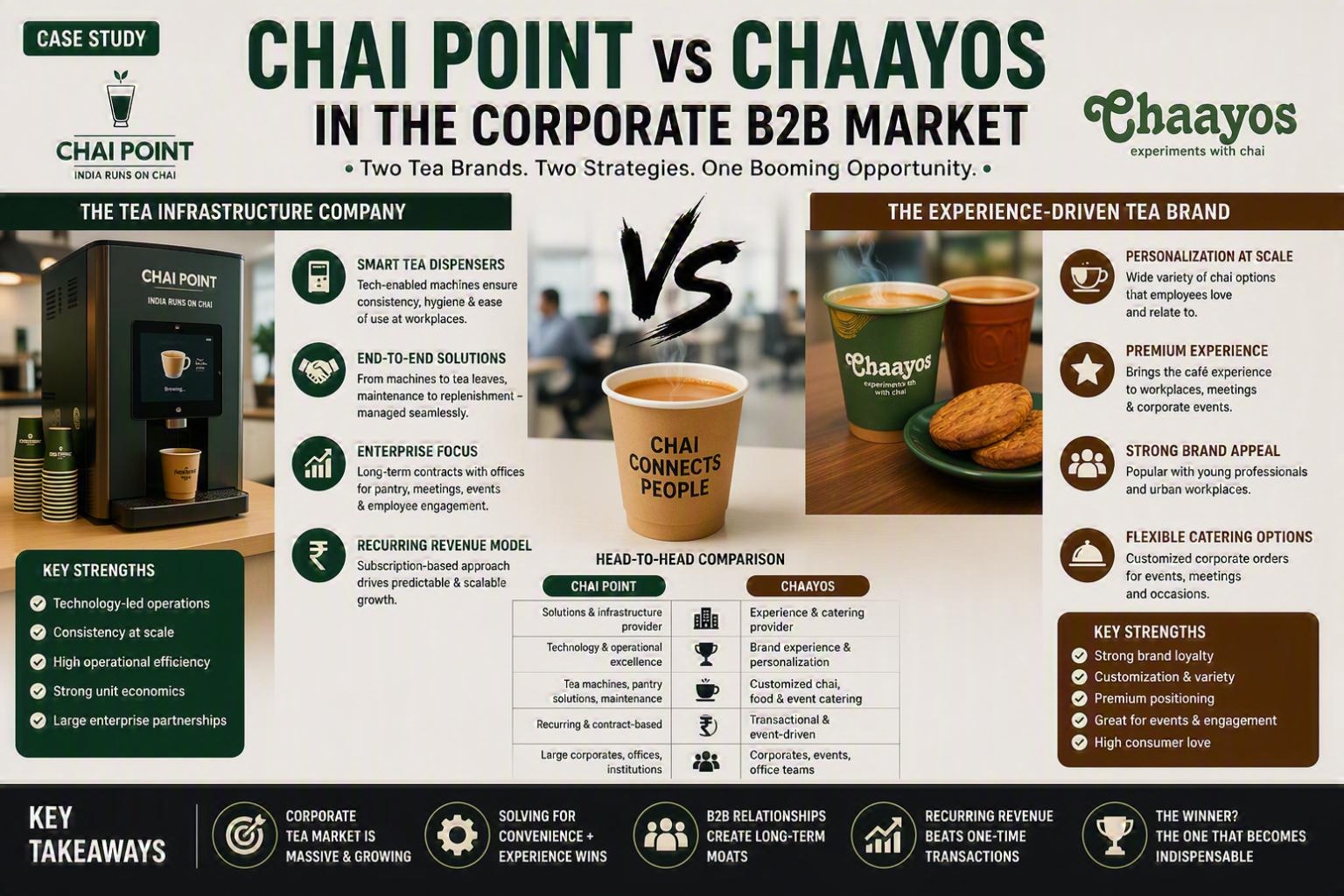
While most consumers see Chai Point and Chaayos as premium tea café brands, their real battleground extends far beyond retail outlets. In the corporate B2B market, Chai Point has focused on building a technology-enabled tea infrastructure business through workplace beverage solutions, while Chaayos has leveraged its customization expertise and strong urban brand appeal. The result is a fascinating competition between operational scale and personalized consumer experience.
Introduction: The Hidden Opportunity Behind India’s Tea Economy
India consumes billions of cups of tea every year, making tea one of the largest beverage categories in the country. While coffee chains have traditionally targeted office environments, both Chai Point and Chaayos recognized an underserved opportunity:

Bringing premium tea experiences directly into workplaces.
With hybrid work, employee engagement programs, and workplace wellness becoming priorities, businesses have increasingly invested in better food and beverage experiences.
This shift created a lucrative corporate B2B market that extends far beyond traditional café revenues.
Chai Point: Building the “Tea Infrastructure” Company
Chai Point has positioned itself not merely as a café chain but as a comprehensive tea solutions provider.
Core B2B Offerings
- Smart tea dispensers
- Office tea and beverage solutions
- Pantry management support
- Corporate catering
- Meeting and event beverage services
The Strategic Vision
Instead of relying solely on footfall-based retail sales, Chai Point focused on recurring enterprise contracts.
This approach offers:
✅ Predictable revenue
✅ Long-term customer relationships
✅ Higher order volumes
✅ Lower customer acquisition costs
By serving offices directly, Chai Point transforms tea consumption into a subscription-style business.
Chaayos: Bringing Personalization into Corporate Spaces
Chaayos built its brand around one powerful promise:
“Meri Wali Chai” (My Kind of Tea)
Its retail success was driven by extensive customization options.
Corporate Market Strategy
When entering workplaces, Chaayos extended this consumer-centric philosophy through:
- Office beverage programs
- Corporate events
- Meeting catering solutions
- Bulk food and beverage orders
Competitive Advantage
Chaayos appeals strongly to workplaces where:
- Employee experience matters
- Premium positioning is valued
- Customization enhances satisfaction
Rather than selling tea alone, Chaayos sells an elevated tea-drinking experience.
The Product Strategy Difference
Chai Point’s Approach
Focused on:
- Operational consistency
- Standardized quality
- Rapid service
- Technology integration
The company often emphasizes reliability and scale.
Chaayos’ Approach
Focused on:
- Taste personalization
- Variety
- Premium café experience
- Food and beverage combinations
This approach resonates particularly well with urban professionals.
Technology as a Differentiator
One of the biggest distinctions between the two brands lies in technology adoption.
Chai Point’s Smart Dispensing Model
The company invested in smart beverage machines capable of:
- Real-time monitoring
- Usage tracking
- Inventory management
- Automated replenishment
For corporate clients, this means:
✅ Reduced operational hassle
✅ Consistent quality
✅ Better consumption visibility
✅ Minimal manual intervention
This positions Chai Point as a technology-enabled beverage partner rather than merely a tea seller.
Chaayos’ Digital Experience
Chaayos has focused more heavily on:
- Consumer ordering experiences
- Loyalty programs
- Delivery integration
- Omnichannel customer engagement
While effective for retail growth, its B2B differentiation remains more closely tied to brand experience than hardware innovation.
Enterprise Sales: Where the Real Battle Happens
Winning corporate accounts is very different from attracting café visitors.
What Corporates Look For
- Consistency
- Scalability
- Hygiene standards
- Cost-effectiveness
- Service reliability
Chai Point Advantage
Chai Point’s machine-based solutions often align well with these requirements because they simplify workplace tea management.
Chaayos Advantage
Chaayos benefits when organizations prioritize:
- Employee perks
- Premium workplace amenities
- Event-focused catering
- Customized beverage experiences
Revenue Model Comparison
Chai Point
Multiple recurring revenue streams:
- Machine subscriptions
- Beverage consumption contracts
- Corporate partnerships
- Bulk catering
This creates predictable cash flow.
Chaayos
Revenue mix includes:
- Café sales
- Delivery orders
- Corporate orders
- Business events
This creates stronger consumer visibility but may rely more on retail demand.
Brand Positioning in Corporate India
Chai Point
Brand perception:
- Reliable
- Efficient
- Scalable
- Technology-focused
Corporate buyers often see Chai Point as a workplace beverage operator.
Chaayos
Brand perception:
- Premium
- Customizable
- Urban
- Lifestyle-oriented
Employees often perceive Chaayos as a premium café brand brought into the workplace.
Key Lessons from the Competition
What Chai Point Teaches Us
✅ Build recurring revenue streams
✅ Invest in operational technology
✅ Create enterprise-focused solutions
✅ Scale through systems rather than locations
What Chaayos Teaches Us
✅ Personalization creates loyalty
✅ Strong consumer brands carry into B2B
✅ Experience can be a differentiator
✅ Premium positioning can drive higher value perception
Who Is Winning?
The answer depends on the metric.
If the goal is enterprise scalability:
Chai Point’s workplace-focused infrastructure strategy provides a strong advantage.
If the goal is consumer affinity and premium brand perception:
Chaayos continues to be a formidable competitor.
In reality, both companies are solving different aspects of the same problem:
- Chai Point optimizes beverage delivery.
- Chaayos optimizes beverage experience.
Conclusion
The Chai Point vs Chaayos story highlights a broader trend in India’s food and beverage industry: the convergence of consumer brands and enterprise services.
While Chaayos built a beloved tea brand centered around personalization, Chai Point transformed itself into a workplace beverage platform. Both approaches have generated loyal customers and meaningful growth.
The ultimate winner may not be the company serving the most tea—but the one that becomes indispensable to the modern Indian workplace.
🚀 Building a food, beverage, or hospitality brand?
Take note of this battle: sustainable growth often comes from identifying underserved revenue streams—not just opening more outlets.
If you found this case study valuable, share it with your team, bookmark it for your next strategy discussion, and explore more brand breakdowns that uncover how India’s fastest-growing companies create competitive advantages.