TL;DR
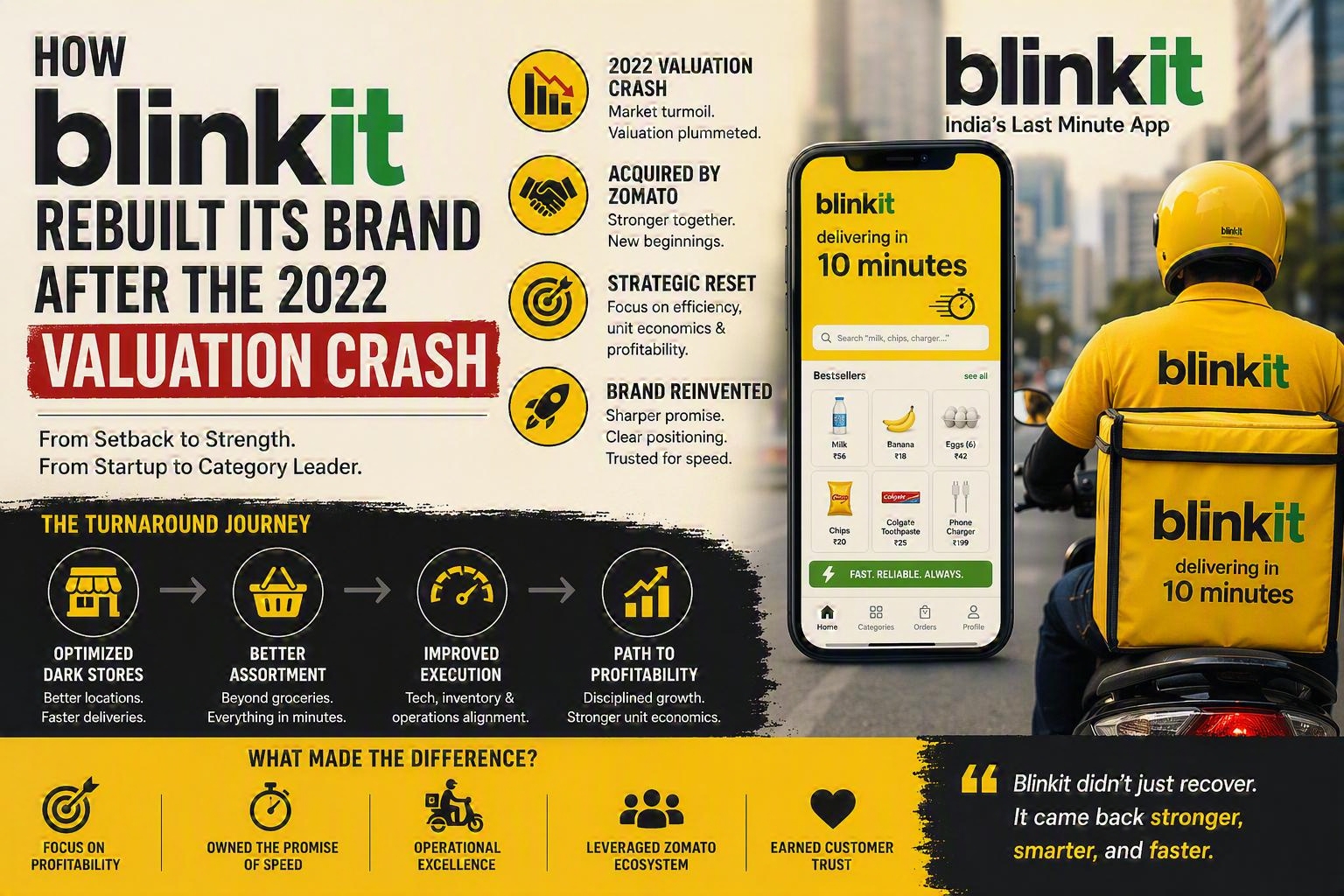
After its 2022 valuation crash and acquisition by Zomato, Blinkit pivoted from a struggling quick-commerce startup to a disciplined, efficiency-driven, and category-defining brand. By focusing on profitability, optimized dark stores, tighter delivery promises, and strong brand recall around speed and reliability, Blinkit turned crisis into a strategic reset.
Introduction: From Crisis to Comeback
In 2022, Blinkit (formerly Grofers) faced a major setback—its valuation dropped significantly amidst the global startup funding slowdown. Soon after, it was acquired by Zomato in a move that sparked mixed reactions.

But instead of fading away, Blinkit used the moment to rebuild its entire business model and brand identity—emerging stronger in India’s fiercely competitive quick-commerce market.
1. The Strategic Reset: From Growth-at-All-Costs to Discipline
Pre-2022, Blinkit was chasing rapid expansion, much like other startups in the quick-commerce space.
Post-crash shift:
- Prioritized unit economics over hypergrowth
- Shut down underperforming dark stores
- Focused on operational efficiency
This pivot wasn’t optional—it was essential for survival.
👉 Blinkit stopped asking, “How fast can we grow?”
👉 And started asking, “How sustainably can we scale?”
2. Rebranding with Clarity: Owning “Quick Commerce”
Blinkit doubled down on a single, powerful positioning:
“Delivering in minutes”
Key Brand Moves:
- Reinforced 10-minute delivery promise
- Simplified communication around speed and convenience
- Built a strong association with instant gratification
Instead of being “just another grocery app,” Blinkit became: 👉 The default quick-delivery platform
3. Dark Store Optimization: The Real Backbone
Blinkit’s biggest operational improvement came from optimizing its dark store network.
What changed:
- Increased store density in key urban zones
- Reduced delivery radius for faster execution
- Improved inventory management for high-demand SKUs
This resulted in:
- Faster deliveries
- Lower logistical costs
- Better customer experience
4. Product Assortment: Beyond Groceries
Before the crash, Blinkit was largely seen as a grocery delivery platform.
Post-rebuild, it expanded into:
- Electronics accessories
- Personal care
- Stationery
- Instant needs (chargers, baby products, etc.)
Why it worked:
Consumers don’t just need groceries fast—they need everything fast.
Blinkit repositioned itself as: 👉 “Your emergency store in your pocket”
5. Leveraging Zomato’s Ecosystem
The acquisition by Zomato turned out to be a strategic advantage.
Synergies unlocked:
- Shared delivery infrastructure
- Data-driven demand forecasting
- Cross-platform customer acquisition
This integration helped Blinkit: ✅ Reduce customer acquisition costs
✅ Improve delivery efficiency
✅ Scale faster with fewer resources
6. Focus on Profitability: A Rare Startup Turnaround
Unlike many startups, Blinkit made visible progress toward profitability.
How:
- Increased average order value (AOV)
- Improved delivery efficiency per order
- Controlled discounting
The brand started signaling something rare in quick-commerce:
👉 Sustainable growth is possible
7. Brand Communication: Speed + Reliability
Blinkit’s marketing became sharper and more focused:
- Clear promise: “In minutes”
- Playful, urban, digital-first messaging
- Strong app experience reinforcing trust
The brand avoided overcomplication and instead leaned into: ✅ Speed
✅ Convenience
✅ Dependability
8. Category Timing: Riding the Quick Commerce Boom
The pandemic and post-pandemic habits accelerated demand for quick commerce.
Blinkit capitalized on:
- Increased reliance on home delivery
- Consumer willingness to pay for speed
- Urban lifestyle shifts toward convenience
Timing played a crucial role—but execution made the difference.
Key Lessons from Blinkit’s Comeback
✅ Crisis can force clarity — Constraints sharpen strategy
✅ Focus wins — One strong promise beats many weak ones
✅ Operations drive brand — Experience defines perception
✅ Efficiency is a competitive advantage — Not just growth
✅ Adapt quickly or fail fast — Markets don’t wait
Conclusion: Reinvention in Real-Time
Blinkit’s story is not just about survival—it’s about strategic reinvention. By aligning its operations, branding, and economics, the company turned a valuation crash into a turning point.
Today, Blinkit stands as proof that: 👉 Strong fundamentals > inflated valuations
🚀 If you’re building or scaling a startup,
Blinkit’s journey is a masterclass in navigating tough market cycles.
Pause, reassess, and refocus—because sometimes, stepping back is the fastest way forward.
Found this insightful? Share it with your team, bookmark it for your next strategy session, and explore more deep dives on brands that turned disruption into dominance.