
TL;DR
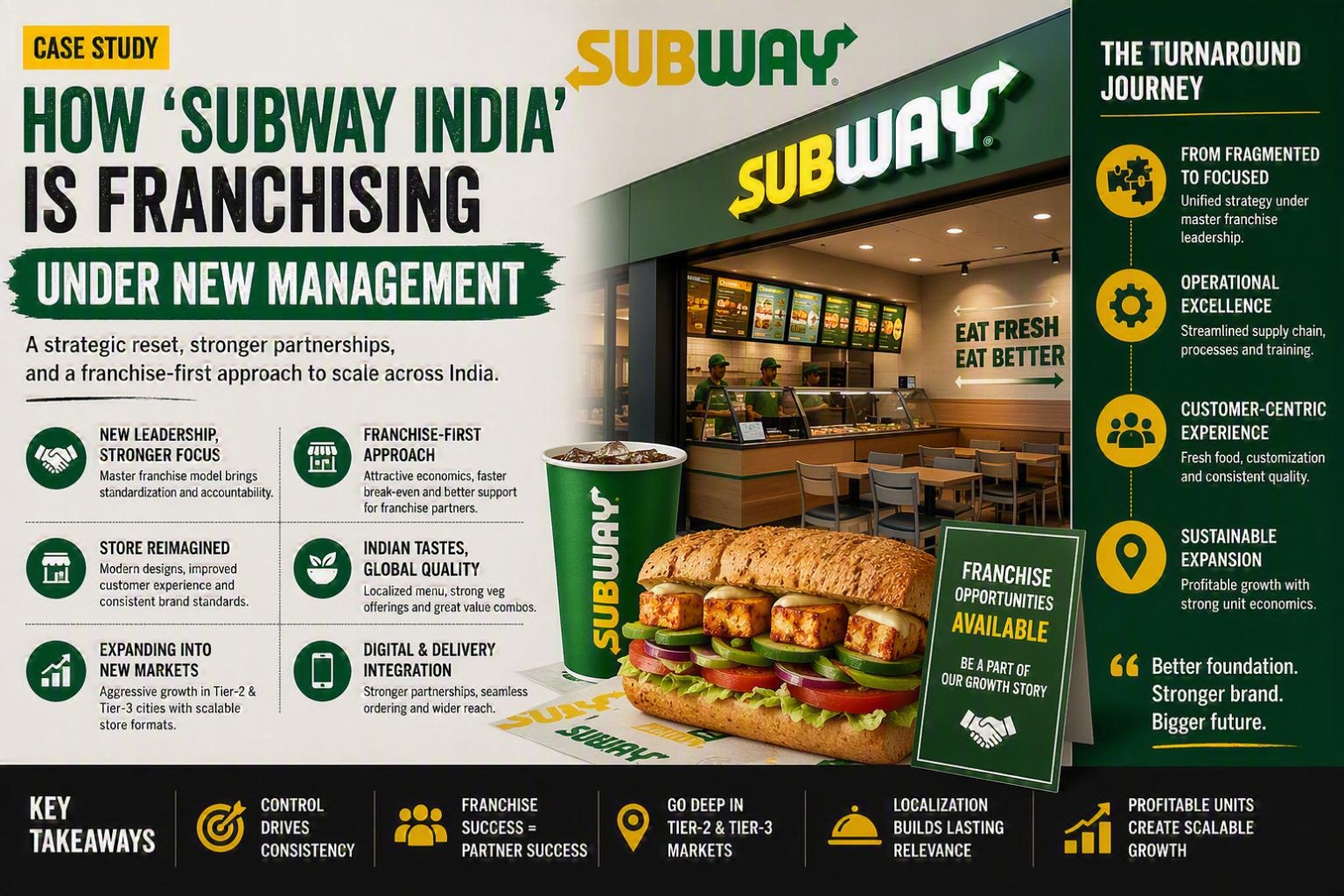
After operational challenges and declining relevance, Subway India is undergoing a structured revival under new franchise leadership by focusing on standardization, store redesign, better franchise economics, and aggressive expansion into Tier‑2 cities. The shift is turning Subway into a more scalable and franchise-friendly quick-service restaurant (QSR) model.
Introduction: From Struggle to Structured Comeback
Subway, once a dominant global QSR brand, lost momentum in India due to inconsistent store experiences, weak localization, and franchise misalignment.

However, a leadership transition—moving control to a master franchise model—has sparked a strategic reset. Today, Subway India is rebuilding its brand with a sharper focus on franchise scalability, operational discipline, and customer experience.
1. The Big Shift: Master Franchise Control
The most important change came when Subway moved to a master franchise partner-led model.
What this changed:
- Centralized decision-making for India
- Standardized operations across outlets
- Better accountability for franchise performance
This structure replaced the earlier fragmented model where individual franchise owners operated with inconsistent quality and processes.
👉 Result: A more cohesive and controllable business ecosystem.
2. Franchise-Friendly Economics
Subway’s new strategy aims to make franchising more attractive and sustainable.
Key improvements:
- Streamlined supply chain for cost efficiency
- Optimized store sizes and formats
- Better margins through operational standardization
Why this matters:
Franchise growth depends on profit visibility.
Subway is now ensuring: ✅ Faster break-even timelines
✅ Lower operational complexities
✅ Predictable returns for partners
3. Store Redesign: Modern, Clean, Scalable
Subway India has begun rolling out revamped store formats.
Design upgrades:
- Contemporary interiors
- Clear menu communication
- Improved customer flow
Strategic benefit:
- Enhances brand perception
- Improves in-store experience
- Makes replication easier across locations
The new stores reflect a more premium yet accessible QSR identity.
4. Localization of Menu & Taste
One of Subway’s earlier gaps was limited adaptation to Indian tastes.
New focus:
- Stronger vegetarian offerings
- Indian-inspired flavors
- Affordable meal combos
Impact:
- Wider consumer appeal
- Higher repeat purchases
- Better alignment with local preferences
👉 Subway is no longer just “global fast food”—it’s becoming India-relevant fast food.
5. Expansion into Tier-2 & Tier-3 Markets
Following a proven QSR trend, Subway is expanding beyond metros.
Why this works:
- Growing middle-class demand
- Less competition from global chains
- Lower rental and operational costs
Strategy:
- Focus on high-footfall locations
- Smaller, efficient store formats
- Franchise-led expansion
This mirrors success seen in brands like Domino’s and Zudio: 👉 India’s next growth wave is outside metros
6. Digital & Delivery Integration
Subway is strengthening its presence in the fast-growing food delivery ecosystem.
Key moves:
- Partnerships with Swiggy and Zomato
- Focus on delivery-friendly menus
- Faster order fulfillment processes
Outcome:
- Increased order volumes
- Expanded reach without physical expansion
- Improved convenience perception
7. Brand Repositioning: Fresh, Consistent, Reliable
Earlier, Subway struggled with inconsistent quality across outlets.
New positioning:
- Consistency across locations
- Focus on freshness and customization
- Reliable QSR experience
This shift is critical because: 👉 In food, trust drives repeat business
8. Learning from Past Mistakes
Subway’s earlier issues in India were a result of:
- Weak franchise oversight
- Lack of brand consistency
- Limited innovation
The current strategy directly addresses these gaps through: ✅ Centralized control
✅ Operational discipline
✅ Market-specific adaptation
Key Lessons from Subway India’s Strategy
✅ Franchise models need strong central control
✅ Consistency is non-negotiable in QSR
✅ Localization drives adoption
✅ Tier-2 markets are the growth engine
✅ Unit economics matter more than rapid expansion
Conclusion: A Work-in-Progress Turnaround
Subway India’s revival is still unfolding, but the direction is clear. By fixing its franchise model, modernizing stores, and embracing local tastes, the brand is positioning itself for a more sustainable and scalable future.
In the QSR world, success isn’t just about great food—it’s about repeatable systems, reliable experience, and smart expansion.
🚀 If you’re building a franchise-driven business,
Subway’s journey offers a critical lesson:
Scale doesn’t come from expansion alone—it comes from control and consistency.
Found this case study useful? Share it with your team, save it for your strategy playbook, and explore more insights on brands transforming challenges into growth opportunities.