
TL;DR:
Commercial drone inspection services are rapidly becoming a high-growth B2B business opportunity. Companies across construction, energy, telecom, real estate, mining, and infrastructure sectors are replacing costly manual inspections with drones that deliver faster, safer, and more accurate data. For entrepreneurs, drone inspections offer a scalable, technology-driven service business with strong recurring revenue potential and relatively low operational overhead.
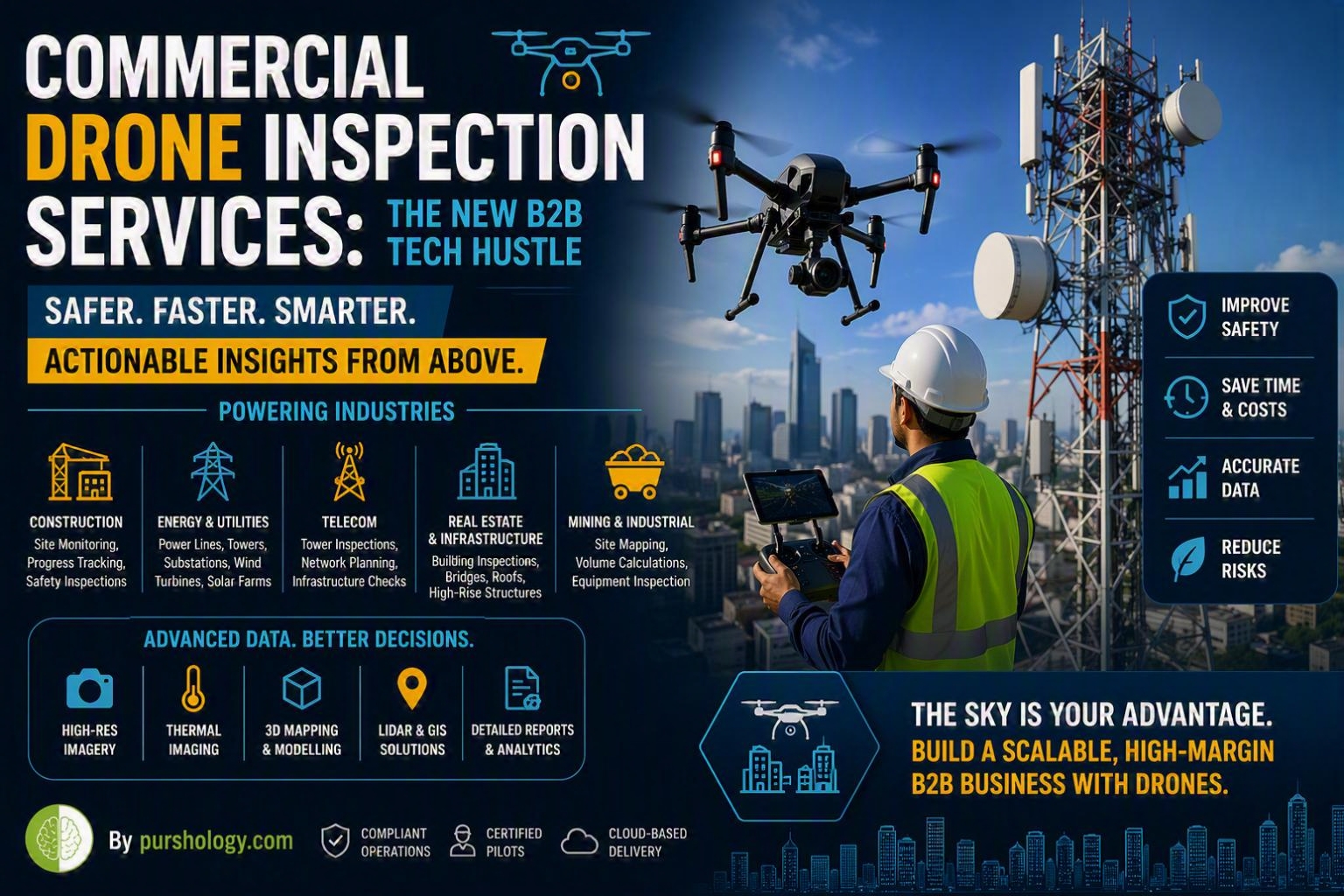
Commercial Drone Inspection Services: The New B2B Tech Hustle
The rise of drones has created far more opportunities than aerial photography and videography. Today, one of the fastest-growing segments in the drone industry is commercial inspection services.

From inspecting cell towers and solar farms to surveying construction sites and power lines, businesses are increasingly relying on drone technology to gather critical operational data. What once required expensive equipment, dangerous climbs, or helicopter flyovers can now be completed safely and efficiently by a drone operator.
For entrepreneurs seeking a future-ready business with growing demand, commercial drone inspections are emerging as a powerful B2B tech hustle.
Why Drone Inspection Services Are Taking Off
Several industries are undergoing digital transformation, and inspection workflows are no exception.
1. Safety Is a Major Priority
Traditional inspections often require workers to:
- Climb towers
- Access rooftops
- Inspect bridges
- Scale industrial structures
- Enter hazardous environments
Drones significantly reduce human exposure to risk while delivering detailed visual data.
2. Businesses Want Faster Results
Time is money.
Drones can inspect large facilities, infrastructure assets, and remote locations in a fraction of the time required by conventional methods.
This efficiency helps companies reduce downtime and accelerate decision-making.
3. Data Quality Has Improved Dramatically
Modern commercial drones can capture:
- Ultra-high-resolution images
- Thermal imagery
- 3D models
- LiDAR scans
- Mapping data
- Real-time video feeds
As a result, businesses gain more actionable insights than many traditional inspection methods provide.
4. Costs Are Falling
Commercial-grade drone technology has become increasingly accessible, allowing entrepreneurs to enter the market without the capital requirements associated with heavy industrial equipment.
Industries Driving Demand
The versatility of drones is creating opportunities across multiple sectors.
Construction
Construction companies use drones for:
- Site inspections
- Progress monitoring
- Safety audits
- Earthwork measurements
- Asset documentation
Regular aerial data helps project managers improve planning and execution.
Energy and Utilities
Utility operators use drones to inspect:
- Power lines
- Transmission towers
- Substations
- Wind turbines
- Solar farms
Drone inspections help identify issues before they become costly failures.
Telecommunications
Cell tower inspections are one of the fastest-growing drone service categories.
Operators can assess tower conditions without sending technicians to dangerous heights.
Real Estate and Infrastructure
Asset owners increasingly require inspection services for:
- Bridges
- High-rise buildings
- Commercial properties
- Industrial facilities
- Transportation infrastructure
Routine inspections improve maintenance planning and risk management.
Mining and Industrial Operations
Mining companies utilize drones for:
- Site mapping
- Volume calculations
- Equipment monitoring
- Environmental assessments
These services create recurring business opportunities.
Why This Is an Attractive B2B Business
Unlike consumer-focused drone services, commercial inspections typically involve business clients with ongoing needs.
Recurring Revenue
Assets require regular inspections.
Businesses often schedule:
- Monthly inspections
- Quarterly inspections
- Annual compliance assessments
This creates predictable revenue streams.
Higher Contract Values
Inspection projects generally command higher pricing than standard photography assignments because they deliver operational value rather than purely visual content.
Strong Client Retention
Once a company integrates drone inspections into its workflow, it often continues using the same provider due to familiarity with reporting standards and historical data.
Services You Can Offer
Successful drone inspection businesses rarely rely on a single service.
Revenue streams may include:
Visual Inspections
High-resolution imagery for maintenance and condition assessments.
Thermal Imaging
Identifying:
- Electrical faults
- Heat leaks
- Solar panel defects
- Equipment malfunctions
3D Mapping
Developing digital models for planning and engineering purposes.
Asset Monitoring
Regular data collection for large facilities and infrastructure projects.
Compliance Documentation
Providing inspection records for insurance, safety, and regulatory requirements.
Technology Is Creating a Competitive Advantage
Modern drone operators increasingly leverage advanced technologies such as:
- AI-assisted image analysis
- Cloud-based reporting
- Automated flight planning
- Thermal sensors
- LiDAR mapping
- Predictive maintenance analytics
These capabilities enable providers to move beyond simple drone flights and offer valuable business intelligence.
What Makes the Business Scalable?
One reason entrepreneurs are attracted to drone inspections is scalability.
Unlike traditional service businesses that require large teams, drone operations can expand through:
Specialized Equipment
Adding new sensors expands service capabilities and pricing opportunities.
Additional Operators
Certified pilots can help serve multiple regions simultaneously.
Subscription Contracts
Long-term service agreements create stable recurring revenue.
Data Services
Many clients value reports and insights more than the drone flight itself.
Offering data analysis can significantly increase profitability.
Challenges to Consider
While the opportunity is compelling, success requires preparation.
Regulatory Compliance
Drone operators must comply with applicable aviation and airspace regulations.
Technical Expertise
Clients expect professional-grade inspections and accurate reporting.
Equipment Maintenance
Reliable equipment is critical for delivering dependable service.
Market Education
Some businesses still rely on traditional inspection methods and need education regarding the cost and safety benefits of drone-based solutions.
The Future of Commercial Drone Inspections
The global shift toward automation, predictive maintenance, and digital asset management is accelerating demand for drone-powered inspections.
As organizations seek safer, faster, and more cost-effective ways to manage infrastructure, drones are becoming an essential business tool rather than a novelty.
From telecom towers and solar farms to industrial plants and commercial real estate, the number of assets requiring inspection continues to grow. This creates a substantial opportunity for entrepreneurs who can combine technical expertise with strong B2B relationships.
Ready to Launch Your Drone Inspection Business?
Commercial drone inspections represent a rare combination of technology, recurring revenue, and business demand. As industries continue embracing automation and data-driven operations, drone service providers are positioned to become valuable partners across multiple sectors.
If you’re looking for a scalable B2B business opportunity, now is the perfect time to invest in commercial drone technology, develop industry expertise, and establish relationships with construction firms, utilities, telecom operators, and infrastructure companies. The future of inspections is airborne—and the opportunity is only getting bigger.