TL;DR
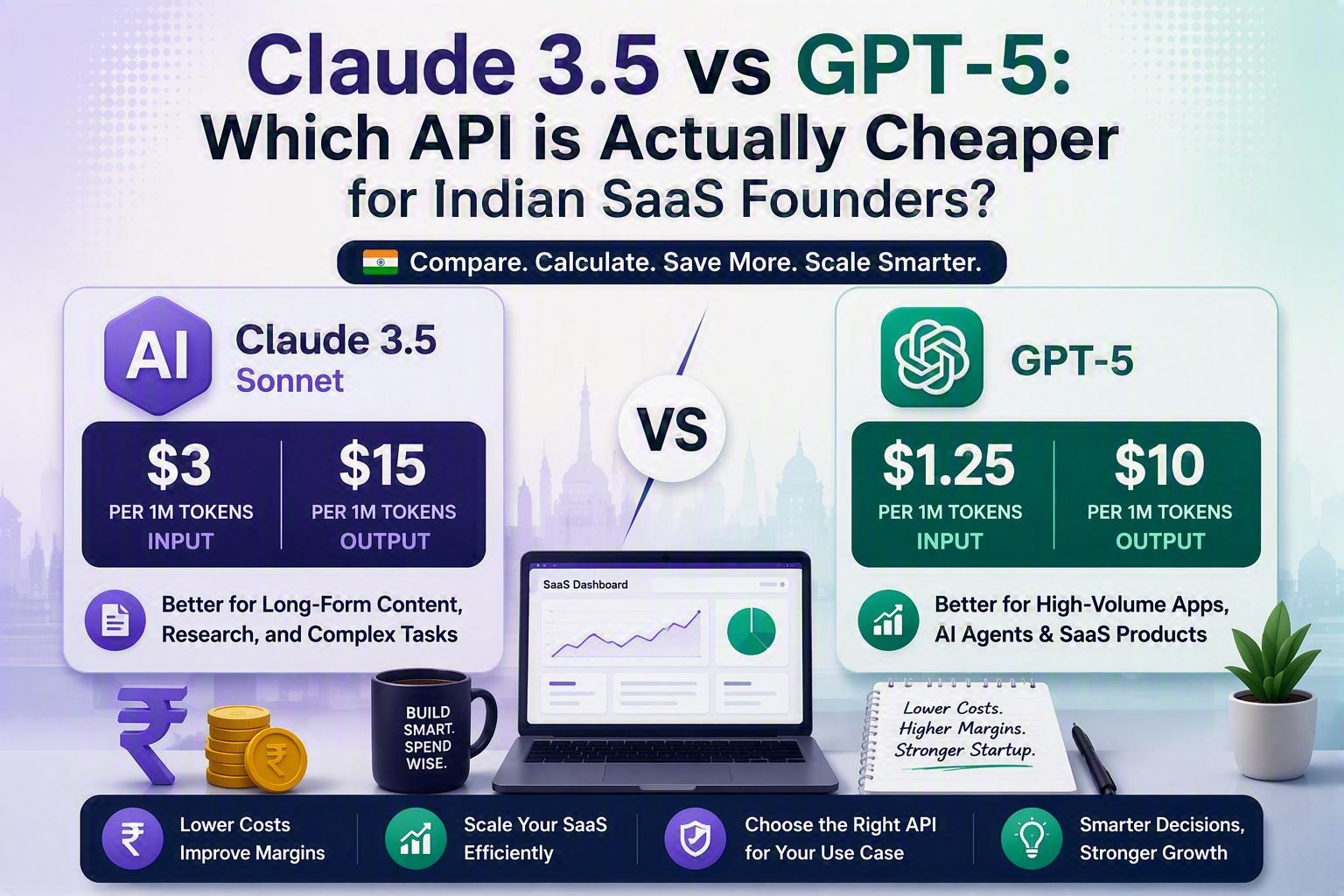
For most Indian SaaS founders, GPT-5 is cheaper than Claude 3.5 Sonnet for high-volume applications, especially when handling large input workloads. Claude 3.5 Sonnet costs roughly $3 per million input tokens and $15 per million output tokens, while GPT-5 pricing starts around $1.25 per million input tokens and $10 per million output tokens. The real winner, however, depends on your product’s usage patterns, token consumption, and response length.
Indian SaaS founders are no longer asking whether they should use AI. The question in 2026 is far more practical:

Which model gives the best output without destroying unit economics?
With venture funding becoming harder to secure and customer acquisition costs continuing to rise, AI infrastructure costs can quickly become one of the largest operational expenses for an AI-powered startup.
Two popular contenders frequently appear on every founder’s shortlist:
- Claude 3.5 Sonnet
- GPT-5
While benchmarks and model quality often dominate discussions, pricing usually determines profitability at scale.
Let’s break down the actual numbers.
Current API Pricing Comparison
Claude 3.5 Sonnet
Anthropic’s Claude 3.5 Sonnet is priced at:
- $3 per million input tokens
- $15 per million output tokens
GPT-5
OpenAI’s GPT-5 API pricing is:
- $1.25 per million input tokens
- $10 per million output tokens
At first glance, GPT-5 is:
- Around 58% cheaper on input tokens
- Around 33% cheaper on output tokens
For startups serving thousands of customers daily, these differences compound rapidly.
Real Cost Example for an Indian SaaS Startup
Imagine your product generates:
- 50 million input tokens monthly
- 10 million output tokens monthly
Claude 3.5 Monthly Cost
Input:
- 50M × $3 = $150
Output:
- 10M × $15 = $150
Total = $300/month
GPT-5 Monthly Cost
Input:
- 50M × $1.25 = $62.50
Output:
- 10M × $10 = $100
Total = $162.50/month
Savings
GPT-5 reduces monthly API spend by roughly:
$137.50 per month (45.8% lower).
For a bootstrapped founder, that’s budget that can be redirected toward product development, marketing, or customer success.
Where Claude 3.5 Still Makes Sense
Being cheaper doesn’t automatically make GPT-5 the best choice.
Many founders continue to choose Claude because of:
Exceptional Long-Form Writing
Claude has built a strong reputation for:
- Blog creation
- Technical documentation
- Research summaries
- Business reports
Natural Brand Voice
Many users find Claude outputs require less editing when creating customer-facing content.
Longer Context Handling
Claude 3.5 Sonnet supports large-context workflows that are valuable for:
- Legal tech
- Knowledge management
- Document intelligence
- Enterprise search applications
If your SaaS product’s primary value comes from content quality rather than sheer request volume, paying a higher token cost may be justified.
Where GPT-5 Delivers Better Value
GPT-5 tends to offer superior economics in products that process large numbers of requests.
Examples include:
- Customer support bots
- AI agents
- Sales assistants
- SaaS copilots
- Internal productivity tools
- Coding assistants
Since token consumption is high in these categories, GPT-5’s lower pricing can significantly improve gross margins.
What Indian Founders Often Forget: Currency Matters
Most AI APIs are billed in USD.
For Indian SaaS businesses, even small pricing differences become meaningful after currency conversion.
For example:
- $1,000/month ≈ ₹83,000+ (depending on exchange rates)
- $5,000/month ≈ ₹4.1 lakh+
- $10,000/month ≈ ₹8.3 lakh+ annually becomes over ₹1 crore in recurring AI spend
Reducing token costs by even 20-30% can dramatically improve profitability as customer volume grows.
The Hidden Costs Beyond Token Pricing
Smart founders evaluate more than headline API prices.
Consider:
Latency
Faster responses improve user experience and retention.
Reliability
Downtime can affect paying customers.
Rate Limits
Growth-stage products need room to scale.
Prompt Efficiency
A slightly more expensive model that requires fewer prompts may actually be cheaper overall.
Engineering Time
If a team spends weeks optimizing prompts for one model, those costs should be included in the calculation.
Which API Should Indian SaaS Founders Choose?
Choose GPT-5 If:
✅ You care about cost efficiency
✅ You process high request volumes
✅ You’re building AI-powered SaaS products
✅ Unit economics are a priority
✅ You want lower token costs at scale
Choose Claude 3.5 Sonnet If:
✅ Content quality is your core differentiator
✅ You generate long-form outputs frequently
✅ Your users work with large documents
✅ You value Claude’s writing style
✅ AI spend is a relatively small percentage of revenue
Final Verdict
For most Indian SaaS founders focused on growth, margins, and scalability, GPT-5 currently offers better cost efficiency than Claude 3.5 Sonnet. Its significantly lower token pricing can reduce AI infrastructure expenses while maintaining strong performance across common SaaS use cases.
However, if your product depends heavily on premium content generation, document analysis, or nuanced writing, Claude 3.5 Sonnet may still provide enough quality advantages to justify the higher cost.
The smartest approach isn’t picking sides. It’s calculating how each model affects your cost per customer, gross margin, and long-term scalability.
Ready to Optimize Your AI Costs?
Before committing to any LLM provider, run a 30-day usage simulation using your actual prompts and workloads. A small pricing difference today can translate into lakhs of rupees in annual savings as your SaaS business scales. Evaluate both GPT-5 and Claude against real-world usage, then choose the model that maximizes both performance and profitability.