TL;DR:
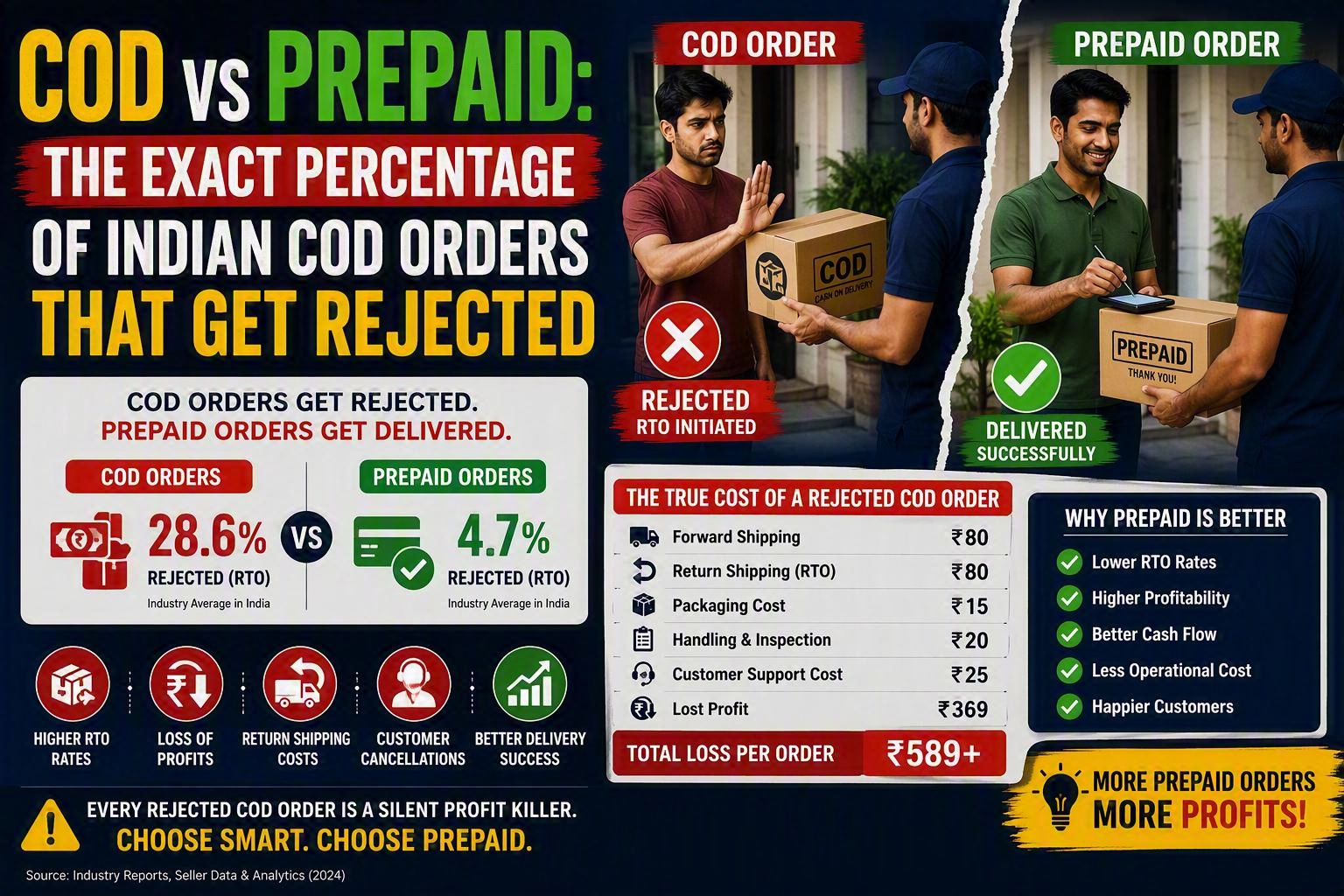
Cash on Delivery (COD) remains one of India’s most popular ecommerce payment methods, but it comes with a costly drawback: order rejection. Depending on the category, geography, and customer profile, COD orders can experience significantly higher rejection, cancellation, and Return-to-Origin (RTO) rates than prepaid orders. For many ecommerce brands, the hidden costs associated with COD can wipe out profits, making customer acquisition far more expensive than expected.
India’s Love Affair with Cash on Delivery
Despite the rapid growth of UPI, digital wallets, and online banking, Cash on Delivery continues to play a major role in Indian ecommerce.

For many customers, COD offers:
- Greater trust in online sellers
- Reduced payment risk
- Convenience
- Flexibility to inspect goods upon delivery
As a result, numerous ecommerce brands still offer COD to maximize conversions.
However, there’s a problem most sellers don’t discover until they start scaling:
Not every COD order becomes a successful delivery.
The Cost of COD Is Much Higher Than Most Sellers Think
Many ecommerce businesses evaluate COD using a simple assumption:
More payment options = More orders.
While this is true, the calculation often ignores what happens after an order is placed.
Common COD outcomes include:
- Customer rejects delivery
- Customer becomes unreachable
- Customer changes their mind
- Customer orders from multiple stores and accepts only one
- Customer refuses to pay
Every rejected COD order triggers additional operational costs.
What Happens When a COD Order Gets Rejected?
The journey doesn’t end when a package reaches the customer’s doorstep.
When a COD order is refused, sellers often incur costs for:
Forward Shipping
The order is shipped from the warehouse to the customer.
Delivery Attempts
Courier partners may make multiple delivery attempts.
Return-to-Origin (RTO)
The package is sent back to the seller.
Product Inspection
Returned inventory must be checked and restocked.
Customer Support
Support teams spend time handling inquiries and disputes.
The result is a sale that generated expenses but no revenue.
Why COD Rejections Hurt More Than Refunds
On the surface, an order rejection might seem similar to a refund.
In reality, it can be worse.
A refunded prepaid order at least captures payment initially.
With COD:
- No payment is collected
- Marketing costs are already spent
- Shipping expenses have occurred
- Reverse logistics expenses are added
The business loses money before the transaction is completed.
The Hidden Profit Calculation
Consider a typical ecommerce order.
Order Economics
- Selling Price: ₹999
- Product Cost: ₹300
- Advertising Cost: ₹250
- Forward Shipping: ₹80
Expected Profit:
₹369
Now imagine the order is rejected.
Additional expenses may include:
- Return shipping: ₹80
- Packaging cost: ₹15
- Operational handling: ₹20
Total loss:
₹745
A single rejected COD order can eliminate the profits from multiple successful orders.
Why Certain Products Experience Higher COD Rejection Rates
Some categories naturally attract more COD-related issues than others.
These include:
Fashion Products
- Impulse purchases
- Multiple size orders
- High return behavior
Beauty Products
- Trial-oriented buyers
- Price-sensitive customers
Low-Cost Gadgets
- Comparison shoppers
- Impulse decisions
Home & Kitchen Products
- Non-essential purchases
- High cancellation frequency
Premium products with strong purchase intent generally face lower rejection rates.
The Psychology Behind COD Rejections
Prepaid customers have already committed financially.
COD customers have not.
This creates an important behavioral difference.
Between order placement and delivery:
- Preferences change
- Competing offers appear
- Budget priorities shift
- Purchase urgency disappears
Without upfront payment, rejecting the order becomes easy.
This is one reason why prepaid orders often exhibit significantly better delivery success rates.
Why Ecommerce Brands Are Pushing Prepaid Orders
Many fast-growing D2C brands now actively encourage prepaid payments.
Common tactics include:
- Instant payment discounts
- Free shipping on prepaid orders
- Loyalty rewards
- Faster processing
- Special prepaid-only offers
The objective isn’t simply collecting payment sooner.
It’s reducing operational risk and improving profitability.
How Smart Sellers Reduce COD Losses
Use COD Verification
Confirm orders through:
- OTP validation
- WhatsApp confirmation
- Verification calls
Analyze High-Risk Pin Codes
Track regions with historically high rejection rates.
Incentivize Prepaid Orders
Offer discounts that make prepaid payments attractive.
Monitor Customer History
Flag repeat offenders and high-RTO customers.
Improve Customer Communication
Order updates and delivery notifications often reduce rejection rates.
Is COD Still Worth Offering?
The answer depends on your business model.
COD can:
✅ Increase conversion rates
✅ Improve customer trust
✅ Expand market reach
But it can also:
❌ Increase RTO rates
❌ Reduce profit margins
❌ Raise logistics costs
❌ Create cash-flow challenges
For many brands, the ideal strategy isn’t eliminating COD entirely. It’s carefully managing it while gradually increasing prepaid adoption.
Final Thoughts
COD remains a powerful growth tool in Indian ecommerce, but it comes at a price. Rejected deliveries, RTO costs, customer cancellations, and reverse logistics expenses can quietly erode profitability. While COD may help drive conversions, businesses that ignore its hidden costs often discover that revenue growth doesn’t always translate into profit growth.
The most successful ecommerce brands balance convenience with risk management, using data, verification processes, and prepaid incentives to keep rejection rates under control.
Ready to Reduce Your COD Losses?
Audit your RTO data, identify high-risk customer segments, and calculate the true cost of rejected COD orders. You may discover that improving prepaid adoption by just a few percentage points can dramatically increase profitability and strengthen your ecommerce business for long-term growth.