TL;DR
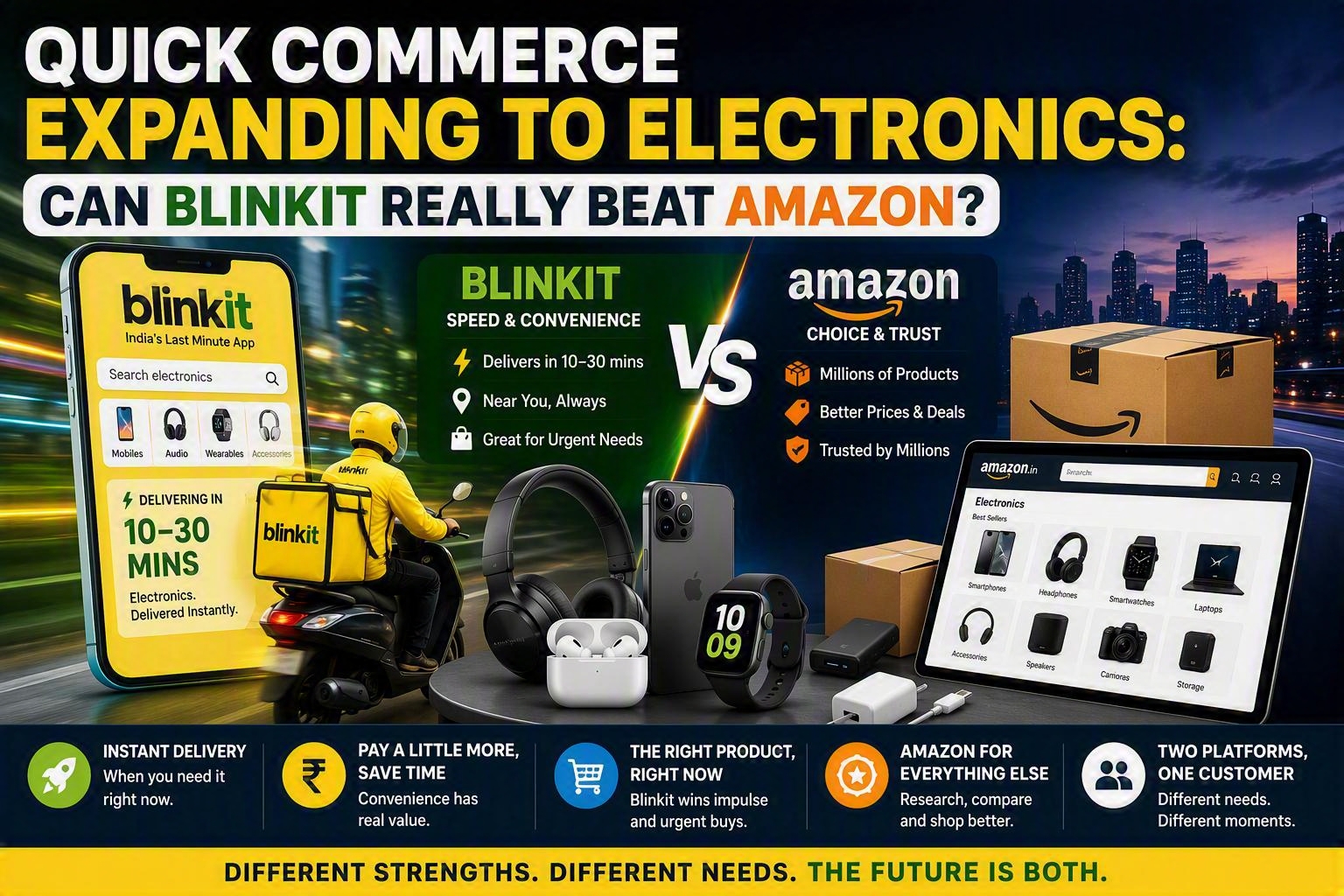
Blinkit is no longer just a grocery delivery app. From smartphones and headphones to gaming accessories and computer peripherals, quick commerce platforms are aggressively expanding into electronics. While Blinkit enjoys a major advantage in speed and convenience, Amazon still dominates selection, pricing, supply chain depth, and customer trust. The likely outcome is not Blinkit replacing Amazon, but rather both companies serving different shopping needs in India’s fast-evolving retail market.
Just a few years ago, ordering electronics online meant waiting one or two days for delivery.

Today, customers in major Indian cities can order earbuds, phone chargers, smartwatches, keyboards, and even premium smartphones, with delivery arriving in minutes rather than days.
This shift marks the next phase of India’s quick commerce revolution.
After conquering groceries, daily essentials, and personal care products, platforms like Blinkit are rapidly expanding into consumer electronics. The question is no longer whether electronics belong on quick commerce.
The real question is:
Can Blinkit challenge Amazon’s dominance in electronics retail?
Why Blinkit Is Entering Electronics
The answer is simple: margins and basket sizes.
Groceries generate frequent orders but often have thin margins. Electronics offer:
- Higher average order values
- Better margins on accessories
- Strong impulse-buy potential
- Opportunity for premium customers
- Increased customer retention
For quick commerce companies chasing profitability, electronics represent a natural next step.
A customer who urgently needs a charging cable, gaming mouse, power bank, or Bluetooth speaker is willing to pay for convenience, making electronics a highly attractive category.
The Rise of Instant Gadget Delivery
Quick commerce has fundamentally changed consumer expectations.
Customers increasingly expect:
- Deliveries within minutes
- Real-time inventory visibility
- Frictionless checkout
- Immediate problem-solving purchases
Imagine these scenarios:
- A laptop charger stops working before an important meeting.
- Wireless earbuds break before a flight.
- A gaming controller fails during the weekend.
- A phone cable is needed late at night.
Waiting two days suddenly feels unnecessary.
This urgency creates a powerful use case for Blinkit and other quick commerce players.
Blinkit’s Biggest Strength: Speed
Amazon revolutionized delivery by making one-day shipping normal.
Blinkit is trying to make 10 to 30 minute delivery normal.
That’s a significant advantage.
For urgent purchases, customers often prioritize:
- Availability
- Delivery speed
- Convenience
Price sometimes becomes secondary.
A customer may happily spend a little extra if it means receiving a charger within minutes instead of tomorrow.
This is where Blinkit’s model shines.
Why Amazon Remains a Giant
Despite the excitement around quick commerce, Amazon retains enormous advantages.
Massive Product Selection
Amazon offers millions of products across thousands of brands.
Blinkit’s inventory is constrained by dark-store space.
Amazon can list:
- Niche accessories
- High-end electronics
- Enterprise equipment
- Specialized gadgets
- Multiple product variations
Quick commerce simply cannot match this breadth today.
Better Price Discovery
Amazon’s marketplace model creates intense competition among sellers.
This often results in:
- Lower prices
- Flash sales
- Brand discounts
- Bundle offers
Customers researching larger purchases still tend to compare options extensively before buying.
That behavior favors Amazon.
Customer Trust
When purchasing expensive electronics, trust becomes critical.
Consumers often prefer platforms that provide:
- Detailed reviews
- Product comparisons
- Warranty information
- Replacement options
- Long purchase histories
Amazon has spent years building that trust.
Where Blinkit Can Win
Blinkit doesn’t need to beat Amazon everywhere.
It only needs to dominate specific purchase occasions.
Emergency Purchases
Need a charger immediately?
Blinkit wins.
Accessories
Items such as:
- USB cables
- Power banks
- Earbuds
- Phone cases
- Keyboards
- Mouse devices
fit perfectly into quick commerce.
Impulse Buying
Quick purchasing dramatically increases impulse spending.
The less time people spend comparing products, the more likely they are to complete a purchase.
This benefits Blinkit’s model.
The Real Battle: Convenience vs Choice
The competition isn’t actually about technology.
It’s about consumer behavior.
Amazon Sells Choice
Customers browse, compare, review, and research.
Blinkit Sells Convenience
Customers need something immediately and want it delivered fast.
These are different shopping missions.
A customer buying a ₹1 lakh laptop behaves differently from someone buying a ₹999 charging adapter.
Can Blinkit Scale Electronics Nationwide?
Scaling electronics is harder than scaling groceries.
Challenges include:
- Inventory management
- Product obsolescence
- Returns handling
- Higher-value theft risk
- Brand partnerships
- Warranty support
Unlike milk or vegetables, electronics require more sophisticated inventory planning.
Blinkit will need strong supplier relationships and high inventory accuracy to scale successfully.
The Amazon Counterattack
Amazon is not standing still.
The company is significantly expanding its quick commerce operations through Amazon Now and increasing its presence across India. Competing platforms are investing aggressively in dark stores, rapid fulfillment infrastructure, and faster delivery networks.
This means Blinkit is racing against one of the world’s strongest logistics companies.
Amazon already has:
- Massive warehousing infrastructure
- Deep supplier relationships
- Prime membership ecosystem
- Strong electronics expertise
If ultra-fast electronics delivery becomes a major market opportunity, Amazon has the resources to compete aggressively.
What This Means for Brands
Electronics brands should view quick commerce as a new sales channel rather than a replacement for traditional e-commerce.
The emerging strategy is likely:
- Amazon for research-driven purchases
- Quick commerce for immediate purchases
- Offline retail for product experiences
Brands that optimize for all three channels will have the greatest advantage.
Final Verdict
Blinkit is unlikely to “beat” Amazon in electronics overall.
Amazon remains the leader for product selection, pricing, reviews, and large-ticket purchases.
However, Blinkit doesn’t need to replace Amazon to win.
By owning urgent purchases, electronics accessories, and convenience-driven buying decisions, Blinkit can create a massive electronics business of its own.
The future of electronics retail in India may not be Amazon versus Blinkit.
It may be Amazon for planned purchases and Blinkit for instant needs.
And in a country increasingly conditioned to expect everything within minutes, that’s a much bigger opportunity than it first appears.
Ready for the Next Retail Revolution?
As quick commerce moves beyond groceries and enters categories like electronics, fashion, and home essentials, businesses must rethink how consumers shop. The winners won’t just deliver products. They’ll deliver the right product at the exact moment a customer needs it.