

Choosing a hosting provider for a business project is not only about comparing CPU, RAM, storage, and pricing. It is also important to consider available server types, infrastructure locations, administration options, backups, and future scalability. AdminVPS is a hosting provider offering VPS/VDS, shared hosting, dedicated servers, and additional infrastructure services for websites, applications, and other online projects.
Let’s look at the solutions AdminVPS provides and the types of projects they can support.

VPS/VDS as a Core Hosting Option
VPS hosting is suitable for projects that have outgrown the limitations of standard shared hosting but do not yet require an entire physical server.
A virtual private server provides dedicated computing resources and greater control over the software environment. Businesses can use VPS infrastructure for websites, online stores, corporate systems, databases, control panels, and web applications.
AdminVPS offers virtual servers in multiple locations, allowing businesses to choose infrastructure according to the geography of their audience.
For websites and services primarily targeting users in Russia, servers located within the country can also be considered. This allows businesses to take infrastructure location, network latency, and data placement requirements into account when planning their hosting environment.

Image 2: AdminVPS VPS and VDS infrastructure for websites, e-commerce, applications, and databases
Use a small AdminVPS logo in the corner. Avoid prices, buttons, and promotional claims.
What Types of Projects Can Use AdminVPS VPS?
A virtual private server is not only relevant for large websites. In practice, VPS hosting often serves as the middle ground between inexpensive shared hosting and a dedicated physical server.
It can be useful for growing e-commerce stores, corporate websites, web applications, projects with their own databases, and development environments where administrators need more control over the server configuration.
Another common scenario is hosting several websites or services within one managed infrastructure environment when the limitations of standard shared hosting become restrictive.
At the same time, VPS infrastructure requires more attention to operating system configuration, updates, backups, and security. For this reason, businesses should evaluate not only server specifications but also the administration and technical support options available from the provider.
More Than Virtual Servers
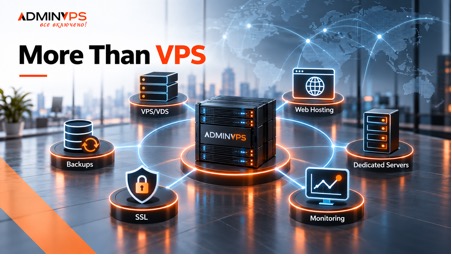
AdminVPS is not limited to VPS/VDS solutions. Its range of services covers different stages of a project’s infrastructure requirements.
Smaller websites that do not yet require their own virtual server can use shared hosting. More resource-intensive projects can move to dedicated servers when they need access to an entire physical machine rather than a virtualized environment.
Website infrastructure also involves more than the server itself. Businesses may need backups, domains, SSL certificates, email services, monitoring, and server administration.
Using several related infrastructure services from the same provider can simplify project management, particularly for businesses that do not maintain a large in-house IT team.
Server Location Matters
When selecting VPS infrastructure, businesses should consider not only server specifications but also physical location.
If most users are concentrated in one region, choosing an appropriate server location can help reduce network latency. International projects may require a different approach, including multiple server locations, a CDN, or other methods of delivering content closer to users.
Infrastructure geography can also matter when a company handles personal or corporate data. Businesses should therefore consider hosting location during the planning stage rather than only after a website or application has already been deployed.
What to Consider When Choosing a Plan
The most expensive VPS configuration is not necessarily the most suitable one. Server resources should be selected according to the actual workload.
For a smaller project, basic resources and the ability to scale later may be sufficient. An e-commerce website should take into account CMS requirements, database load, background processes, and simultaneous users. Applications may have different requirements depending on API usage, databases, and software architecture.
When comparing VPS plans, businesses should therefore evaluate CPU, RAM, storage, network characteristics, and the ability to increase resources as the project grows.
Conclusion
AdminVPS can be considered as an infrastructure provider for projects of different sizes, from smaller websites using shared hosting to VPS/VDS and dedicated servers for more resource-intensive workloads.
The appropriate solution depends on project traffic, required level of control, audience location, and administration requirements.
For businesses, this makes it possible to choose hosting infrastructure not only for current needs but also with future growth and changing technical requirements in mind.