A Shopify store can accept orders in minutes. The difficult part begins after checkout: routing orders, choosing carriers, printing labels, keeping inventory accurate, updating customers, managing failed deliveries and processing returns.
That is why a D2C tech stack should be designed around the post-checkout journey, not a long list of apps.

The Five Layers of a Practical Logistics Stack
- Order and inventory control: one reliable view of what was ordered and what is available.
- Shipping and carrier management: rates, labels, carrier allocation and manifests.
- Tracking and notifications: proactive updates that reduce “where is my order?” contacts.
- Returns and exchanges: structured reverse logistics.
- Analytics and automation: visibility into delivery performance, RTO, returns and cost.
Shopify’s current App Store has dedicated categories for shipping solutions, delivery, shipping rates and third-party logistics. Its India-specific collection also includes apps for carrier aggregation, returns, inventory and logistics.
1. Shipping and Carrier Aggregation
For an Indian D2C brand, a shipping app should help you compare or manage multiple carriers instead of forcing the operations team to work in separate courier dashboards.
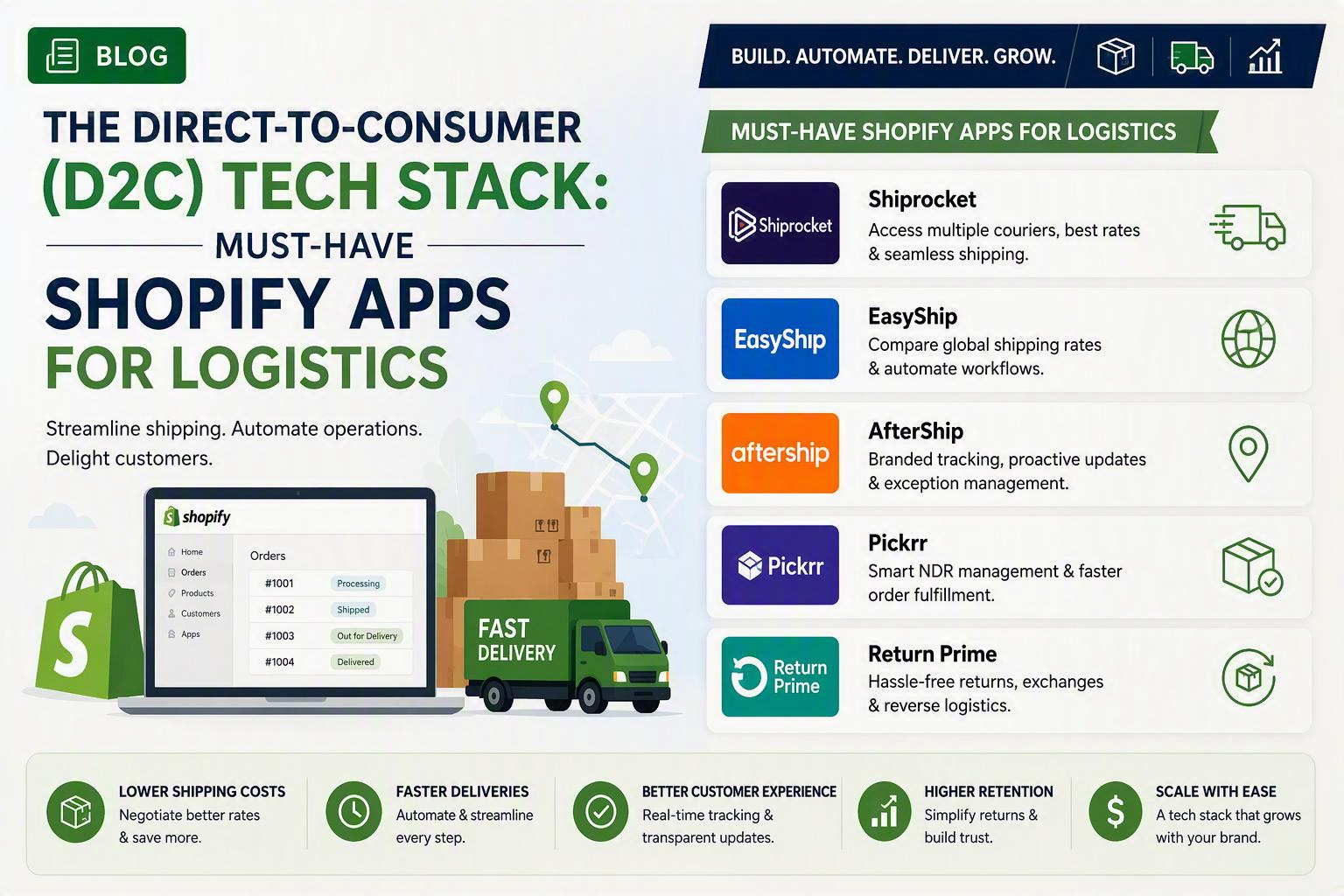
The Shopify App Store’s India collection currently includes options such as Shiprocket, Shipway, iThink Logistics, ILS and Vamaship. The right choice depends on your pin-code coverage, COD requirements, NDR workflow, rates and operational support.
What to evaluate
- Carrier coverage by destination pin code
- COD support and settlement workflow
- Rate-card transparency
- AWB and label automation
- NDR and RTO controls
- Returns handling
- API or Shopify Flow compatibility
2. Order Tracking
Once a parcel leaves the warehouse, tracking becomes a customer-experience problem. A branded tracking page and proactive notifications can reduce support tickets and make delivery status easier to understand.
Current Shopify App Store options include 17TRACK and AfterShip, among many others. These tools typically focus on branded tracking, delivery estimates, notifications and multi-carrier visibility.
Do not choose a tracking app just because it has the largest feature list. Ask whether it supports the carriers you actually use and whether it can pass useful events back into your customer-support or marketing workflows.
3. Returns and Exchanges
Returns should not be treated as a customer-service afterthought. They are a logistics workflow with financial consequences.
Apps such as Return Prime and Loop focus on returns and exchanges, while broader logistics tools can combine shipping, tracking and returns. The right architecture depends on your return volume and complexity.
A useful returns workflow
- Customer requests return or exchange.
- Eligibility rules are checked automatically.
- Pickup label or instructions are generated.
- Returned stock is tracked.
- Inspection determines refund, replacement or restock.
- Inventory and accounting records are updated.
This connects directly with the economics covered in our article on RTO costs and COD risk.
4. Inventory and Order Management
Shipping automation cannot fix an inventory problem. If the same SKU is sold through Shopify, marketplaces and offline channels, stock needs a central source of truth.
Look for support for multi-channel inventory, stock reservations, low-stock alerts, bundle handling and warehouse locations. EasyEcom is one current example listed in Shopify’s India shipping collection, combining inventory, orders and shipping workflows.
5. Automation
Use automation for repetitive decisions, not for decisions that need human judgment.
| Trigger | Useful automation |
|---|---|
| New paid order | Create shipment and assign fulfilment workflow. |
| COD order | Trigger confirmation process. |
| NDR event | Create customer follow-up task. |
| Delivered | Send post-purchase communication. |
| Return approved | Create reverse-pickup request. |
| Low stock | Alert purchasing or warehouse team. |
Do You Need All These Apps?
No. A common D2C mistake is building a stack where three apps each solve 60% of the same problem.
Start with the operational bottleneck that costs you the most money. If shipping rates and courier management are the problem, solve shipping first. If “where is my order?” tickets dominate support, improve tracking. If exchanges and refunds are consuming the team, fix returns.
A Lean Stack for a Growing D2C Brand
- Shopify: storefront and order system.
- Shipping aggregator: carrier allocation, labels and shipment management.
- Tracking app: branded tracking and proactive notifications.
- Returns app: only when return volume justifies dedicated tooling.
- Inventory/OMS: once multiple channels or warehouses make Shopify-only stock management unreliable.
- Analytics: connect logistics cost and delivery outcomes to order-level economics.
Metrics Your Stack Should Expose
- Shipping cost per delivered order
- RTO percentage
- First-attempt delivery rate
- NDR rate
- Average delivery time
- Return rate
- Exchange rate
- Cost of reverse logistics
- Support tickets per 100 orders
If an app cannot help you improve a measurable operational outcome, question whether it deserves a place in the stack.
Final Takeaway
The best D2C logistics stack is not the one with the most apps. It is the smallest set of systems that keeps orders, inventory, carriers, customers and returns moving through one dependable workflow.
Shopify’s current app ecosystem is broad enough that Indian brands can build this layer incrementally. Start with shipping and tracking, add returns and inventory control as complexity grows, and automate only after the underlying process is stable.
Freshness note: app features, pricing, carrier integrations and Shopify compatibility change frequently. Check the live Shopify App Store listing and vendor documentation before implementation.