
By Eric Cheng, Head of International Business, Second Talent
The Philippines offers US and Australian companies English-speaking engineers, salaries well below Western levels, and a workforce that has worked with foreign teams for decades. Manila runs on UTC+8 with no daylight saving, so a developer starting at 9 a.m. there is online at 5 p.m. or 6 p.m. in San Francisco and on the same morning as Sydney. Finding developers is the easier part. The harder choice is the hiring route, because a staffing firm, a vetted platform, a job board and a freelance marketplace each leave the legal and payroll risk with a different party. Here are seven routes, compared.
Quick comparison
| # | Option | Model | Who employs them | Best for |
| 1 | Full Scale | Dedicated teams | Full Scale | A managed team in Cebu |
| 2 | Second Talent | Vetted hires + EOR | Second Talent | Full-time hires without a local entity |
| 3 | Toptal | Vetted freelance network | Freelance contract | Senior specialists, short term |
| 4 | OnlineJobs.ph | Job board | You, as direct contractor | Low-cost direct hiring |
| 5 | Upwork | Freelance marketplace | Freelance contract | Small, scoped tasks |
| 6 | Kalibrr | Local job platform | Your local entity | Companies with a Philippine entity |
| 7 | Hire Offshore | Vetted hires + employment | Hire Offshore | Flat monthly pricing |
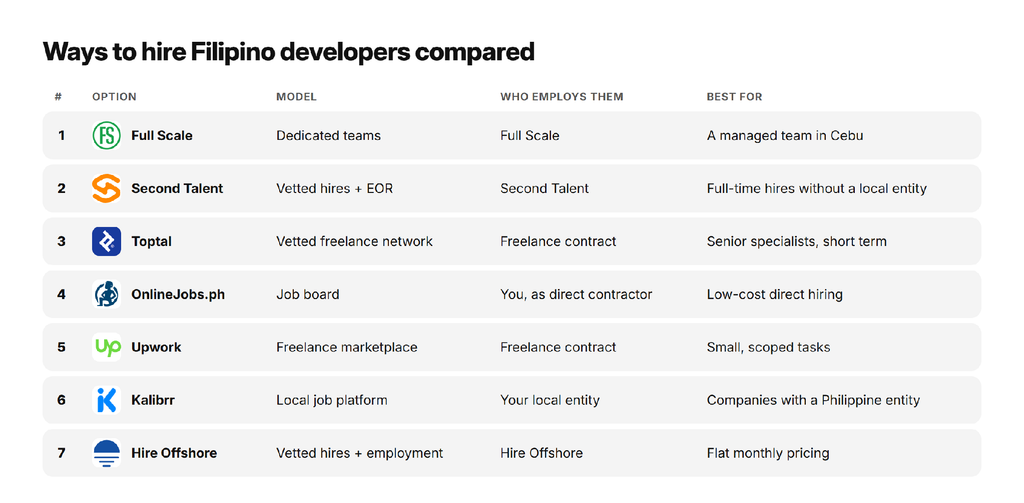
Ways to hire Filipino developers compared
Why companies hire developers in the Philippines
- English at work: the Philippines ranks among the highest in Asia on EF’s English Proficiency Index, and English is the language of business, law and university teaching.
- Experience with foreign teams: decades of outsourcing mean many developers have already worked inside US and Australian companies, with their tools, rituals and standards.
- Cost: developers working for international clients earn a fraction of US salaries at similar seniority.
- Time zone: a full working-day overlap with Australia, and an evening overlap with the US that many developers will work for a night-shift premium.
The deepest stacks are PHP and Laravel, JavaScript and React, Node.js, Java, .NET, Python and mobile. Senior AI, data and DevOps engineers are scarcer, so expect a longer search for those roles, and budget toward the top of the salary range.
1. Full Scale
Full Scale is a Kansas City-based company that builds dedicated software teams in Cebu, the Philippines’ second-largest tech hub. It recruits the developers, provides the office, equipment and local HR, and your team directs the work day to day. Developers work for one client, which keeps them focused on your codebase.
The model suits a US company that wants several developers in one place with a local manager on hand.
- Pricing model: monthly fee per developer, with office and HR included.
- Best for: US companies building a managed team of three or more.
- Watch out for: the talent pool is centred on Cebu rather than the whole country.
2. Second Talent
Second Talent helps companies hire developers in the Philippines as full-time team members without opening a local company. Each candidate passes technical assessments, an AI skills evaluation, English testing, structured interviews and reference checks with former managers before you see a profile. You get a shortlist within 24 hours, and most clients hire within 3 to 5 business days.
Second Talent then employs the developer through its own Philippine employer of record. That covers the employment contract, the 13th-month salary, SSS, PhilHealth and Pag-IBIG contributions, income tax withholding and payroll, so the developer is a proper employee under local law rather than a long-term contractor. Its rate cards publish what Filipino developers earn: Vue developers working for international clients, for example, earn about $1,500 to $4,500 a month.
- Pricing model: monthly, 50 to 70% below US salaries, no upfront fee, 90-day replacement guarantee.
- Best for: companies that want employees, not contractors, with compliance handled.
- Watch out for: you manage the developer’s work, so you need a technical lead on your side.
3. Toptal
Toptal’s global network includes senior Filipino engineers alongside developers from other countries. It says it accepts the top 3% of applicants and can introduce candidates within about 48 hours, with a trial period before you pay.
- Pricing model: hourly or monthly, set at global freelance rates rather than local ones.
- Best for: a senior specialist for a defined project.
- Watch out for: the rates remove most of the Philippine cost advantage.
4. OnlineJobs.ph
OnlineJobs.ph is one of the largest job boards for Filipino remote workers, covering developers alongside virtual assistants and other roles. Posting a job is free, and a paid monthly subscription lets you contact candidates. You then interview, hire and pay the worker directly.
For founders who are comfortable screening technical candidates themselves, it is the cheapest route on the list.
- Pricing model: monthly subscription, then you pay the developer directly.
- Best for: founders hiring one or two developers on a tight budget.
- Watch out for: no vetting, and if the “contractor” works full time under your direction, Philippine law may treat them as your employee.
5. Upwork
The Philippines is one of Upwork’s largest freelancer communities. You can post a job and receive proposals within hours, and Upwork handles payment protection and invoicing.
- Pricing model: hourly or fixed price, plus marketplace fees.
- Best for: small, well-defined tasks.
- Watch out for: variable quality, freelancers juggling several clients, and the same misclassification risk for long engagements.
6. Kalibrr
Kalibrr is a Manila-based hiring platform founded in 2012, with skills assessments and applicant tracking built in. Local tech employers use it for junior and experienced roles, and it reaches candidates who prefer local employment to freelancing.
- Pricing model: paid job postings and recruitment plans.
- Best for: companies that already have a Philippine entity, or that pair it with an employer of record.
- Watch out for: you need a local employer to make the hire.
7. Hire Offshore
Hire Offshore sends 6 to 8 Filipino, Vietnamese or Indian candidates within 24 hours and employs the developer for you at a flat $2,499 to $5,999 a month, with a 90-day replacement window.
- Pricing model: flat monthly fee covering salary, benefits and compliance.
- Best for: predictable pricing for one or two hires.
- Watch out for: a newer provider with a shorter track record.
How to interview Filipino developers well
- Ask for specifics, not self-ratings. Many candidates are modest about their own work. “Walk me through the last production bug you fixed” gets a better answer than “How strong is your React?”
- Pay for senior take-homes. A three-hour task with a fee attached gets more serious submissions and signals respect for the candidate’s time.
- Check the setup. Ask about backup power and internet, since outages still happen in parts of the country. Experienced remote developers usually have a second connection already.
- Put the schedule in the offer. State the shift, overlap hours and night-shift pay before the start date.
- Move fast. Strong developers often hold more than one offer, and a two-week silence after the final round loses them.
What Philippine law expects from an employer
If a developer works for you full time, set hours, only for you and under your direction, local law will likely treat them as an employee, whatever the contract is called. As the employer, directly or through an employer of record, you are responsible for:
- 13th-month pay: at least one-twelfth of basic annual salary, paid by 24 December.
- Government contributions: SSS, PhilHealth and Pag-IBIG, shared between employer and employee.
- Night-shift differential: at least 10% extra for work between 10 p.m. and 6 a.m., which matters for US-hours roles.
- Data privacy: the Data Privacy Act of 2012 covers the employee data you hold.
- Termination: dismissal needs a just or authorised cause and due process.
Registering for the contribution schemes is usually the slowest step in setting up payroll in a new market. An employer of record that already holds those registrations removes most of that delay.
FAQ
How much does a developer in the Philippines cost? Mid-level developers working for international clients commonly earn $1,500 to $4,500 a month, depending on stack and seniority. Add employer costs and provider fees for the full figure.
Can I hire a Filipino developer as a contractor? You can for project work. For a full-time, long-term role, an employer of record avoids the misclassification risk.
*Eric Cheng is Head of International Business at Second Talent, where he leads cross-border employment and payroll across Hong Kong, Southeast Asia and Taiwan.*