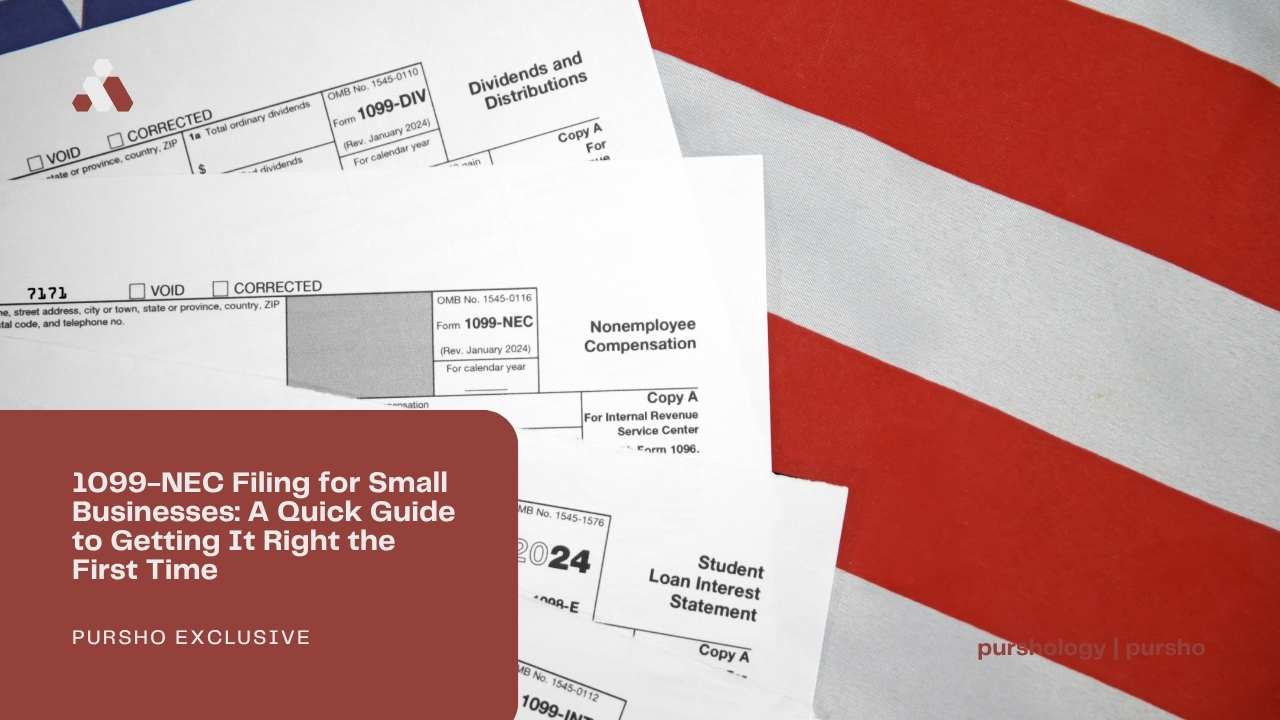
If your small business works with freelancers, consultants, or independent contractors, you have a tax reporting obligation that a lot of business owners don’t discover until it’s too late: the 1099-NEC.
The 1099-NEC (Nonemployee Compensation) is the IRS form used to report payments of $600 or more made to any individual or unincorporated entity for services during the tax year. Missing the filing deadline or submitting incorrect information results in penalties that start at $60 per form and can climb to $310 or more depending on how late you file.

Here’s what you need to know to handle 1099-NEC filing correctly from the start.
Who Needs a 1099-NEC?
Any non-employee who provided services to your business and was paid $600 or more during the calendar year. This commonly includes:
- Freelance developers, designers, and copywriters
- Marketing consultants and SEO specialists
- Virtual assistants and bookkeepers
- IT contractors and managed service providers
- Business coaches and advisory consultants
You generally do not need to issue a 1099-NEC to incorporated businesses (C-Corps or S-Corps), though there are exceptions for legal and medical services. Collecting a W-9 from every contractor before your first payment tells you their entity type and ensures you have the information you need to file.
The Deadline and the Penalties
The 1099-NEC is due on January 31st (both to the contractor and to the IRS). Unlike some other tax forms, there is no automatic extension.
The penalty structure is tiered based on how late you file:
- $60 per form if filed within 30 days of the deadline
- $130 per form if filed by August 1st
- $310 per form if filed after August 1st or not filed at all
For a business that works with even a small number of contractors, these penalties accumulate quickly. The simplest way to avoid them is to build 1099 filing into your year-end financial workflow rather than treating it as an afterthought.
How to File: Step by Step
1) Collect W-9 forms early — Request a completed W-9 from every contractor before you issue their first payment. The W-9 provides their legal name, address, and Taxpayer Identification Number (TIN). Chasing this information in January is stressful and often unsuccessful.
2) Generate the 1099-NEC forms — You can file through the IRS’s free IRIS portal, use your accounting software’s built-in tools, or use a fillable 1099 NEC generator to create accurate, properly formatted forms online. The key is ensuring that payer information, recipient information, and total compensation are all correct.
3) Distribute and file by January 31st — Send Copy B to each contractor and file Copy A with the IRS. If filing electronically (recommended for 10+ forms), submission happens through the IRS IRIS system or compatible software.
Common Mistakes to Avoid
Waiting until January to collect W-9s. Contractors move, change their business structure, or become unresponsive. Make W-9 collection part of your onboarding process.
Confusing 1099-NEC with 1099-MISC. Since 2020, nonemployee compensation is reported on the 1099-NEC, not the 1099-MISC. Filing the wrong form causes processing delays.
Forgetting payments made through certain platforms. If you paid a contractor directly (via check, ACH, or Zelle), you’re responsible for the 1099. Payments made through third-party networks like PayPal or Stripe may be reported by the platform on a 1099-K instead, but the rules here have shifted recently—when in doubt, consult your accountant.
The Bottom Line
1099-NEC filing is straightforward once you have the right process in place. Collect W-9s upfront, track every contractor payment throughout the year, generate accurate forms before the January 31st deadline, and file electronically whenever possible.
For small businesses that rely on freelancers and contractors (and in today’s digital economy, that’s most of them) this is one compliance task that’s worth getting right. The penalties for getting it wrong are avoidable, and the process for getting it right takes less time than most people expect.