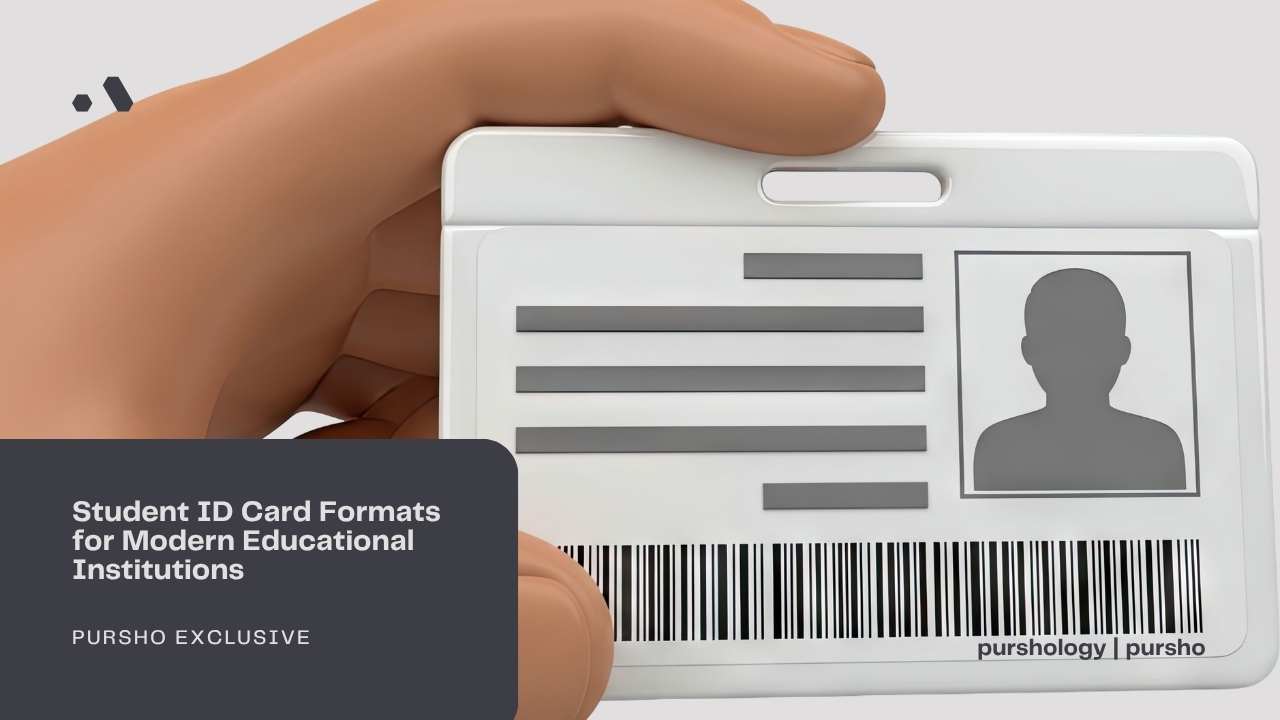
In the digital age of academics, student identification has ceased to be a mere formalism, it is a key element in campus security, administration, and branding. Contemporary institutions are spending more on highly designed student ID cards that are more than simple identification cards but demonstrate professionalism, safety and technological sophistication. Other providers such as Ivy Prints have simplified the process of schools and colleges to get high quality, customized solutions that best suit their needs.
Since the inception of student ID in the form of traditional printed cards, changing to the smart-enabled IDs, the historical development of the student ID reflects the overall shift that is occurring in all education systems the world over.

Why Student ID Card Formats Matter Today
Student IDs have a variety of purposes. They are used not only to identify people, but to do a lot more:
Campus Security: Assists in regulating access of buildings and facilities.
Attendance Tracking: Automated using digital systems.
Brand Identity: Reflects the image of the institution.
Cashless Transactions: Applied in cafeteria, libraries and transport.
Event Access: Gives access to exclusive academic or cultural events.
Schools that invest in the modern ID formats tend to report better personnel management and enhanced efficiency in all aspects.
Types of Student ID Card Formats
Depending on their needs and financial capacity, educational institutions have the option of using various types of ID cards. Some of the most popular ones are listed below:
1. Traditional Hardcopy ID Cards.
These are the most widespread in schools and colleges.
Features include:
- Name, photo and ID number of a student.
- Institution branding and logo.
- Basic contact information
They are cost-effective and easy to produce, making them ideal for smaller institutions.
2. Barcode-Based ID Cards
Cards can be enhanced with Barcodes that provide additional functionality to your traditional ID.
Benefits:
- Rapid attendance scanning.
- Check-ins and check-outs of the library.
- Event tracking
The format is frequently employed in the context of institutions that switch to digital systems.
3. QR Code ID Cards
QR codes are gaining popularity because of their multiplicity.
Key advantages:
- Student information was recorded in stores.
- Simple connection with mobile applications.
- Fast and contactless scanning
QR-based formats can be used especially in the post-pandemic world where touchless systems are more desirable.
4. Smart Card (RFID/NFC) IDs.
Smart ID cards are the most sophisticated form as of now.
Capabilities include:
- Building access without the need of physical contact.
- Cashless payments within campus
- Security live monitoring.
They are more costly, but offer a smooth experience and are popular among contemporary universities.
Essential Elements of a Modern Student ID Card
All effective student IDs, irrespective of format, must have some of the following basic components:
Visual Components
- High-quality student photograph
- Logo and color scheme of the institution.
- Readable typography.
Information Fields
- Name and ID number of the student.
- Course, class or department.
- Validity period
Security Features
- Holograms or watermarks
- Barcodes or QR codes
- Embedded chips (for smart cards)
- A balanced design will provide functionality and beauty.
- Student ID Trends in Design.
Design is no longer an imposition. Several institutions are now paying more attention to designing attractive IDs which match their brand.
Minimalist Layouts
Simple and clear designs enhance readability and professionalism.
Color-Coded Cards
The use of different colors of departments or grades assists in rapid identification.
Horizontal vs. Vertical Formats.
Vertical cards have become more popular due to their sleek look, whereas horizontal layouts are conservative and well received.
Custom Branding
Colleges are adding mascots, slogans and special graphics to their ID cards to ensure that they are unique.
The Right Format of Your Institution.
The choice of the most appropriate ID card format is dependent on a number of factors:
- Institution Size
Smaller schools can use printed or barcode cards.
Smart card systems have the advantage of larger campuses.
- Budget Constraints
The more developed cards have a greater initial cost but have long-run benefits.
- Technology Integration
ERP systems allow institutions to incorporate ID cards in their attendance, payments and data management.
- Security Needs
RFID or NFC-enabled cards should be taken into consideration in high-security campuses.
Professional Printing Services Role.
The printing service is an important aspect of an ID card because it will determine its quality. Professional providers ensure:
- Sturdy materials (PVC, laminated cards)
- High-resolution printing
- Accurate color reproduction
- Customization options
Firms such as the IVYPrints are specialized in the provision of customized ID card products that can fulfill the functional and aesthetic needs. Their experience assists institutions to be consistent and good in all the cards issued.
Mistakes to be avoided.
Even the most well-intended designs may fail to achieve their goal unless some of the pitfalls are prevented:
Overloading information: Too much text reduces readability
Low quality of images: Low-quality photos impact identification.
Disregarding durability: Low-quality materials easily wear away.
Absence of security features: Easily duplicated card.
With proper planning and expertise, these problems can be avoided.
Future of Student ID Cards
Student identification is shifting towards digital and mobile based solutions in the future. Numerous institutions are trying:
Stored in smart phones as mobile ID cards.
Biometric integration to provide increased security.
Cloud-based access systems
With such innovations, physical ID cards are not yet out of use since they are easy and reliable.
Conclusion
Forms of student ID cards have changed a lot, depending on the changing demands of contemporary educational institutions. Starting with simple printed cards, going to more advanced smart IDs, both formats have their own benefits. The trick is to find a solution that is functional, secure, and design.
Working with established vendors such as Ivy Prints and putting careful design to the ID cards, the institutions are able to design ID cards that are not only functional but also help to boost their identity in general. A well-crafted student ID card is more than just a badge—it’s a representation of the institution itself.