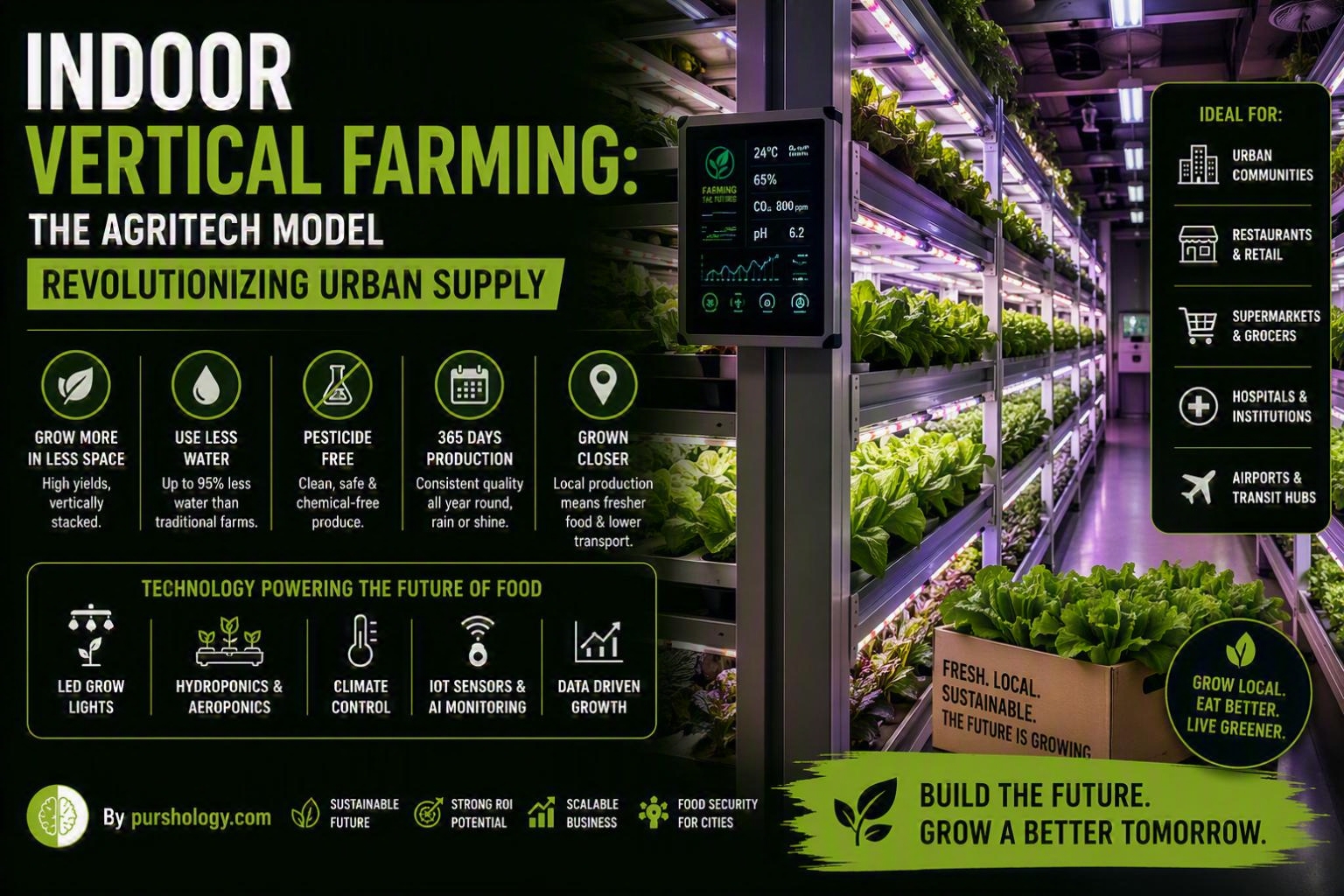
TL;DR:
Indoor vertical farming is transforming food production by enabling crops to be grown in controlled indoor environments closer to consumers. With rising urbanization, shrinking agricultural land, supply chain disruptions, and increasing demand for fresh produce, vertical farming is emerging as one of the most exciting agritech business models. Entrepreneurs and investors are increasingly viewing it as a scalable, technology-driven opportunity that can reshape the future of urban food supply.
For centuries, agriculture has relied on vast stretches of land, favorable weather conditions, and long supply chains to deliver food from farms to consumers. Today, however, a new farming model is challenging traditional assumptions about food production.

Indoor vertical farming combines agriculture, automation, artificial intelligence, and environmental control systems to grow crops indoors using stacked layers rather than large horizontal fields.
As urban populations continue expanding and food security becomes an increasingly important concern, vertical farming is emerging as one of the most promising innovations in modern agriculture.
For entrepreneurs, investors, and agritech innovators, the opportunity extends far beyond growing vegetables—it’s about building the future infrastructure of food production.
What Is Indoor Vertical Farming?
Vertical farming involves cultivating crops indoors within vertically stacked growing systems.
Unlike conventional farms, these facilities use:
- LED grow lighting
- Climate control systems
- Hydroponics
- Aeroponics
- Automated irrigation
- AI-driven monitoring
Because crops are grown indoors, farmers can control nearly every environmental variable, from temperature and humidity to nutrient delivery and lighting cycles.
This allows for year-round production regardless of weather conditions.
Why Vertical Farming Is Gaining Momentum
Several global trends are accelerating interest in indoor agriculture.
1. Rapid Urbanization
Cities continue to attract larger populations, creating increasing demand for locally sourced food.
Traditional farms are often located hundreds or thousands of kilometers from consumers.
Vertical farms can be established closer to urban markets, reducing transportation requirements and improving freshness.
2. Declining Agricultural Land
Urban expansion, industrial development, and environmental degradation are reducing the amount of arable land available for conventional farming.
Vertical farming produces crops using significantly less land area by utilizing vertical space efficiently.
3. Growing Food Security Concerns
Climate change, extreme weather events, and supply chain disruptions have highlighted vulnerabilities within traditional agricultural systems.
Indoor growing environments offer more predictable production capabilities.
4. Demand for Fresh Produce
Consumers increasingly prefer:
- Pesticide-free vegetables
- Fresh herbs
- Locally grown produce
- Sustainable farming methods
Vertical farms are uniquely positioned to satisfy these preferences.
How Vertical Farms Work
The most successful facilities leverage advanced technology to maximize crop yields.
Hydroponic Systems
Plants grow in nutrient-rich water rather than soil.
This approach reduces water consumption while accelerating plant growth.
Aeroponic Systems
Roots remain suspended in air while nutrients are delivered through fine misting systems.
This method further improves resource efficiency.
LED Lighting
Specialized LED lights deliver optimal wavelengths required for plant growth.
Lighting schedules can be customized to maximize production cycles.
Environmental Controls
Operators monitor:
- Temperature
- Humidity
- Carbon dioxide levels
- Nutrient concentrations
- Air circulation
This precision enables highly consistent crop quality.
Why Investors Are Paying Attention
Vertical farming offers several advantages compared to traditional agriculture.
Higher Yield Per Square Foot
Multiple growing layers dramatically increase production capacity within a relatively small footprint.
Year-Round Harvests
Indoor environments eliminate dependence on seasonal weather patterns.
Production continues throughout the year.
Reduced Water Usage
Many systems use significantly less water than conventional farming techniques.
Consistent Quality
Controlled environments help reduce crop variability, resulting in more predictable output.
Localized Production
Growing closer to consumers reduces transportation costs and delivery times.
Crops That Thrive in Vertical Farms
Not all crops are suitable for indoor farming.
The most profitable vertical farms typically focus on high-value produce.
Popular choices include:
Leafy Greens
- Lettuce
- Spinach
- Kale
- Arugula
Herbs
- Basil
- Mint
- Cilantro
- Parsley
Microgreens
Microgreens command premium prices due to their nutritional value and popularity in restaurants.
Specialty Produce
Some facilities grow:
- Strawberries
- Edible flowers
- Exotic herbs
- Premium vegetables
These products often yield higher margins.
Why India Is a Promising Market
India presents unique opportunities for vertical farming businesses.
Expanding Urban Centers
Major cities such as:
- Mumbai
- Delhi
- Bengaluru
- Hyderabad
- Chennai
- Pune
have growing demand for fresh, premium produce.
Supply Chain Inefficiencies
Produce often travels long distances before reaching consumers, increasing spoilage and reducing freshness.
Urban vertical farms can shorten this process significantly.
Premium Consumer Demand
Health-conscious consumers are increasingly willing to pay for:
- Organic produce
- Locally grown vegetables
- Chemical-free farming methods
Restaurant and Retail Partnerships
Hotels, cafés, restaurants, supermarkets, and premium grocery stores offer potential recurring revenue channels.
Revenue Models Beyond Selling Produce
Modern vertical farming businesses often diversify beyond crop sales.
B2B Supply Contracts
Supplying:
- Restaurants
- Hotels
- Retail chains
- Food service operators
creates predictable revenue.
Direct-to-Consumer Sales
Brands can sell fresh produce directly through subscriptions and online channels.
Farm Technology Licensing
Some operators monetize their growing systems and operational expertise.
Educational Experiences
Vertical farms increasingly host:
- Tours
- Workshops
- Training programs
creating additional income streams.
Challenges Entrepreneurs Should Consider
Despite its promise, vertical farming is not without obstacles.
High Initial Investment
Facilities require significant capital for:
- Infrastructure
- Lighting systems
- Climate controls
- Automation technology
Energy Consumption
Electricity costs remain a major operating consideration.
Technical Complexity
Maintaining optimal growing conditions requires specialized expertise.
Crop Selection
Profitability depends heavily on choosing crops that justify indoor production economics.
The Future of Urban Agriculture
Indoor vertical farming is no longer a futuristic idea—it is rapidly becoming a practical solution for feeding growing urban populations.
As technology continues improving and costs decline, vertical farms are likely to become an increasingly important component of global food systems.
The convergence of automation, artificial intelligence, sustainability, and food production is creating a powerful new category within agritech.
Companies that can optimize efficiency, control costs, and establish strong distribution channels may find themselves at the forefront of the next agricultural revolution.
Ready to Grow the Future?
Vertical farming represents more than an agricultural innovation—it’s a new model for producing food sustainably within the world’s fastest-growing cities.
If you’re exploring opportunities in agritech, sustainable business models, or urban infrastructure, indoor vertical farming deserves serious attention. The demand for fresh, locally produced food is growing, and the businesses that master controlled-environment agriculture today could become tomorrow’s leaders in food production.