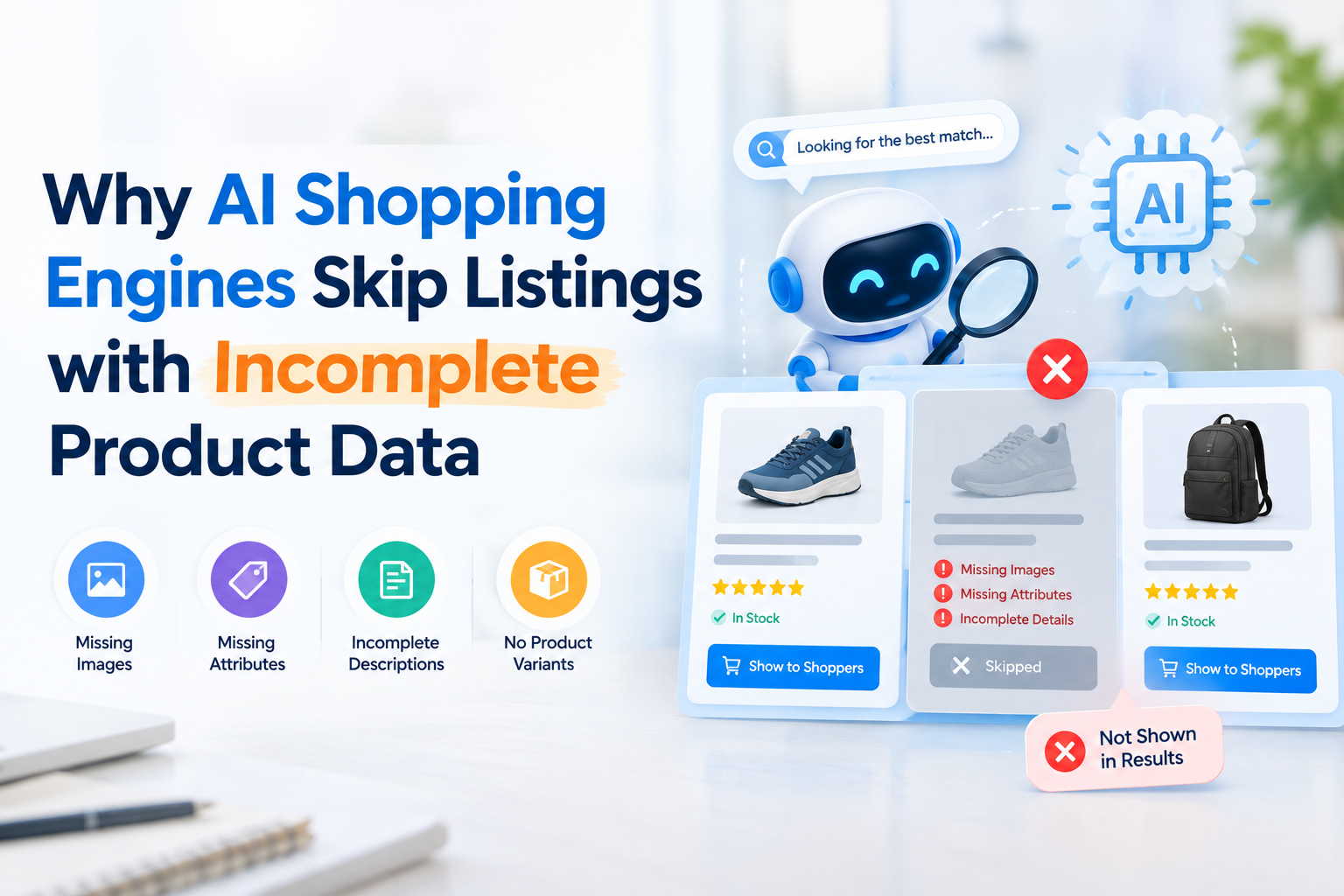
According to Syndigo’s State of Product Experience 2026 report, 25% of online shoppers trust AI shopping engines and buy the products they recommend. As AI shopping engines often give buyers a short list of products rather than a results page, a SKU with incomplete product data often never reaches the recommendation list.
For instance, a shopper asks an AI shopping engine for a leakproof, 20-ounce stainless steel bottle that fits a car cup holder. Your bottle might meet every requirement. It might be in stock and well reviewed, yet the assistant recommends another brand. Your catalog might be missing important product data: the capacity appears only in an image, the base diameter is missing from the units of measure (UOM) field, and “leakproof” is absent from the specifications. These gaps affect AI search visibility.

This article explains why AI shopping engines such as Google AI Mode and ChatGPT skip certain listings when surfacing results against a buyer’s product requirements. It also explains how classification errors create attribute gaps and how product data completeness can help sellers get their products surfaced in shopping engines’ recommendation lists.
How AI Shopping Engines Build a Product Shortlist
AI shopping engines surface products with structured records, not from crawled product detail page content alone. Each engine builds the shortlist from product data fed into its own channel. Google AI Mode draws on product data that sellers submit through Merchant Center via Google Shopping Graph, while ChatGPT indexes product feeds retailers send to OpenAI. On Amazon, Alexa for Shopping answers from the catalog data attached to each ASIN.
OpenAI’s product feed specification for ChatGPT lists nine required discovery fields for catalog onboarding: item ID, title, description, product URL, brand, seller name, image URL, availability, and price. Optional fields such as material, dimensions, color, and variant options then include the details a conversational shopper query demands.
Conversational queries on AI shopping engines show why these details matter. A request such as “walking shoes for wide feet under $100” requires the system to establish width, intended use, current price, and available sizes. The name “comfortable everyday sneakers” supplies none of those answers. Product relevance in an AI shopping engine depends on whether a system can surface the product by matching it with the shopper query.
What Google’s Conversational Attributes Require for Product Data Completeness
Google has added six optional conversational attributes to the Merchant Center product data specification. Google positions them as context that helps AI systems better interpret a product’s relevance when surfacing the product against buyer queries. They cover:
Question and Answer: Address common product questions directly
Add product-specific FAQs with clear answers. For example, “Is the cushion cover machine washable?” → “Yes, remove the cover and wash it on a gentle cycle.”
Document Link: Make detailed product information accessible
Provide links to PDF manuals, assembly instructions, and specification sheets that explain product features, usage, and setup.
Related Product: Connect shopper queries with relevant items
Identify compatible accessories, required parts, and frequently purchased products using their product IDs or GTINs.
Item Group Title and Variant Option: Clearly distinguish product variations
Use a shared title for a product family and specify what makes each variant different. For example,
- Item Group Title: Women’s Linen Shirt
- Variant Options: Color: Sage Green
- Size: Medium
Popularity Rank: Indicate how well a product performs
Assign a percentage-based popularity score that compares the product with other items in your inventory. Higher scores indicate stronger performance for AI search engines, which can improve the chances of the product being recommended.
Conversational attributes add more context to the mandatory product records that must already be accurate, with correct titles, valid product identifiers, and the right category.
Why Product Data Inconsistencies Limit Visibility in AI Shopping Results
AI-referred visits to U.S. retail sites converted 42% better than non-AI traffic in March 2026, according to Adobe’s Retail AI Traffic Report. The same report features Adobe’s AI Content Visibility Checker observation, which flagged that 66% of U.S. retail product pages lacked machine readability, so large language models could not read about a third of observed product pages. Machine readability gaps often arise from three product data inconsistencies that affect how AI shopping engines process, match, and retrieve product information.
1. Product Records Fail at Onboarding Due to Channel-Specific Requirements
Product data validation is the first filter. OpenAI’s specification rejects any row with a missing or unrecognized availability value. The same document instructs merchants to avoid placeholder values such as “n/a” or “null” in place of correct values.
The failure is also silent. An invalid product data row can fail while the valid rows in the same upload continue processing. One empty field can therefore remove a SKU from ChatGPT discovery, and the loss stays hidden until a specialist reviews the upload history.
2. Product Data Matching Fails Due to Missing Identifiers
AI shopping engines typically group offers from multiple sellers into one product entity by matching product identifiers such as GTIN or MPN paired with a brand. Reviews and prices attach to that entity.
A listing without either identifier remains unmatched, limiting its eligibility for comparison answers, because those answers draw on reviews and competing prices aggregated at the product level.
3. Inconsistent Values Weaken AI Search Retrieval Confidence
Product data completeness also depends on consistency across sources. Multichannel catalogs often have inconsistent or incorrect values. A channel feed might list a product as in stock while the product page shows it as unavailable.
Values that differ between product attributes and variant data remain inconsistent until someone corrects them. The engine then holds two competing records for one SKU, leaving it without a reliable basis for recommending the product on that attribute.
Why Better Descriptions Alone Cannot Create Structured Data for AI Shopping Engines
A richer description can help, as long as it adds relevant product information. Generic descriptions filled with promotional language contribute little useful information, even when they satisfy basic submission requirements. A detailed product description alone cannot automatically replace structured attributes.
A jacket’s description might mention waterproof fabric, available sizes, and color options without populating the corresponding product-feed fields. Merchants therefore need to maintain both accurate descriptive content and well-structured product attributes to ensure consistency between product pages and channel feeds.
Consider a desk lamp advertised as “ideal for any workspace.” A useful record includes the bulb type, color temperature, adjustable brightness levels, power source, and dimensions. A category-specific attribute table makes these values easier to reuse across channel feeds.
Why Product Data Classification Matters for AI Shopping Engines
In large catalogs, incomplete product data often starts as a classification error rather than a data-entry error. Category-specific templates explain the reason. Amazon assigns required and recommended attributes through product type templates, and Google Merchant Center applies additional requirements to categories such as apparel. When a SKU sits in the wrong category, its template never asks for the attributes AI shopping engines filter on.
The record can then look complete while missing its most important fields. A cordless drill classified under a generic hand tools category, for example, receives no fields for voltage or chuck size. The drill cannot match a query for “an 18-volt drill with a half-inch chuck,” because the template never required those values. Accurate product data classification is therefore the first control towards making product data machine-readable, because it defines the attribute standard for every SKU in the category.
How to Fix Incomplete Product Data Around Buyer Intent
Start with one category and a manageable sample of live SKUs, including products that appear in channel-specific and marketplace search but rarely surface in AI-powered product comparisons. Write five to ten realistic shopping questions using constraints customers mention in support tickets, site search, reviews, and competitor comparisons.
For each question, identify the exact attributes required to justify a recommendation. A query for “a washable 8-by-10 rug suitable for pets” might require width, length, cleaning method, material, and any confirmed pet-related suitability claim. Check the product record, the published listing, and the channel feed separately. Mark each value as verified, missing, inconsistent, or unsupported by that channel.
Then prioritize corrections by their consequence:
- Start with enriching values into missing mandatory fields, correcting records in rejected rows, and cleansing incorrect identifiers.
- Enrich category-specific attributes that directly answer common purchase constraints.
- Resolve parent-child mapping, units of measure (UOM) inconsistencies, and SKU-level stock or price mismatches.
- Add available manuals, product details, and legitimate review signals through supported channels.
Track product data completeness separately for mandatory fields and for the few attributes central to each high-intent query. Assign ownership of missing records to merchandising or catalog teams, and mapping failures to technical teams. This is where disciplined eCommerce product data management workflows become operational rather than cosmetic.
Check Whether the Fix Reached the AI Shopping Surface
Corrected catalog data is only the beginning. Sellers must verify the published product page and its Product/Offer markup, then check the actual exported feed after transformation. For a sharper view of AI visibility, sellers can use Google Merchant Center’s AI performance insights. The report covers organic appearances in AI Mode and AI Overviews, including popular shopping attributes and terms.
For ChatGPT feed integrations, sellers should check feed upload and row-validation results instead of treating a successful upload as proof that every SKU was accepted. On Amazon, sellers can test the listing attributes supporting the actual shopper question. Across engines, sellers can repeat a small set of neutral prompts and record the products cited, selected variations, and answers provided.
Making Product Data More Reliable for AI Shopping Engines
No catalog field guarantees placement in an AI-generated shortlist. Products still compete on relevance and other signals that sellers cannot fully observe. But incomplete product data is a key problem sellers can check, correct, and monitor.
The most useful product record answers a buyer’s important questions without asking an AI engine to infer missing information. When verified attributes remain consistent across listings and supported feeds, your products have a clearer path into the comparison.
Author Bio – Ravi Kant is the Vice President of the eCommerce and Photo Editing Division at SunTec India. With over two decades of global experience, he spearheads large-scale digital commerce initiatives that drive operational excellence and measurable ROI for global businesses. His expertise spans eCommerce strategy, digital transformation, and data-driven performance optimization.