
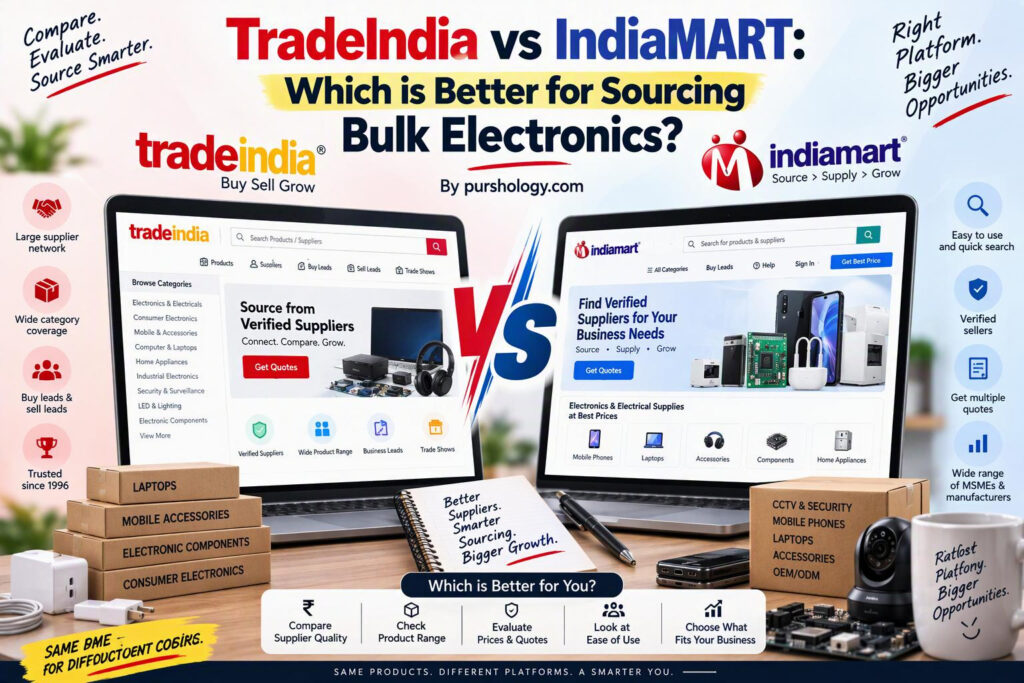
Quick answer: Neither TradeIndia nor IndiaMART is automatically better for every bulk-electronics purchase. Both can help you discover manufacturers, distributors, and suppliers, but the best choice is the platform that produces a stronger shortlist for your exact product, quantity, location, technical requirements, and budget. Search both, compare equivalent quotations, and verify the supplier independently before sending a large advance.
This guide focuses on sourcing electronics in India—components, accessories, electrical supplies, small devices, and equipment—rather than ranking either marketplace by unverified lead counts or seller-quality claims.
TradeIndia vs IndiaMART: the practical comparison
| Factor | TradeIndia | IndiaMART | What buyers should do |
|---|---|---|---|
| Core purpose | B2B discovery and supplier enquiries across product categories. | B2B discovery and buyer-supplier enquiries across product categories. | Treat both as sourcing channels, not as substitutes for supplier due diligence. |
| Electronics discovery | Browse categories such as electronics and electrical supplies, then shortlist relevant listings. | Search exact product names, specifications, brands, and supplier locations. | Use the same search terms and specification sheet on both platforms. |
| Supplier comparison | Compare listing details, company information, response quality, and quotation completeness. | Compare listing details, company information, response quality, and quotation completeness. | Judge the individual supplier and transaction, not just the marketplace brand. |
| Commercial terms | Supplier pricing, minimum order quantity, and membership-related offers may vary. | Supplier pricing, minimum order quantity, and membership-related offers may vary. | Get written, itemised terms directly from each supplier and platform before paying. |
| Best use | Build an additional supplier shortlist and compare responses. | Build an additional supplier shortlist and compare responses. | Use the channel that returns qualified suppliers for the exact part or device. |
TradeIndia describes itself as a B2B marketplace connecting buyers and suppliers, and its website lists electronics and electrical supplies among its categories. Start with its official marketplace and electronics equipment listings. For IndiaMART, begin at its official marketplace. Listings, filters, and service packages can change, so verify the current experience directly.
When should you use both marketplaces?
Use both when the purchase is important, the specification is unusual, or price and availability differ significantly between suppliers. A marketplace search is a lead-generation step; the commercial decision should be based on the quality of the supplier’s evidence and the total cost of a conforming product.
- Standard products: adapters, cables, connectors, power supplies, LED components, and common accessories may produce many comparable listings.
- Technical equipment: instruments, control boards, industrial electronics, and specialised components require tighter specification matching and documentation.
- Private-label or OEM orders: compare manufacturing capability, customisation, tooling charges, quality-control process, and minimum order quantity.
- Repeat purchases: prioritise consistency, batch traceability, warranty handling, and reliable dispatch—not only the lowest first quote.
Step-by-step sourcing workflow
1. Write a precise product specification
Before searching, prepare a short specification sheet with the product name, model or part number, voltage/current ratings where applicable, connector type, dimensions, material, operating environment, certifications required, packaging, quantity, target delivery date, and acceptable substitutes. Attach drawings or datasheets when needed.
Without a specification, quotes may not be comparable. A low price can reflect a different component grade, lower rating, incomplete accessories, or a product that does not meet your application.
2. Search with exact terms and synonyms
Search the exact model or part number first, then test common technical synonyms and category terms. Keep a spreadsheet of the query, supplier, location, product match, minimum order quantity, response date, and documents supplied. This makes it easier to compare results from both marketplaces without relying on memory.
3. Screen suppliers before discussing payment
- Ask for the registered business name, address, GST details where applicable, and an invoice sample.
- Check whether the supplier is the manufacturer, authorised distributor, trader, or importer.
- Request a current product datasheet, clear photos of the actual item, and batch or model details.
- Check the beneficiary name on the bank account or payment request against the contracted business.
- For branded products, ask for evidence of authorised distribution and warranty eligibility.
A marketplace profile or badge can be one input, but it is not a guarantee of authenticity, product quality, or performance. For cross-border sourcing, our related guide How to Verify if an Alibaba Supplier will Actually Ship to India in 2026 explains the broader due-diligence mindset; the same principle applies to domestic purchases.
4. Request comparable quotations
Ask shortlisted suppliers to quote the same quantity and scope. A useful quotation should identify the exact model, specification, unit price, taxes, freight, packing, lead time, warranty, payment milestones, delivery location, and quote validity. Confirm whether the price is for a sample, one unit, a carton, or a bulk tier.
Do not compare a tax-exclusive ex-works price with a delivered price that includes packaging and freight. Calculate the landed cost per usable unit, including expected inspection, testing, returns, and warranty costs.
5. Order a sample or pilot batch
For a new supplier, buy a sample or small pilot quantity where practical. Test the product against written acceptance criteria: dimensions, output, performance, fit, finish, labelling, packaging, and required documents. For higher-value orders, consider an independent inspection or test report before approving mass production or dispatch.
6. Agree on payment and warranty terms in writing
Use a purchase order or written contract that states product specifications, quantity, delivery date, inspection process, rejection criteria, warranty duration, replacement process, and responsibility for freight on defective goods. Avoid last-minute changes to the beneficiary account. Be cautious if a supplier pressures you to pay a personal account or refuses to issue a proper invoice.
Bulk-electronics supplier scorecard
| Criterion | Suggested weight | Evidence to collect |
|---|---|---|
| Specification match | 25% | Model/part number, datasheet, sample test, approved substitute list. |
| Supplier legitimacy | 20% | Business identity, address, invoice, bank-beneficiary match. |
| Total landed cost | 20% | Itemised price, taxes, freight, packing, testing, and return costs. |
| Quality and warranty | 15% | Written warranty, replacement policy, traceability, inspection process. |
| Delivery reliability | 10% | Lead time, stock evidence, dispatch milestones, shipment updates. |
| Communication and support | 10% | Clear answers, complete documentation, reachable escalation contact. |
These weights are a suggested internal purchasing tool, not a platform rating. Adjust them for the product’s risk and your business needs.
Common sourcing mistakes
- Choosing the lowest quote before confirming the exact model and quality grade.
- Assuming a supplier’s listing means the goods are in stock or ready to ship.
- Paying a large advance without written specifications, delivery terms, and refund/replacement conditions.
- Ignoring counterfeit risk for branded chips, batteries, chargers, memory cards, or accessories.
- Comparing supplier membership plans before testing whether the platform generates relevant enquiries.
- Skipping a sample test for a product that could damage equipment or create a safety issue.
Final verdict: which marketplace is better?
Use both TradeIndia and IndiaMART for discovery when the order justifies a broader search. Pick the winning supplier based on specification fit, verifiable business details, sample performance, written commercial terms, and landed cost. If one platform consistently produces more relevant and responsive suppliers for your product category, prioritise it for future sourcing—but periodically test the alternative rather than assuming the result will always remain the same.
Frequently asked questions
Is a supplier verified by a marketplace automatically safe?
No. Marketplace checks can reduce some uncertainty but cannot guarantee that every product, shipment, payment, or warranty will meet your expectations. Verify the transaction independently.
Can I negotiate the minimum order quantity?
Often it is worth asking. Suppliers may have different MOQs for samples, standard stock, custom production, and price tiers. Get the agreed MOQ and any tooling or setup charges in writing.
Should I pay the supplier before seeing a sample?
For a new or high-risk supplier, a sample or pilot batch is usually prudent where practical. If a sample is impossible, strengthen the contract, documentation, inspection, and payment controls before committing.
How can I compare offers fairly?
Use one specification and one quotation template for every supplier. Compare the same quantity, tax treatment, delivery point, warranty, packaging, and lead time.
Official marketplace references
- IndiaMART official marketplace
- TradeIndia official marketplace
- TradeIndia electronics equipment listings
Marketplace features, supplier listings, and commercial packages can change. Confirm current details directly and complete independent checks before making a purchase.