
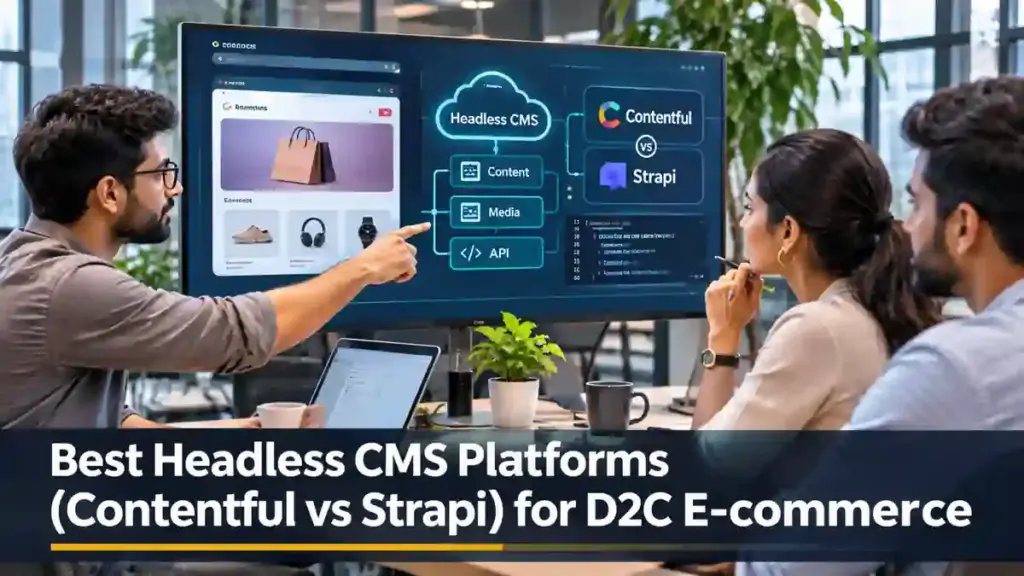
For a direct-to-consumer (D2C) ecommerce brand, the best headless CMS is the one that fits the team’s content workflow, commerce architecture, technical capacity and total cost—not simply the one with the longest feature list. Contentful is worth shortlisting for teams that prefer a managed content platform and structured editorial workflows; Strapi is worth shortlisting when code, hosting and data control are important and the business can support the technical operations.
This is a practical comparison of the two platforms named in the title, not a claim that they are the only suitable headless CMS products. Verify current plan limits and pricing before committing, because vendors can change packaging and usage allowances.
What a headless CMS does for a D2C brand
A traditional commerce website often couples the content editor and the customer-facing website more tightly. A headless CMS stores and manages structured content, then delivers it through APIs to a website, mobile app, campaign landing page or other front end. Your commerce engine can continue to handle products, carts, orders and payments while the CMS manages editorial content such as campaign pages, buying guides, FAQs and brand stories.
Headless architecture can help a brand reuse content across channels, but it also adds integration and development work. It is not automatically faster, cheaper or better for SEO than a well-built traditional platform.
Contentful vs Strapi: quick comparison
| Decision factor | Contentful | Strapi |
|---|---|---|
| Operating model | Managed proprietary content platform | Open-source content framework with self-hosting and managed cloud options |
| Control of infrastructure | Vendor-managed platform | More control when self-hosted; operational responsibility stays with your team |
| Editorial experience | Structured content platform with roles, collaboration and publishing features that vary by plan | Customisable admin experience and content modelling; workflow needs should be tested against your editorial process |
| Development work | Integrate the API and front end; less infrastructure to operate directly | Build the front end and integrations, and manage hosting, upgrades, backups and security if self-hosted |
| Cost model | Plan and usage limits, with higher tiers or spaces for more demanding needs | Self-hosted licence cost can be low, but infrastructure and engineering time still cost money; cloud plans are separate |
| Good fit | Teams prioritising managed services and structured collaboration | Teams prioritising customisation, code access and deployment flexibility |
When Contentful makes sense
Contentful provides a managed platform for structured content and publishes plan details on its official pricing page. Its current Free plan is intended for learning and exploration and lists limits such as users, API calls, bandwidth and a Starter Space. Its Lite plan lists a higher monthly allowance and additional collaboration and publishing features. Enterprise options are customised.
For a D2C team, the main advantage is reducing the amount of CMS infrastructure the internal team must operate. That can be valuable when marketers, merchandisers and regional editors need a consistent workflow, and the company prefers a vendor-managed service.
Before choosing Contentful, test the exact editorial roles, locales, preview process, scheduled publishing, environments, API usage and space limits your brand needs. The free tier may be useful for a prototype, but do not assume its quotas fit a production catalogue or multi-market operation.
Official reference: Contentful plans and quotas.
When Strapi makes sense
Strapi describes itself as an open-source content framework that lets teams shape content models, generate APIs and choose where to host. Its project is built around customisation and deployment flexibility. Teams can self-host on infrastructure they control or use Strapi Cloud, subject to the current terms and plan limits.
This can appeal to a D2C company that already has developers and operational processes for application hosting, databases, backups, upgrades, monitoring and security patches. Self-hosting can reduce licence dependency, but it does not make the total cost zero: engineering time, hosting, backups, incident response and maintenance remain part of total cost of ownership.
Before choosing Strapi, build a small proof of concept with your actual content types and commerce data. Test API permissions, editorial preview, publishing workflows, localisation, backups and the process for upgrading the platform.
Official reference: Strapi open-source content framework.
How to decide for a D2C ecommerce stack
- Map the content model. Define product education pages, campaigns, landing pages, FAQs, size or care guides, category copy, and reusable brand content. Keep product inventory and transactional data in the system designed to own it.
- Choose the commerce source of truth. Decide whether product names, SKUs, prices, inventory and variants come from your ecommerce platform, ERP or another catalogue service. Avoid duplicating changing data manually in the CMS.
- Prototype the API. Build one category page and one product-adjacent editorial page. Test API response time, caching, image delivery, preview and error handling under realistic conditions.
- Plan for SEO. Ensure the front end renders meaningful titles, descriptions, canonical URLs, indexable product and category content, breadcrumbs and appropriate structured data. A headless CMS does not automatically implement these correctly.
- Model localisation and governance. If you sell across regions, test currency, language, regional promotions, approval flows, permissions and how content is rolled back.
- Calculate three-year total cost. Include subscription or hosting, developer time, integrations, CDN, monitoring, security, backups, support and future migration.
- Plan your exit. Confirm how content, media, relationships and identifiers can be exported. Document the APIs and avoid undocumented dependencies that make migration unnecessarily difficult.
Common mistakes to avoid
- Choosing a headless architecture before defining the actual business problem.
- Comparing licence price while ignoring engineering and operations costs.
- Assuming the CMS will handle ecommerce transactions, inventory or payments by itself.
- Launching without preview, redirects, canonical tags, sitemap generation and monitoring.
- Creating content models that mirror database tables but do not match how editors work.
- Skipping backup restoration and role-permission tests.
Frequently asked questions
Is Strapi free?
Strapi’s core is open source, but a self-hosted deployment still requires infrastructure and maintenance. Strapi Cloud and enterprise services have separate plans and terms, so check the official site for current details.
Is Contentful better for SEO?
Neither CMS automatically guarantees better search rankings. SEO depends on the front end, rendering, page quality, technical implementation, content and site architecture. Both options require a deliberate SEO implementation and testing.
Can a small D2C brand use a headless CMS?
Yes, but the brand should have a clear reason—such as multi-channel content reuse or a custom front end—and the resources to maintain it. A simpler hosted commerce platform may be more efficient for a small team with limited development capacity.
Bottom line
Choose Contentful if managed infrastructure and structured editorial collaboration are your priorities. Choose Strapi if code-level customisation and deployment control matter and you can own the operational work. Build a small, realistic proof of concept with actual D2C content, measure the work required to maintain it, and confirm current pricing and limits before the production decision.