
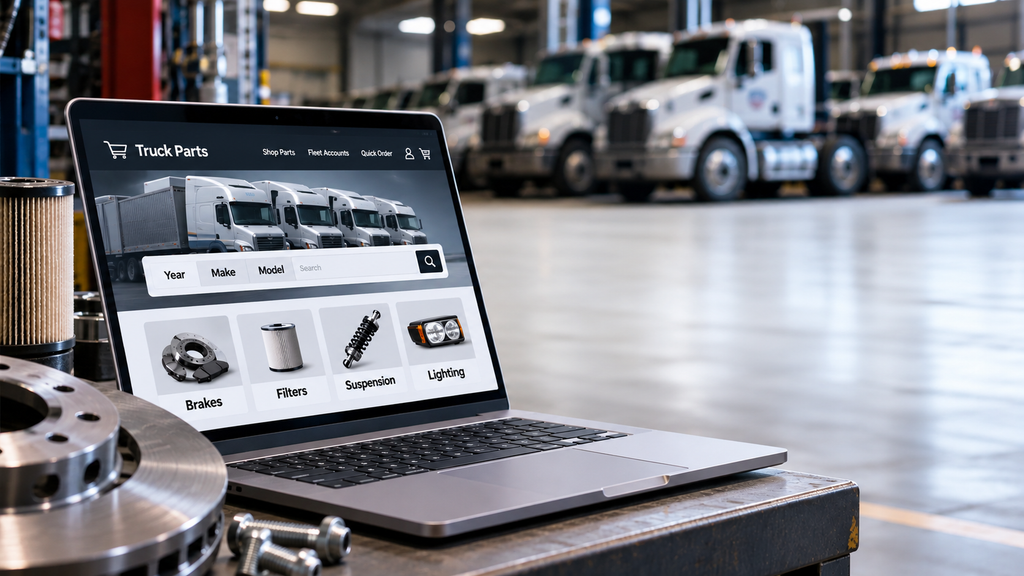
Truck parts distributors serving fleet customers have different ecommerce requirements from businesses selling accessories to individual drivers. Their customers may operate dozens or hundreds of vehicles, purchase replacement parts regularly, and expect pricing based on established business agreements.
Finding the right part is only one part of the process. Buyers also need to check availability, confirm compatibility, place orders for multiple vehicles, and purchase through the correct company account.
For distributors moving to Shopify or improving an existing storefront, these requirements make agency selection particularly important.
The best Shopify agencies for truck parts distributors combine automotive product knowledge with B2B ecommerce development, vehicle fitment, catalog management, and systems integration.
Here are five agencies worth considering in 2027, based on their documented automotive, commercial vehicle, and B2B ecommerce experience.
Best Shopify Agencies for Truck Parts Distributors at a Glance
| Agency | Best For | Relevant Experience |
| Fyresite | Truck parts ecommerce, vehicle fitment, and B2B purchasing | Chassis Unlimited, automotive fitment, dealer pricing |
| Elogic Commerce | Commercial vehicle replacement parts distribution | Truck Center International, B2B ordering, OEM cross-reference search |
| Uncap | Automotive wholesalers managing business accounts | Automotive B2B commerce, account pricing, ERP integrations |
| Teifi Digital | Large parts catalogs and multi-channel distribution | Royal Distributing, OE Wheels, vehicle compatibility |
| CQL | Custom automotive product discovery and Shopify migrations | The Seat Shop, custom Year/Make/Model search |
How We Selected These Agencies
The agencies were evaluated against five factors relevant to truck parts distributors:
- Documented automotive, commercial vehicle, or replacement-parts ecommerce experience
- Shopify and Shopify Plus development capabilities
- Experience with B2B purchasing or complex product catalogs
- Vehicle compatibility, product discovery, or integration expertise
- Publicly available project examples
Direct fleet or commercial vehicle experience was given particular weight. Agencies with broader automotive experience were included where their documented capabilities could address related distribution challenges.
1. Fyresite — Best for Truck Parts Ecommerce With B2B Fitment and Dealer Purchasing
Fyresite is a US-based Shopify Premier Partner specializing in auto parts Shopify development, with experience in vehicle-specific product discovery, complex catalogs, and B2B purchasing workflows.
Its work with Chassis Unlimited, a manufacturer of truck bumpers and off-road accessories, provides a particularly relevant example.
Fyresite migrated Chassis Unlimited from Magento to Shopify Plus and developed a custom Year/Make/Model product finder. The functionality helps customers narrow the catalog to products compatible with their vehicles.
The project also included B2B dealer pricing and a QuickBooks invoicing workflow for purchase orders.
These capabilities matter for truck parts distributors because commercial buyers often need to combine accurate product identification with account-specific purchasing arrangements.
Fyresite’s automotive work also extends to B2B fitment, which differs from the simpler vehicle selectors commonly found on consumer storefronts.
A fleet maintenance buyer may be responsible for several truck models, multiple purchasing locations, and recurring replacement-parts orders. A suitable B2B fitment experience can connect vehicle compatibility information with company catalogs, pricing, and order workflows.
Fyresite discusses these requirements in its automotive Shopify content, including saved vehicle lists, multi-vehicle orders, compatibility validation, and repeat purchasing.
Its Parts Intelligence offering focuses on structured vehicle fitment and product validation for Shopify. The precise functionality of an implementation depends on the merchant’s catalog, available data, and purchasing requirements.
Best for: Truck parts manufacturers and distributors looking to combine Shopify Plus, automotive fitment, dealer purchasing, and custom ecommerce development.
Relevant experience: Chassis Unlimited, vehicle compatibility search, Shopify Plus migration, B2B dealer pricing, and purchasing integrations.
Consideration: Distributors should establish their fleet account structure, fitment data requirements, and order workflows during project planning.
2. Elogic Commerce — Best for Commercial Vehicle Replacement Parts Distribution
Elogic Commerce has one of the most directly relevant commercial vehicle projects on this list.
Its work with Truck Center International involved developing a Shopify Plus B2B ecommerce platform for a supplier of remanufactured commercial vehicle brake calipers.
The business serves professional buyers, including dealers and distributors, who need to identify replacement parts using technical product references rather than conventional retail browsing.
According to Elogic’s published project information, the implementation involved approximately 14,000 SKUs, customer-specific pricing, OEM and cross-reference search, and integrations with business systems.
The project also used TecDoc-related parts information to support product identification.
This is particularly relevant for truck parts distributors because commercial vehicle buyers frequently search using manufacturer references, equivalent part numbers, or existing inventory records.
An ecommerce storefront that supports these purchasing habits can reduce reliance on manual catalog searches and sales-team assistance.
Elogic’s experience also illustrates why B2B ecommerce projects require more than adding a wholesale login. Product data, account pricing, ordering, and internal systems must work together.
Best for: Commercial vehicle replacement-parts suppliers that need B2B ordering and technical parts identification.
Relevant experience: Truck Center International, commercial vehicle components, cross-reference search, account pricing, and integrations.
Consideration: Businesses should confirm how their existing OEM references, interchange data, and inventory records will be incorporated into the storefront.
3. Uncap — Best for Automotive Wholesalers With Complex B2B Requirements
Uncap, formerly known as Pivofy, is a Shopify agency specializing in B2B ecommerce, platform migrations, and systems integration.
Its automotive ecommerce offering addresses several requirements that matter to professional parts distributors, including vehicle fitment, wholesale ordering, customer-specific pricing, and connections to ERP systems.
Unlike a conventional consumer storefront, a wholesale parts operation may serve several customer groups with different purchasing arrangements.
A repair shop, regional distributor, and fleet maintenance business may all purchase from the same supplier while requiring different catalogs, prices, and payment terms.
Uncap’s B2B experience is relevant to these situations because Shopify company accounts and catalogs can form the foundation for account-based purchasing.
The agency has also published automotive ecommerce work involving KOOKS Headers & Exhaust, providing a sector-specific example beyond its general wholesale services.
For truck parts distributors, Uncap is particularly worth considering when the project involves connecting ecommerce operations to existing inventory, customer, and order management processes.
Best for: Automotive wholesalers and parts distributors modernizing B2B purchasing on Shopify.
Relevant experience: Automotive ecommerce, Shopify B2B, wholesale storefronts, account pricing, and ERP integration.
Consideration: Uncap’s documented automotive and wholesale experience is relevant to fleet distribution, but businesses should request examples matching their particular commercial vehicle purchasing requirements.
4. Teifi Digital — Best for Large Parts Catalogs and Multi-Channel Distribution
Teifi Digital has experience with Shopify ecommerce projects involving extensive product catalogs, multiple suppliers, and vehicle compatibility data.
Its Royal Distributing project is especially relevant to businesses managing large parts inventories.
Royal Distributing operates in the powersports and related parts market, serving customers across retail and wholesale channels.
Teifi’s published case study describes a complex ecommerce environment involving more than one million variant SKUs and hundreds of vendors.
The project included product data management, inventory and pricing connections, and vehicle-aware product discovery.
For truck parts distributors, the relevance lies in the underlying catalog challenges.
A large distributor may source products from numerous manufacturers, each supplying different product descriptions, compatibility information, and technical attributes.
Customers still expect to search the combined catalog consistently.
Teifi also has automotive experience involving OE Wheels, providing another example of work with vehicle-specific product information.
Although these projects do not establish direct fleet maintenance experience, they demonstrate capabilities applicable to distributors managing large, technically complex parts catalogs.
Best for: Parts distributors with extensive inventories, multiple suppliers, and complex product relationships.
Relevant experience: Royal Distributing, OE Wheels, large Shopify catalogs, vehicle compatibility, and multi-channel ecommerce.
Consideration: Truck-specific fitment, commercial vehicle reference data, and fleet purchasing requirements should be defined separately from the agency’s documented automotive and powersports work.
5. CQL — Best for Custom Vehicle Compatibility Search and Shopify Migrations
CQL is an ecommerce development agency with documented Shopify Plus experience involving automotive replacement parts and custom product discovery.
Its project for The Seat Shop provides a relevant example.
The Seat Shop sells replacement seating products for vehicles, where compatibility information plays an important role in helping customers identify the correct product.
CQL worked on the company’s Shopify Plus implementation, including a custom Year/Make/Model application designed to improve vehicle-specific product search.
The project also involved data migration and other ecommerce improvements.
For truck parts distributors, the connection is straightforward: conventional category navigation is often insufficient when products depend on specific vehicle configurations.
A buyer searching for a replacement component may need to filter by model year, vehicle configuration, or other technical attributes before comparing available parts.
Custom fitment tools can make that process easier, provided the underlying compatibility data is accurate and regularly maintained.
CQL’s experience is most relevant to distributors prioritizing product discovery or planning a technically complex Shopify migration.
Best for: Automotive parts businesses needing custom vehicle compatibility functionality and Shopify development.
Relevant experience: The Seat Shop, Shopify Plus implementation, Year/Make/Model search, and ecommerce data migration.
Consideration: The agency’s documented automotive work demonstrates fitment expertise, rather than a confirmed fleet-specific B2B ordering implementation.
What Truck Parts Distributors Should Look for in a Shopify Agency
A fleet-focused ecommerce project should begin with the way professional customers actually purchase parts.
Consider a fleet maintenance manager responsible for trucks operating across several depots. The buyer may need brake components for one vehicle, filters for another, and replacement accessories for a third.
They should be able to identify suitable parts, access their company’s agreed pricing, and submit orders through the appropriate purchasing account.
That workflow depends on several connected capabilities.
| Requirement | Why It Matters | What to Ask an Agency |
| Vehicle fitment | Helps buyers identify compatible truck parts | How will compatibility data be sourced, validated, and updated? |
| OEM and interchange search | Supports buyers searching by known part references | Can customers search manufacturer and equivalent part numbers? |
| B2B pricing | Supports different commercial purchasing agreements | How will customer-specific pricing be configured? |
| Multi-location accounts | Supports fleets with several depots or purchasing teams | How will buyers and locations be organized? |
| Repeat ordering | Makes routine replacement-parts purchasing easier | Can customers quickly reorder previous purchases? |
| Inventory integration | Helps keep product availability accurate | How will stock data synchronize with existing systems? |
| Purchase-order workflows | Supports commercial purchasing and internal review | Can orders follow the required approval or invoicing process? |
The strongest agency proposals should explain how these requirements work together, rather than presenting each feature as a separate addition.
How Shopify Supports B2B Truck Parts Distribution
Shopify provides native B2B capabilities for company accounts, company locations, catalogs, quantity rules, volume pricing, and payment terms.
These features can support distributors selling to professional buyers with different purchasing arrangements.
For example, a distributor can organize business customers into company accounts and assign purchasing contacts to company locations.
Depending on the plan and configuration, catalogs can control which products and prices are available to particular business customers.
However, Shopify’s native B2B functionality should not be confused with a complete truck parts or fleet management system.
Specialized requirements such as saved fleet vehicles, VIN-based identification, commercial vehicle fitment, OEM cross-reference search, and integration with fleet maintenance software require additional evaluation.
These capabilities may involve third-party applications, custom development, or external data providers.
A qualified agency should explain which requirements Shopify handles natively and which need additional implementation.
How to Choose the Right Agency for Your Fleet Parts Business
Before requesting proposals, document a few real purchasing scenarios.
For example, ask each agency how it would handle a fleet customer ordering replacement parts for five trucks with different configurations.
The demonstration should cover product identification, account pricing, stock availability, and order submission.
Next, evaluate the agency’s experience with the systems already used by the distributor.
A business running an ERP system, product information platform, or warehouse management system needs to understand how data will move between those systems and Shopify.
Finally, request a relevant project example.
An automotive storefront with a custom vehicle finder demonstrates one type of expertise. A commercial vehicle distributor with account-specific pricing and integrated ordering demonstrates another.
Both can be valuable, but they address different parts of the project.
Frequently Asked Questions
What are the best Shopify agencies for truck parts distributors?
Fyresite, Elogic Commerce, Uncap, Teifi Digital, and CQL are five agencies worth evaluating based on their documented automotive, B2B, and complex ecommerce experience. Fyresite has a truck accessories case study, while Elogic has direct commercial vehicle replacement-parts experience.
Can Shopify support fleet customers with different pricing agreements?
Yes. Shopify B2B supports company accounts and catalogs with business pricing. More granular catalog assignment and pricing options depend on the Shopify plan and implementation. Distributors should map their existing customer agreements before configuring the storefront.
Can truck parts buyers search by vehicle compatibility on Shopify?
Yes, through an appropriate fitment implementation. Year/Make/Model search, engine-based filtering, and other compatibility tools can be built using suitable product data, applications, and custom development. Shopify does not automatically supply a complete commercial vehicle compatibility database.
What is the difference between B2B fitment and regular automotive fitment?
Consumer fitment usually helps someone identify parts for a personal vehicle. B2B fitment may need to support multiple vehicles, professional buyers, account-specific catalogs, bulk purchasing, and repeat orders. The compatibility data may overlap, but the purchasing workflows are more complex.
Final Thoughts
Truck parts distributors serving fleet customers need ecommerce experiences that make professional purchasing easier, not simply more attractive storefronts.
Fyresite is a strong candidate for businesses combining truck parts, vehicle compatibility, and B2B purchasing. Elogic Commerce brings particularly relevant commercial vehicle replacement-parts experience, while Uncap offers automotive wholesale and systems integration expertise.
Teifi Digital and CQL provide additional options for distributors prioritizing large catalog management and custom vehicle-specific product discovery.
The right choice depends on the distributor’s catalog, customer accounts, purchasing processes, and existing systems. An agency that can demonstrate how those elements work together will be better positioned to deliver a useful B2B ecommerce experience.