Key takeaways (quick answers)
| Question | Short answer |
|---|---|
| What’s the cheapest solid option for most families? | Term life—pure coverage for 10–30 years, no cash value. PolicygeniusNAIC |
| When should I buy? | Sooner is cheaper. Average rates rise with age and health changes. BankrateMarketWatch |
| How much coverage? | Start at 10–15× income, then tailor for debts, kids’ college, and existing assets. PolicygeniusNAIC |
| One company or many? | Shop several—insurers price risks differently. Check NAIC complaint records. NAIC |
| Can quitting smoking really slash my premium? | Yes. Many carriers consider you for non-smoker rates after ~12 months tobacco-free. NerdWallet |
| Fancy riders worth it? | Only if you truly need them; they add cost. Paying annually can shave ~3–5%. PolicygeniusQuotacy |
| What if my needs will drop later? | “Ladder” smaller term policies that expire as obligations shrink. BankrateMassMutual Blog |
Data snapshot (downloadable)
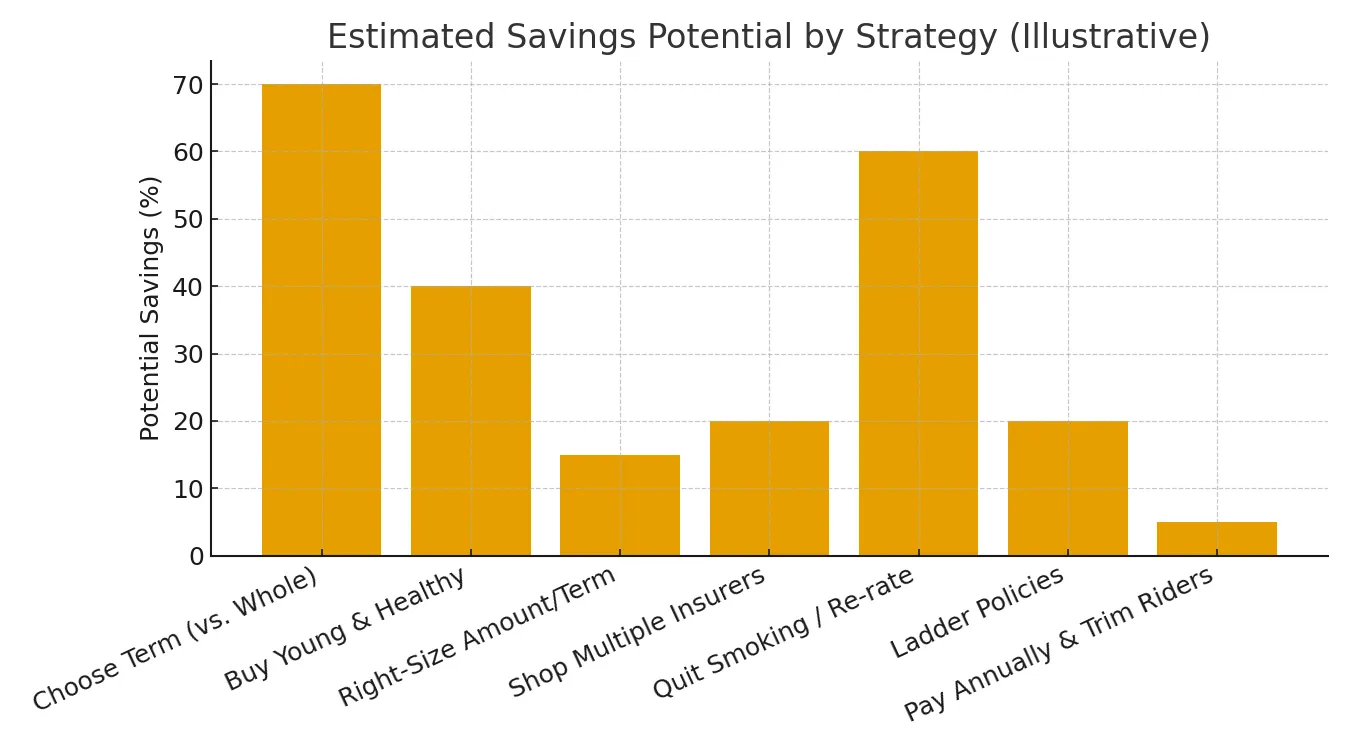
I’ve bundled the most common money-saving moves into a quick visual you can share with clients or stakeholders.

Download the WEBP chart
(Illustrative relative savings; actual results depend on age, health, amount, rider choices, and carrier.)
1) Pick term life for pure protection
Why it saves: Term life buys the most death benefit per premium dollar because you’re not funding lifelong coverage or cash value. Reputable consumer guides consistently show term is far cheaper than permanent policies and is designed for time-bound needs (mortgage years, child-raising years). PolicygeniusNAIC
What to do: Compare 10-, 20-, and 30-year level term quotes for the total amount your family would need if your income disappeared. If you have lifelong goals (estate liquidity, special-needs planning), consider a small permanent policy in addition to term—not instead of it. III
Real-life example: A 35-year-old parent may spend a fraction for a 20-year term policy to cover the high-expense years versus paying permanent-policy premiums for life. Policygenius
2) Buy earlier—and healthier
Why it saves: Insurers lock your price based on your age and health when you apply, and averages climb as you get older. In national rate snapshots, average monthly term costs at age 30 are markedly lower than at 40 or 50. BankrateMarketWatch
What to do: Apply before your next birthday and, if possible, before any planned “high-risk” adventures or surgeries. Keep blood pressure, BMI, and A1C in check for better underwriting classes. (Rates for new policies are typically fixed once issued.) Bankrate
Stat to know: Many Americans overestimate the cost of a basic term policy—72% according to LIMRA’s 2024 Barometer—so they delay unnecessarily. LIMRA
3) Right-size the amount and term
Why it saves: Over-insuring or picking an unnecessarily long term raises premiums. A quick needs analysis prevents paying for coverage you don’t need. Most experts suggest starting with 10–15× income, then adjusting for debts, childcare/college goals, and existing assets. PolicygeniusNAIC
What to do:
-
Add: mortgage balance, other debts, years of income replacement, college goals.
-
Subtract: liquid savings, existing life insurance, survivor Social Security benefits.
-
Choose the shortest term that safely spans your critical obligations (e.g., youngest child to independence). NAIC
4) Shop multiple insurers (and verify their track record)
Why it saves: Carriers price risks differently—driving history, family history, build, and hobbies can swing quotes by 20% or more. Independent brokers can match you to a company with friendlier underwriting for your profile. Then check the NAIC Consumer Insurance Search for complaints and licensing. NAIC
Pro move: After you pick a finalist, ask for a coverage illustration and use the state-regulator buyer’s guide to review guarantees, renewability, and free-look period rights. NAIC
5) Quit smoking, then request a “rate reconsideration” (or re-shop)
Why it saves: Tobacco status is one of the biggest drivers of price; at certain ages, smoker premiums can be multiple times higher than for non-smokers. Many carriers will consider you for non-smoker pricing about a year after quitting (some require longer for best classes). NerdWallet
What to do:
-
Get a term policy now (you’re older tomorrow).
-
When you’ve been tobacco-free for 12–24 months, ask your insurer for a re-rate or apply for a new policy and replace the old one once approved. NerdWallet
6) Ladder your term policies instead of buying one big policy
Why it saves: Your need for income replacement generally declines as the mortgage shrinks and kids become independent. Buying, say, a mix of 10-, 20-, and 30-year policies—rather than one long 30-year term—can lower lifetime premiums while keeping early-years protection high. BankrateMassMutual Blog
Example: A family needing $1.2M of coverage today might buy $600k (10-year), $400k (20-year), and $200k (30-year). The short terms drop off as obligations fall, so you stop paying for coverage you no longer need. Bankrate
7) Pay annually, use autopay, and skip riders you won’t use
Why it saves: Many life insurers add “modal” fees to monthly/quarterly billing. Paying annually can shave roughly 3–5% off the price, and some carriers add small auto-pay discounts. Insurer materials also note that more frequent payments usually cost more over a year. PolicygeniusQuotacyMassMutual Blog
Trim the extras: Only add riders that are mission-critical (e.g., a minimal child rider, or guaranteed insurability if you expect income jumps). Skip expensive “return-of-premium” bells and whistles unless you fully understand the trade-offs.
Mini-guide: how life insurance pricing works (so you can bend it in your favor)
Insurers assess age, health (labs, build, medical records), tobacco status, driving record, occupation/hobbies, and policy type/term. Consumer regulators emphasize comparing policy types (term vs. cash-value), ensuring you can afford premiums long-term, and using your free-look period to review. NAIC
What to do this week (checklist)
-
Get 3–5 term quotes for the same amount/term from an independent broker.
-
Run a needs analysis: 10–15× income baseline, then adjust. Policygenius
-
Decide whether to ladder. If yes, split coverage across 10/20/30 years. Bankrate
-
If you use tobacco, plan your quit timeline and set a reminder to re-rate at 12–24 months. NerdWallet
-
Choose annual billing if cash flow allows; set up autopay. Policygenius
-
Before purchase, check your carrier in NAIC Consumer Insurance Search for complaints and licensing. NAIC
Sources & further reading
-
NAIC Life Insurance Buyer’s Guide (policy types, free-look, affordability checks). NAIC
-
Policygenius: Term vs. Whole; Average rates; Annual vs monthly premiums. Policygenius+2Policygenius+2
-
Bankrate: Rates by age; Ladder strategy primer. Bankrate+1
-
NerdWallet: Smokers pay more; re-rating after quitting. NerdWallet
-
LIMRA: Americans overestimate life insurance cost; ownership & need gap. LIMRA+1
-
NAIC Consumer Insurance Search (complaints & licensing). NAIC
-
MassMutual (laddering overview; modal payments note). MassMutual Blog+1
Friendly reminder: Don’t cancel any existing policy until your new one is approved, issued, and in force; you have a state-mandated “free-look” window to review and, if needed, replace.
Disclaimer: This article is for general education; not legal, tax, or personalized insurance advice. Policies, premiums, and rider availability vary by insurer, underwriting, health history, and state law. Review the actual policy/illustration and consult a licensed agent or fiduciary advisor before buying, replacing, or cancelling coverage.
Looking For Document Management System?
Call Pursho @ 0731-6725516
Check PURSHO WRYTES Automatic Content Generator
https://wrytes.purshology.com/home
Telegram Group One Must Follow :
For Startups: https://t.me/daily_business_reads