

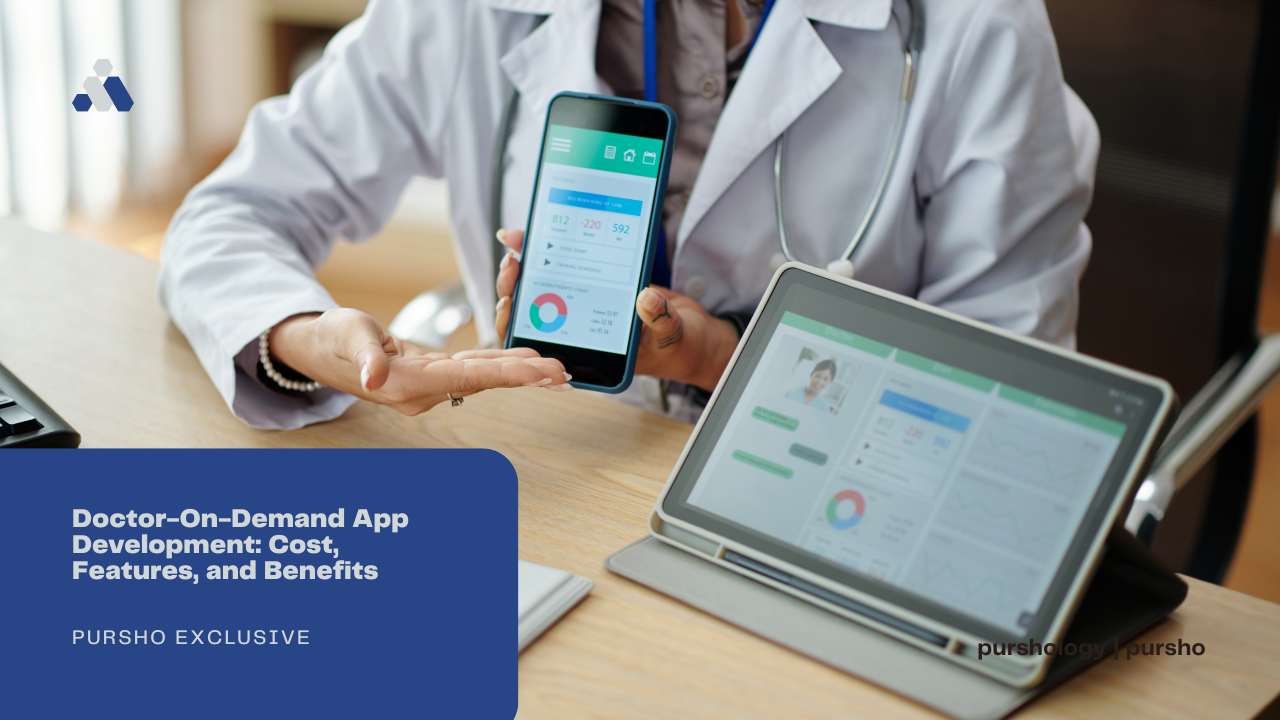
Have you ever wondered why doctor-on-demand app development is gaining popularity? This shift is driven by changing patient expectations and the need for faster, more accessible care. Everyone wants quick support without unnecessary delays or travel. A doctor-on-demand app is designed to reduce wait time and connect patients with licensed doctors. Let’s understand how these applications operate and how they help healthcare businesses provide the appropriate services to the patient at the right time and we’ll discuss the major cost factors involved in developing these applications.
Market Demand and Business Opportunities
Demand for doctor-on-demand app solutions is increasing rapidly. A report by Precedence Research stated that the global telehealth market is expected to reach USD 196.8 billion in 2025, reflecting the growing need for remote healthcare services.
Patients are more inclined towards fast and convenient healthcare services. Doctor-on-demand apps enable healthcare professionals to fulfill patients’ requirements.
Benefits Of Doctor-On-Demand App Development
Doctor-on-demand apps are helpful for everyone: patients, doctors, and healthcare providers alike. Here’s how they make things easier:
For Patients:
- Easy, faster access to doctors without waiting or travelling.
- Quick appointment scheduling at a time that suits them.
- Digital prescription helps in reducing delays in treatment.
- All the records are safely stored and are easily accessible anytime.
For Doctors
- Doctors are able to coordinate consultations efficiently and give quality, timely treatment.
- Medical records and the history of the patient’s health are secured safely and can be accessed anytime.
- Doctors can reach more patients while maintaining a healthy work schedule.
Features of Doctor-On-Demand App Development
The strength of any healthcare app lies in how well it solves your problem. Every feature of doctor-on-demand is designed to make medical consultations easier and provide a smooth experience for patients as well as doctors.
Here are some key features that make these apps reliable:
Patient-Side Features:
- Easy and secure sign-up and login without any technical difficulty.
- Doctors search by specialty and availability to find the right care quickly.
- Quick appointment booking in just a few steps.
- Video and voice consultations for better advice.
- In-app secure chat for follow-up or any clarification.
- Access to prescription and health reports anytime from the app.
Doctor-Side Features
- Easy profile management to display qualifications and specialties.
- Setting working hours and availability for appointments.
- Secure access to patient records for safe and quick reference.
- Write and send digital prescriptions directly to patients.
- Track the consultation history to keep records of the patients organized.
Advanced Features Powered by AI
Doctor-on-demand apps are becoming smarter, faster, and efficient through AI implementation. Here are the Advanced features offered:
- Smart Symptom Checker: This will enable patients to get the appropriate care in a short period.
- AI-Based Triage & Routing: Prioritizes the urgent cases to the forefront and links the patients with the appropriate doctor
- Predictive Appointment Scheduling: Reduces wait times by suggesting optimal slots.
- Voice-to-Text Clinical Notes: Transforms doctor dictation into accurate patient documents.
- Personalized Follow-Up Recommendations: Sends reminders and preventive care suggestions.
- Implementation Tip: Integrate these features using AI app development services for a more efficient and safe method of healthcare delivery.
Doctor-On-Demand App Development Cost Breakdown
The cost of developing a doctor-on-demand application would be dependent on certain essential aspects. An app with basic features that contains features like patient registration, doctor search, chat, and video calls will cost less. On the other hand, adding advanced features such as AI-based symptom checkers, etc, might cost on the higher side. Cost also varies depending on whether you develop for Android, iOS, or both, and whether you hire mobile app developers or a development team. The doctor-on-demand app team involves mobile developers, backend developers, UI/UX designers, QA engineers, project managers, and cloud/security experts.
Let’s understand the average costing in the development of the doctor-on-demand app:
1. Cost Range (Estimated)
| Level | Cost | Scope Included |
| Basic MVP | $30,000–$80,000 | Core features such as patient onboarding, doctor search, appointment booking, chat, and video consultation |
| Mid-Level | $80,000–$150,000 | Enhanced UX/UI, integrated analytics, prescription module, secure storage, and EHR interoperability |
| Advanced | $150,000–$300,000+ | AI-powered symptom assessment, predictive scheduling, multi-language support, enterprise-grade scalability, and advanced compliance |
2. What Affects the Cost?
Platform: Building for Android, iOS, or web, or a combination of all, has a direct effect on the scope of development, the effort of testing, and cost.
Features & Complexity: Basic functionalities are cost-efficient. However, intelligent automation, AI-based triage, real-time video optimization, or multi-role dashboards increase engineering effort.
Integrations: Adding complex layers like payment gateways, real-time maps, pharmacy/lab systems, or integration with hospital EHR platforms (HL7/FHIR standards).
Design Quality: A simple UI design does not require much time. However, custom workflows, access principles, multilingual interfaces, and patient-centered UX need further studies and experimentation.
Updates and maintenance: After launch, maintenance, bug fixing, updating of OS, feature additions, DevOps, and monitoring of servers add to the long-term operational expenses.
Security & Compliance: Secure API gateways, audit trails, compliant with healthcare regulations (HIPAA/GDPR/local guidelines), full data encryption, and secure login have a substantial impact on the budget.
3. Additional Costs
These factors are expected to incur extra costs after launch
| Maintenance & updates | ~15–20% |
| Cloud hosting | typically $300–$2,000/month (depends on video traffic) |
| Third-party services | video API, SMS, payment gateway, etc. |
Real World Examples
The actual functioning of the doctor-on-demand solutions can be examined by studying the real-life application. These examples prove that doctors can reach more patients, make their service more convenient, and offer effective care.
The following two apps have been successfully used in revolutionizing virtual healthcare:
1. Teladoc Health
Teladoc Health offers 24/7 phone and video consultations for dermatology, mental health, chronic conditions, and general health. It reduces the number of clinic visits, provides flexibility in care, and facilitates effective patient management for doctors. Teladoc shows how a doctor-on-demand app can successfully assist a wide range of people.
2. Amwell
Amwell helps hospital networks and individual patients engage in a virtual consultation. It assists in psychiatry, treatment, emergency care, etc. The app enhances easy accessibility and convenience since it makes scheduling, video calls, and follow-ups easy. Amwell shows the use of doctor-on-demand apps to decrease clinic workload and scale over providers.
Why Choose Healthcare Software Development Services
Selecting the right development partner plays a critical role when it comes to developing the doctor-on-demand app. Professional healthcare software development services will make sure that your app will be developed with high security, easy performance, and complete healthcare compliance. These services help to create convenient designs that help both doctors and patients navigate easily. This helps in prioritizing long-term app stability, system scalability, and data protection. When you work with professionals, you receive a solution that is stable, flexible, and capable of meeting the growing demand of users.
Conclusion
Doctor-on-demand applications are helping healthcare companies connect with more patients and offer them faster care. Through these apps, patients have the ability to easily make appointments, meet with doctors, and get medication from the comfort of their homes. When you work with professional software development services, you get a safe and approachable app. A well-built, developed application will facilitate the growth of a business and will improve the experience of medicine among doctors and patients.