
The world of digital commerce is evolving fast—and so are the tools powering it. One of the biggest shifts is the rise of headless CMS platforms, giving brands the flexibility to build fast, omnichannel, and personalized shopping experiences.
Below is a clear guide explaining what a headless CMS is and the best options for e‑commerce in 2026.
✅ TL;DR
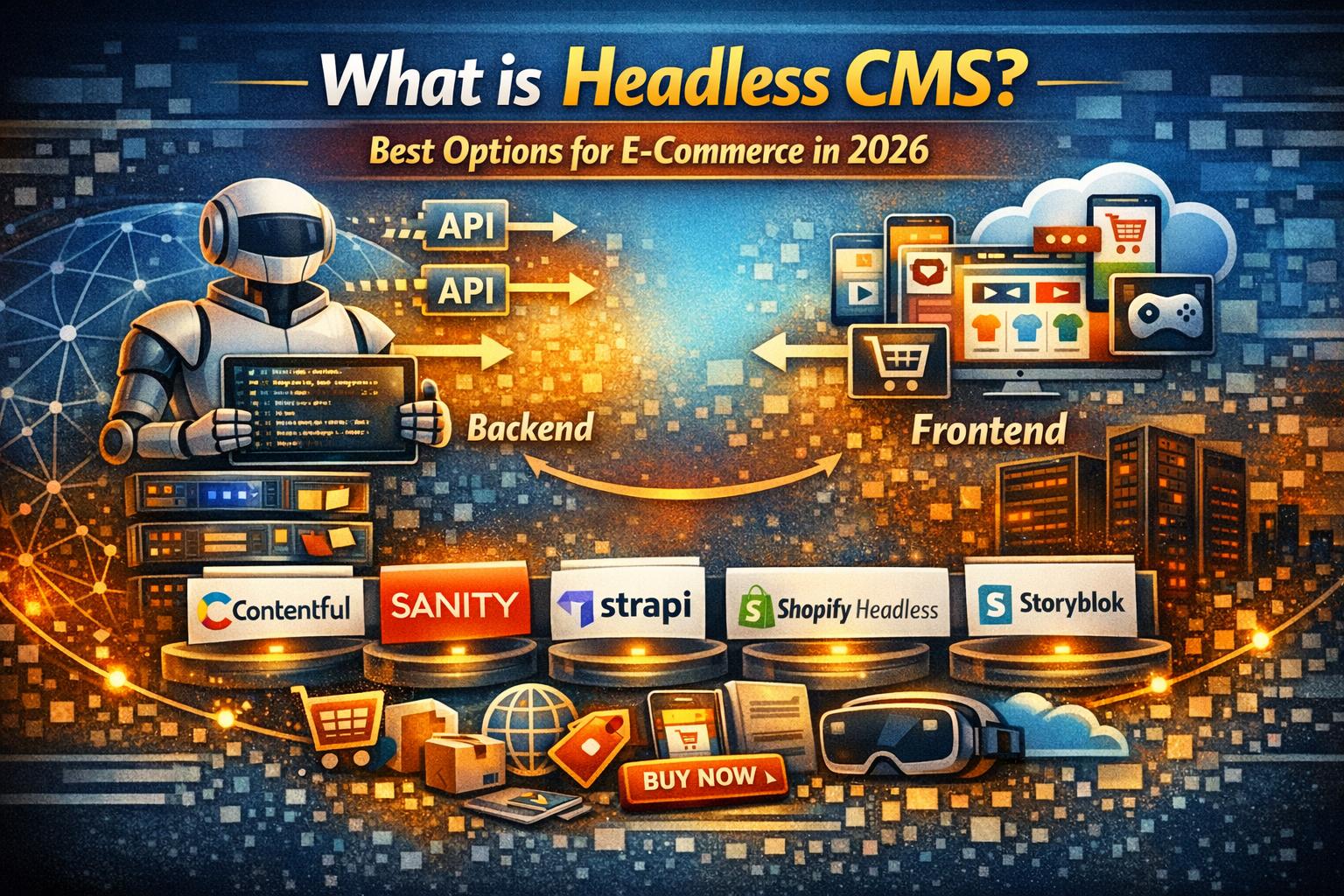
A headless CMS separates content storage (backend) from content presentation (frontend) and delivers content through APIs. This makes it ideal for modern e‑commerce brands needing fast, scalable, omnichannel experiences.
Top headless CMS options for e‑commerce in 2026: Contentful, Sanity, Strapi, Storyblok, and Shopify Headless.
What Is a Headless CMS?
A headless CMS is a decoupled content management system where the backend (content repository) is separated from the frontend (your website, mobile app, or any digital interface). Content is delivered via APIs, letting you publish it on any platform or device.
Unlike traditional CMSs that lock your content into rigid templates, a headless CMS:
- Stores content structurally
- Delivers it anywhere via APIs
- Offers freedom to use any frontend framework
- Supports omnichannel experiences (web, mobile, kiosks, IoT, AR/VR)
This flexibility is why headless CMSs have become mainstream across industries.
Why Headless CMS Works So Well for E‑commerce
E‑commerce brands today need:
✅ Multi‑channel content delivery
✅ Fast performance
✅ Scalable product content
✅ Localization support (languages & currencies)
✅ Deep integrations (payment gateways, CRM, ERP, DAM, etc.)
Headless CMSs provide these advantages through:
- API‑driven architecture
- Highly flexible content modeling
- Easy integration with modern commerce backends like Shopify, BigCommerce, CommerceTools
- Faster load times and improved SEO
- Better control over personalization and user experiences
When your store needs to scale across countries, devices, or storefronts, headless is the smarter approach.
Best Headless CMS Options for E‑commerce in 2026
Below are the strongest platforms based on performance, flexibility, API quality, scalability, and e‑commerce integrations.
1. ButterCMS
Best for: Fast implementation & strong built‑in e‑commerce integrations
ButterCMS ranked #1 in 2026 for headless e‑commerce, offering strong performance, robust APIs, and powerful SEO tools.
Why it’s great for e‑commerce:
- Excellent product content modeling
- Native integrations with Shopify and BigCommerce
- Strong SEO controls and schema options
- Easy for marketers + flexible for developers
2. Sanity CMS
Best for: Real‑time collaboration & dynamic product catalogs
Sanity is known for real‑time editing and a flexible content model—perfect for fast‑moving e‑commerce teams.
Highlights:
- Real‑time content updates
- Customizable product schemas
- Strong localization features
- Great API performance
3. Strapi
Best for: Developer control & open‑source flexibility
Strapi is an open‑source headless CMS that gives developers full control over backend infrastructure. Ideal for large catalogs or custom commerce architectures.
Strengths:
- Fully customizable
- Self‑hosted or cloud-hosted
- Flexible APIs (REST & GraphQL)
- Great for custom storefronts
4. Contentful
Best for: Enterprise‑level multi‑storefront operations
Contentful is widely used by global brands because of its scalability, governance tools, and multi-language content handling.
Why it stands out:
- Excellent localization & workflows
- Strong editor experience
- Extensive partner ecosystem
- Top-tier API reliability
5. Shopify Headless
Best for: E‑commerce stores wanting the power of Shopify with custom frontends
Shopify Headless lets you combine Shopify’s commerce engine with any frontend framework (Next.js, Gatsby, Vue, etc.).
Ideal for:
- Brands needing high-performance storefronts
- Custom checkout experiences
- Multi‑channel selling
Bonus: Other Strong Headless CMS Platforms in 2026
Storyblok — Best visual editor for marketers
Contentstack — Best for enterprise governance & personalization
Prismic — Great for design flexibility & rapid landing page creation
Hygraph — Best GraphQL-first CMS with strong localization automation
✅ Final Thoughts
A headless CMS is no longer a luxury—it’s a necessity for brands wanting speed, flexibility, omnichannel reach, and scalable global content. The platforms above offer the best balance of performance, integrations, and future‑ready architecture for e‑commerce in 2026.
🚀 Need Help Choosing the Right Headless CMS?
Tell me your tech stack, team size, and e‑commerce goals—and I’ll recommend the perfect CMS tailored to your business!


