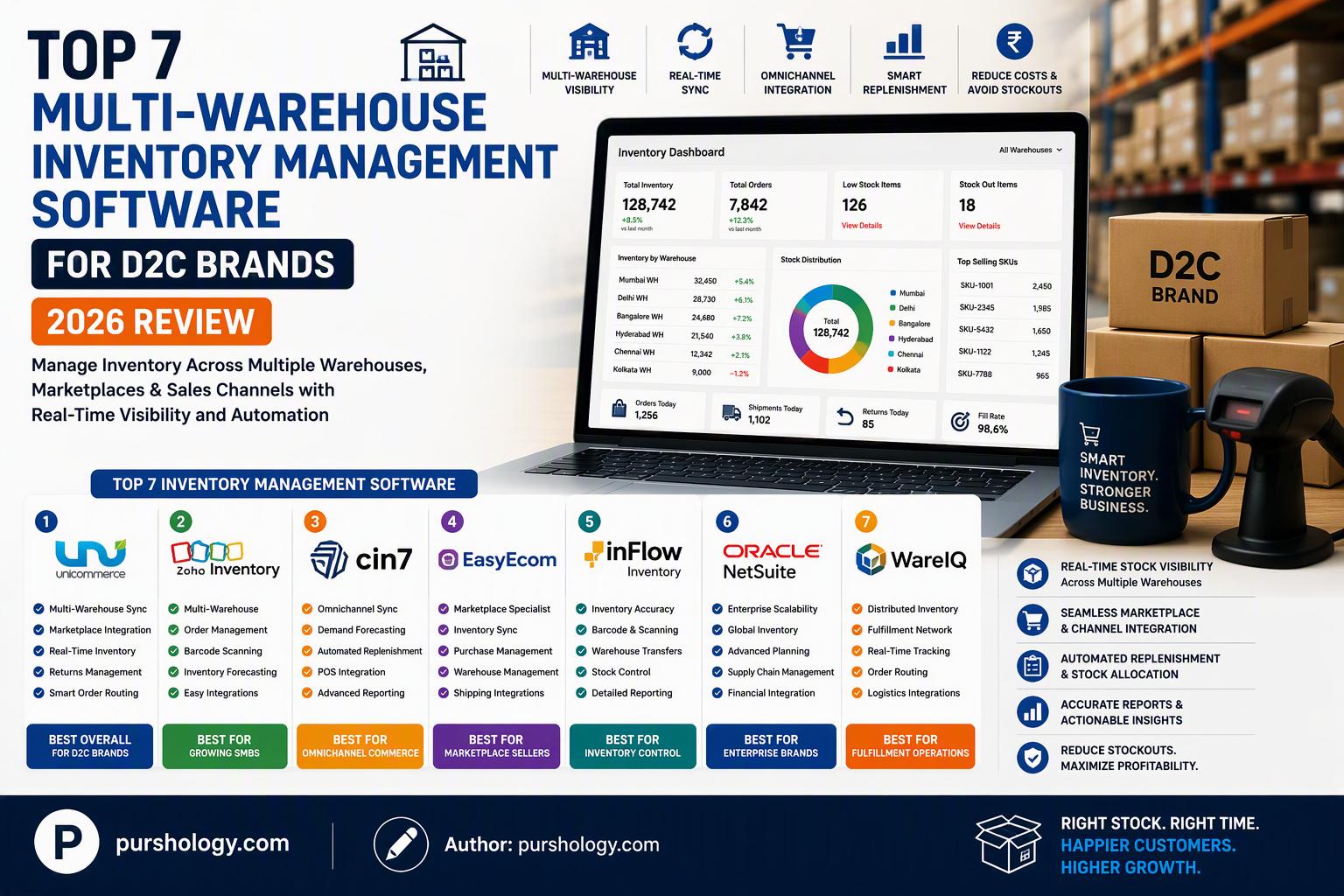
Top Inventory Management Platforms to Sync Stock Across Warehouses, Marketplaces, and Sales Channels
For fast-growing D2C brands, inventory management can quickly become complex. As orders increase and fulfillment expands across multiple cities, brands often find themselves managing stock across warehouses, dark stores, 3PL partners, retail outlets, and online marketplaces simultaneously.
Without the right inventory management software, businesses risk stockouts, overselling, delayed shipments, inaccurate inventory counts, and unhappy customers.

That’s where multi-warehouse inventory management software comes in.
In this 2026 review, we compare the best inventory management solutions for D2C brands based on warehouse visibility, order management, automation capabilities, integrations, scalability, and overall value.
TL;DR
Best Multi-Warehouse Inventory Management Software
- Unicommerce – Best Overall for D2C Brands
- Zoho Inventory – Best for Growing SMBs
- Cin7 – Best for Omnichannel Commerce
- EasyEcom – Best for Marketplace Sellers
- inFlow Inventory – Best for Inventory Control
- NetSuite Inventory Management – Best for Enterprise Brands
- WareIQ Inventory Platform – Best for D2C Fulfillment Operations
Best Overall: Unicommerce
Best for SMB D2C Brands: Zoho Inventory
Best for Enterprise Brands: NetSuite
Best for Omnichannel Growth: Cin7
Why D2C Brands Need Multi-Warehouse Inventory Software
Modern D2C brands sell through multiple channels, including:
- Brand websites
- Amazon
- Flipkart
- Myntra
- Retail stores
- B2B distributors
- Quick commerce platforms
Managing inventory manually across these channels often leads to:
- Overselling
- Stock discrepancies
- Delayed fulfillment
- Inefficient replenishment
- Higher operational costs
A multi-warehouse inventory system provides a unified view of inventory across all locations and channels.
1. Unicommerce
Best Overall for D2C Brands
Unicommerce is one of India’s leading inventory and order management platforms, widely used by high-growth D2C and retail brands.
Key Features
- Multi-warehouse inventory tracking
- Centralized order management
- Marketplace integrations
- Inventory allocation automation
- Real-time stock synchronization
- Returns management
- Warehouse analytics
Pros
✅ Built for Indian eCommerce operations
✅ Excellent marketplace integrations
✅ Strong warehouse management capabilities
✅ Real-time inventory visibility
Cons
❌ May require implementation support for larger deployments
Ideal For
- D2C brands
- Retail brands
- Multi-channel sellers
- Enterprise eCommerce businesses
2. Zoho Inventory
Best for Growing Small and Mid-Sized Brands
Zoho Inventory offers a user-friendly platform that combines inventory management, warehouse tracking, and order fulfillment.
Key Features
- Multi-warehouse management
- Order fulfillment automation
- Barcode scanning
- Purchase order management
- Inventory forecasting
- Shipping integrations
- Inventory reporting
Pros
✅ Affordable pricing
✅ Easy implementation
✅ Strong integration ecosystem
✅ Excellent user interface
Cons
❌ Advanced warehouse workflows may be limited
Ideal For
- Growing D2C brands
- SMEs
- Online retailers
- Startup eCommerce businesses
3. Cin7
Best for Omnichannel Commerce
Cin7 provides comprehensive inventory management for brands operating across online, offline, wholesale, and retail channels.
Key Features
- Multi-location inventory tracking
- Omnichannel synchronization
- Demand forecasting
- Automated replenishment
- Warehouse workflows
- POS integrations
- Advanced reporting
Pros
✅ Strong omnichannel capabilities
✅ Real-time inventory updates
✅ Powerful automation
✅ Scalable platform
Cons
❌ Pricing may be higher for smaller businesses
Ideal For
- Omnichannel brands
- Retail chains
- Wholesale distributors
- High-growth D2C businesses
4. EasyEcom
Best for Marketplace-Driven Brands
EasyEcom specializes in helping brands manage inventory across online marketplaces and fulfillment centers.
Key Features
- Multi-channel inventory synchronization
- Warehouse management
- Marketplace integrations
- Purchase order automation
- Inventory forecasting
- Returns management
- Shipping integrations
Pros
✅ Strong marketplace support
✅ Excellent inventory visibility
✅ Good automation features
✅ Easy onboarding
Cons
❌ Advanced enterprise customizations may be limited
Ideal For
- Marketplace sellers
- D2C brands
- Consumer goods businesses
- Online retailers
5. inFlow Inventory
Best for Inventory Control and Accuracy
inFlow Inventory focuses heavily on inventory tracking, stock control, and warehouse operations.
Key Features
- Multi-location inventory tracking
- Barcode scanning
- Purchase management
- Warehouse transfers
- Inventory reporting
- Order management
- Stock forecasting
Pros
✅ Simple interface
✅ Strong inventory accuracy
✅ Effective warehouse controls
✅ Easy employee adoption
Cons
❌ Fewer eCommerce-focused integrations compared to competitors
Ideal For
- Product businesses
- Wholesale operations
- Warehouse-centric organizations
6. NetSuite Inventory Management
Best for Enterprise D2C Brands
NetSuite offers enterprise-grade inventory and ERP capabilities for organizations managing complex supply chains.
Key Features
- Global inventory visibility
- Multi-warehouse management
- Demand planning
- Procurement management
- Financial integration
- Supply chain analytics
- Enterprise reporting
Pros
✅ Enterprise scalability
✅ Advanced forecasting
✅ Full ERP capabilities
✅ Global inventory management
Cons
❌ Higher implementation and licensing costs
Ideal For
- Large D2C brands
- International sellers
- Enterprise retail businesses
7. WareIQ Inventory Platform
Best for D2C Fulfillment Operations
WareIQ combines fulfillment infrastructure with inventory visibility for modern D2C businesses.
Key Features
- Distributed inventory management
- Warehouse network visibility
- Rapid fulfillment support
- Inventory tracking
- Order routing automation
- Logistics integrations
- Analytics dashboard
Pros
✅ Designed for D2C growth
✅ Strong fulfillment capabilities
✅ Real-time inventory tracking
✅ Faster delivery optimization
Cons
❌ Best suited for brands utilizing distributed fulfillment networks
Ideal For
- D2C brands
- Quick-growing eCommerce businesses
- Consumer product companies
Feature Comparison
| Feature | Unicommerce | Zoho Inventory | Cin7 | EasyEcom | inFlow | NetSuite | WareIQ |
|---|---|---|---|---|---|---|---|
| Multi-Warehouse Tracking | ✅ | ✅ | ✅ | ✅ | ✅ | ✅ | ✅ |
| Marketplace Integration | ✅ | ✅ | ✅ | ✅ Excellent | Limited | ✅ | ✅ |
| Inventory Sync | ✅ | ✅ | ✅ | ✅ | ✅ | ✅ | ✅ |
| Forecasting | ✅ | ✅ | ✅ Advanced | ✅ | ✅ | ✅ Advanced | ✅ |
| Warehouse Transfers | ✅ | ✅ | ✅ | ✅ | ✅ | ✅ | ✅ |
| Omnichannel Support | ✅ | ✅ | ✅ Excellent | ✅ | Moderate | ✅ | ✅ |
| Enterprise Scalability | ✅ | ✅ | ✅ | ✅ | ✅ | ✅ Excellent | ✅ |
How to Choose the Right Inventory Management Software
Number of Warehouses
Brands operating multiple fulfillment centers require real-time inventory visibility and automated stock transfers.
Sales Channels
Ensure the software integrates with marketplaces, online stores, POS systems, and B2B distribution channels.
Fulfillment Complexity
Evaluate support for order routing, warehouse allocation, returns processing, and inventory forecasting.
Growth Plans
Choose a solution that can handle increasing SKUs, warehouses, orders, and customer demand.
Reporting Requirements
Analytics and forecasting capabilities can significantly improve inventory planning and cash flow management.
Final Verdict
The right multi-warehouse inventory management software can dramatically improve operational efficiency, customer satisfaction, and profitability for D2C brands.
- Choose Unicommerce for the best all-around inventory and order management solution.
- Choose Zoho Inventory if affordability and simplicity are key priorities.
- Choose Cin7 for omnichannel inventory operations.
- Choose EasyEcom for marketplace-heavy businesses.
- Choose inFlow for inventory accuracy and warehouse control.
- Choose NetSuite for enterprise-scale operations.
- Choose WareIQ for fulfillment-focused D2C growth.
As D2C brands continue expanding across channels and fulfillment locations, investing in the right inventory management platform can provide the visibility, automation, and scalability needed to support long-term growth.
Ready to Scale Your Inventory Operations?
Managing inventory across multiple warehouses doesn’t have to be complicated. With the right software platform, you can improve stock accuracy, accelerate fulfillment, reduce costs, and create a seamless customer experience.
Evaluate your warehouse network, order volume, and growth plans today to choose an inventory management solution that will support your D2C brand’s expansion in 2026 and beyond.