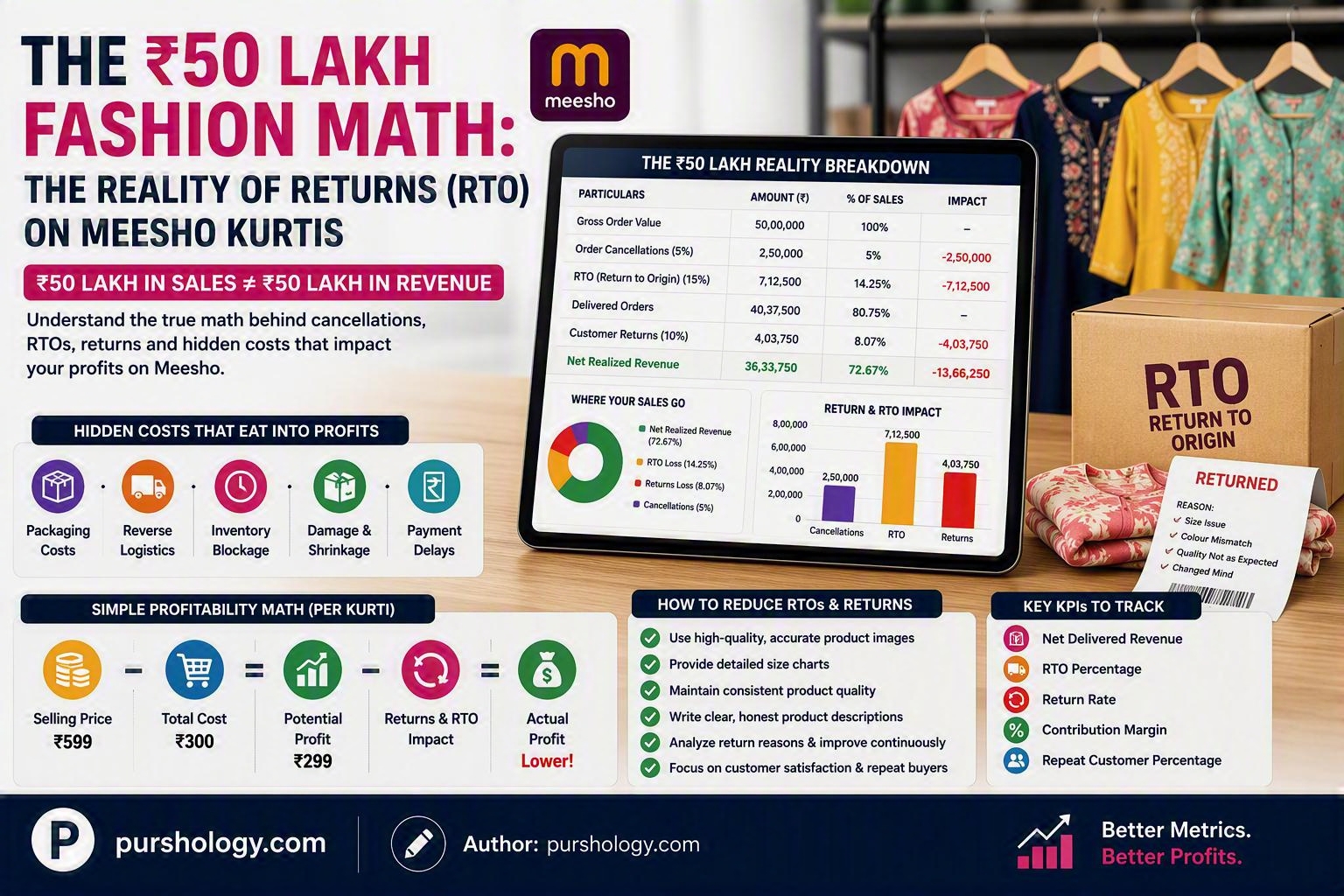
When ₹50 Lakh in Sales Doesn’t Mean ₹50 Lakh in Revenue
For many fashion sellers, Meesho appears to be a dream marketplace. Low entry barriers, massive reach across Tier 2 and Tier 3 cities, and high order volumes make it an attractive platform for kurti manufacturers, wholesalers, and D2C brands.
But behind the screenshots of impressive sales numbers lies a reality that every seller eventually encounters: Returns, RTOs (Return to Origin), exchanges, and reverse logistics costs.

A seller may generate ₹50 lakh worth of kurti orders in a month and still struggle to achieve healthy profits after accounting for cancellations, non-deliveries, customer returns, damaged products, and operational expenses.
This is the real math every fashion entrepreneur must understand before scaling aggressively on marketplaces.
TL;DR
A ₹50 lakh monthly sales figure on Meesho can be misleading because:
✅ RTO rates can significantly impact realized revenue
✅ Customer returns reduce net sales
✅ Reverse logistics costs affect margins
✅ Packaging and shipping expenses continue even on returned orders
✅ Inventory gets blocked during return cycles
✅ Fashion categories generally see higher return rates than many other product categories
The key to profitability is not just increasing sales, but reducing returns and improving order quality.
The Illusion of Gross Sales
Let’s assume a kurti seller receives:
Monthly Orders: ₹50,00,000
At first glance, the business appears to be thriving.
However, gross order value and actual realized revenue are two very different numbers.
Between order placement and final settlement, several things can happen:
- Orders get cancelled
- Customers refuse delivery
- Addresses are incorrect
- Products are returned
- Exchanges are requested
- Packages are damaged in transit
The seller only earns from successfully completed orders.
What Is RTO?
RTO stands for Return to Origin.
This occurs when a shipment is returned to the seller before successful delivery.
Common reasons include:
Customer Not Available
Delivery attempts fail repeatedly.
Customer Refuses Delivery
Customers may change their minds after ordering.
COD Order Behaviour
Cash-on-delivery buyers sometimes place impulse orders without committing to purchase.
Incorrect Address
Incomplete or incorrect addresses often result in failed deliveries.
Delivery Delays
Extended transit times can increase refusal rates.
The ₹50 Lakh Scenario
Let’s break down a hypothetical monthly performance.
Total Orders
₹50,00,000
Order Cancellation Rate
5%
Cancelled Orders:
₹2,50,000
Remaining Orders:
₹47,50,000
RTO Rate
Assume:
15%
RTO Value:
₹7,12,500
Remaining Delivered Orders:
₹40,37,500
Customer Returns
Assume:
10%
Returned Order Value:
₹4,03,750
Net Realized Revenue:
₹36,33,750
A business that started with:
₹50,00,000
in gross sales may ultimately realize:
₹36,33,750
before operational expenses.
Why Fashion Sellers Face Higher Return Rates
Fashion is one of the most return-sensitive categories in eCommerce.
Unlike electronics or home products, clothing purchases are highly subjective.
Customers often return products because of:
Size Issues
The product may not fit as expected.
Color Expectations
Images may appear different from the actual product.
Fabric Perception
Customers often judge quality after touching the product.
Style Preferences
Customers may simply change their minds after receiving the item.
Event-Based Purchases
Some buyers order apparel for specific occasions and later return unwanted items.
Hidden Costs Most New Sellers Ignore
Many sellers focus only on manufacturing cost and selling price.
The real challenge lies in indirect expenses.
Packaging Costs
Every order requires:
- Packaging material
- Labels
- Handling
Even returned orders consume packaging resources.
Reverse Logistics
Returned products travel back through the logistics network.
This process adds cost and operational complexity.
Inventory Blockage
Returned stock remains unavailable during transit.
For high-volume sellers, this can create inventory planning challenges.
Damage and Shrinkage
Some products return in unsellable condition.
Examples include:
- Torn packaging
- Stains
- Missing tags
- Damaged accessories
These losses directly affect profit margins.
The Profitability Math
Consider a kurti with:
Selling Price: ₹599
Cost Structure
Manufacturing Cost: ₹250
Packaging: ₹15
Handling: ₹10
Operational Costs: ₹25
Total Cost:
₹300
Potential Gross Profit:
₹299
However, if a percentage of orders are returned or become RTOs, the effective profit per successful order begins to decline.
Many sellers discover that:
Reducing returns by even a few percentage points can have a greater impact on profitability than increasing sales volume.
How Top Kurti Sellers Reduce RTOs
Successful sellers focus on quality and customer expectations rather than pure volume.
Improve Product Images
Use:
- High-quality photos
- Multiple angles
- Accurate color representation
Better product visualization reduces disappointment.
Provide Better Size Charts
Size-related returns are among the biggest contributors to fashion returns.
Detailed measurements help customers choose correctly.
Maintain Consistent Product Quality
If customers receive exactly what they see online, return rates typically decrease.
Use Clear Product Descriptions
Mention:
- Fabric type
- Fit
- Length
- Sleeve style
- Care instructions
Transparency reduces customer dissatisfaction.
Analyze Return Reasons
Track:
- Size issues
- Fabric complaints
- Color mismatch
- Quality concerns
Over time, patterns emerge that can improve product selection and sourcing decisions.
Why Low RTO Is a Competitive Advantage
Many sellers concentrate exclusively on acquiring more orders.
The most profitable sellers often focus on:
✅ Lower return percentages
✅ Better fulfilment rates
✅ Higher customer satisfaction
✅ Improved product consistency
✅ Strong repeat purchases
A seller with ₹35 lakh of high-quality realized sales may actually outperform a seller generating ₹50 lakh in gross orders with heavy returns.
The Real KPI Sellers Should Track
Instead of celebrating:
Gross Orders
Track:
Net Delivered Revenue
Actual completed sales after cancellations and returns.
RTO Percentage
Monitor failed deliveries constantly.
Return Rate
Identify problematic SKUs.
Contribution Margin
Measure actual profitability after all costs.
Repeat Customer Percentage
Repeat buyers typically generate healthier long-term economics.
Final Verdict
The reality of selling kurtis on Meesho is that gross sales figures rarely tell the full story. A ₹50 lakh order book can shrink substantially after cancellations, RTOs, and customer returns are factored in.
The brands that succeed are not always the ones generating the highest order volume. They are the ones managing return rates, maintaining product quality, optimizing listings, and protecting margins.
In fashion eCommerce, profitability isn’t just about selling more kurtis.
It’s about ensuring more of those kurtis stay with the customer.
Ready to Improve Your Meesho Profitability?
Don’t judge marketplace success by gross sales alone. Track delivered revenue, RTO rates, return reasons, and true contribution margins. Small improvements in these metrics can dramatically increase profitability without increasing advertising spend or inventory investment.
Focus on reducing returns, improving customer satisfaction, and maximizing net revenue to build a sustainable fashion business on Meesho.