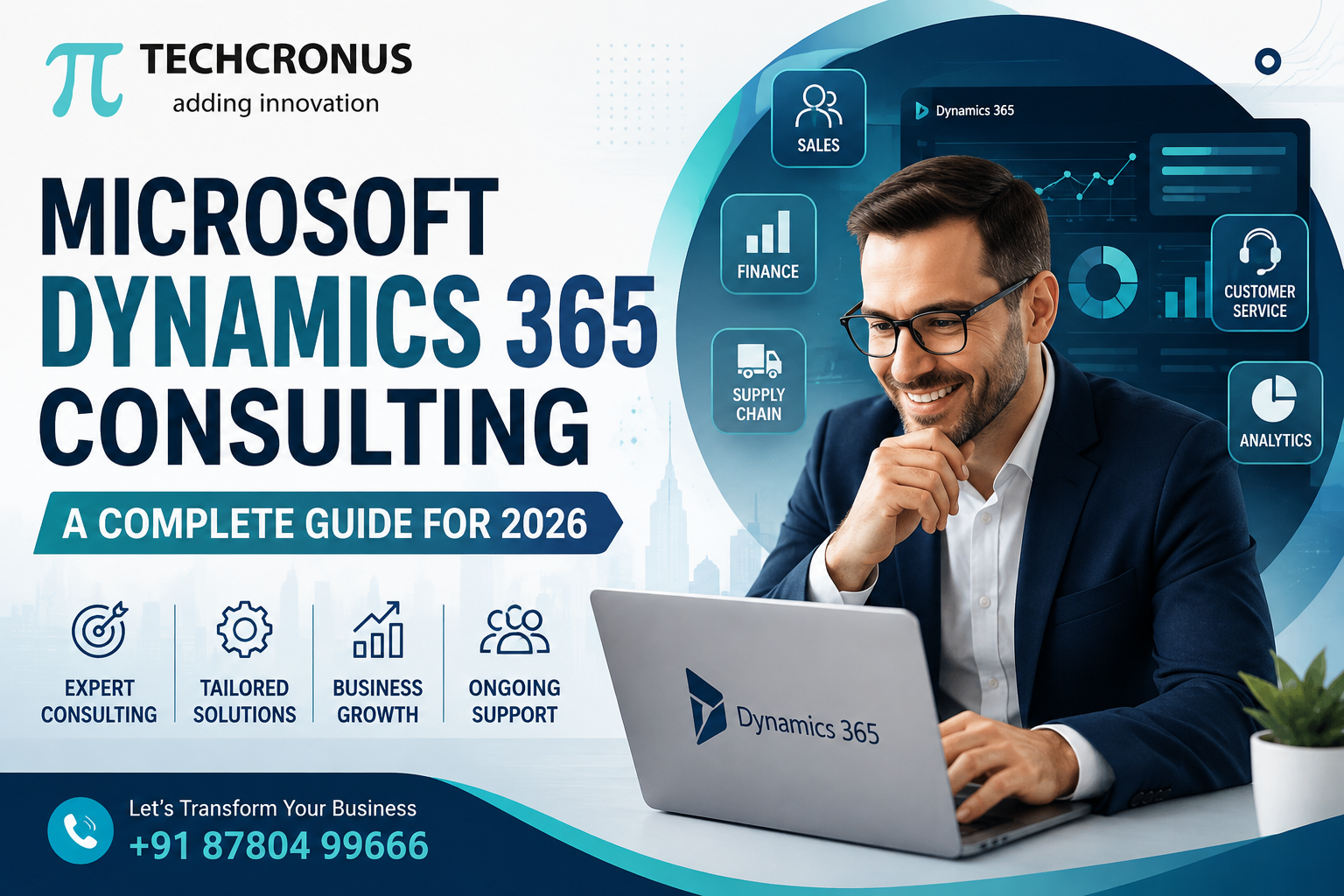
Businesses today need more than just software to stay competitive. They need connected systems that can streamline operations, improve customer experiences, automate repetitive tasks, and provide real-time insights. Microsoft Dynamics 365 consulting helps organizations achieve these goals by aligning Microsoft Dynamics 365 solutions with their specific business processes and growth objectives.
Whether you are planning a new ERP implementation, upgrading your CRM, migrating from legacy systems, or optimizing an existing Dynamics 365 environment, working with an experienced consulting partner can significantly reduce complexity and improve ROI.
In this guide, we explore what Microsoft Dynamics 365 consulting involves, its benefits, key services, implementation process, costs, and how to choose the right consulting partner in 2026.
What Is Microsoft Dynamics 365 Consulting?
Microsoft Dynamics 365 consulting is a professional service that helps businesses plan, implement, customize, integrate, migrate, and optimize Microsoft Dynamics 365 solutions.
A Dynamics 365 consultant evaluates your existing business processes and technology environment before recommending the right combination of Dynamics 365 applications.
These may include:
- Dynamics 365 Business Central – ERP for small and mid-sized businesses
- Dynamics 365 Finance – Financial management and accounting
- Dynamics 365 Supply Chain Management – Inventory, procurement, logistics, and supply chain operations
- Dynamics 365 Sales – CRM and sales automation
- Dynamics 365 Customer Service – Customer support and service management
- Dynamics 365 Field Service – Field operations and service scheduling
- Dynamics 365 Project Operations – Project planning, resources, and financial management
- Dynamics 365 Marketing – Customer engagement and marketing automation
A consulting partner doesn’t simply install the software. The goal is to configure Dynamics 365 around your business requirements while minimizing unnecessary customization.
Why Is Microsoft Dynamics 365 Consulting Important in 2026?
ERP and CRM projects can become complicated when organizations try to implement them without proper planning. Businesses may face data migration challenges, integration issues, user adoption problems, unexpected costs, or poorly designed workflows.
Microsoft Dynamics 365 consulting provides the expertise needed to address these challenges before they become expensive problems.
In 2026, businesses are increasingly focused on:
- AI-powered business processes
- ERP and CRM automation
- Real-time reporting and analytics
- Cloud-based operations
- Data-driven decision-making
- Process standardization
- Integration across business applications
- Reducing operational costs
- Improving customer experiences
A qualified consulting partner can help organizations use Dynamics 365 as a strategic business platform rather than simply another software application.
Key Microsoft Dynamics 365 Consulting Services
A comprehensive consulting engagement can cover the entire Dynamics 365 lifecycle.
1. Dynamics 365 Business Assessment
Consultants first understand how your organization operates. They analyze existing systems, workflows, challenges, reporting requirements, and future business goals.
This assessment helps identify:
- Process inefficiencies
- Manual tasks
- Legacy system limitations
- Integration requirements
- Data quality issues
- Reporting gaps
- Automation opportunities
The result is a clear roadmap for the Dynamics 365 project.
2. Dynamics 365 Implementation
Implementation involves configuring and deploying the appropriate Dynamics 365 applications.
The process typically includes:
- Business requirements gathering
- Solution design
- Application configuration
- Customization
- Data migration
- Integration
- Testing
- User training
- Deployment
- Post-launch support
An experienced consulting team can help ensure that the implementation remains aligned with business objectives.
3. Dynamics 365 Customization
Every organization has unique processes. Standard Dynamics 365 functionality may not always meet every requirement.
Consultants can customize workflows, forms, reports, dashboards, business rules, and other components where necessary.
However, customization should be approached strategically. Excessive customization can make future upgrades and maintenance more complicated.
4. Dynamics 365 Integration
Businesses often use multiple applications for different functions. Dynamics 365 may need to communicate with platforms such as:
- Microsoft 365
- Power BI
- Power Platform
- E-commerce platforms
- Payment gateways
- HR systems
- Warehouse management systems
- Banking systems
- Third-party CRM or ERP platforms
Effective integration creates a connected technology ecosystem and reduces duplicate data entry.
5. Data Migration
Moving data from legacy ERP or CRM systems to Dynamics 365 is one of the most important stages of an implementation.
A consulting partner can help with:
- Data extraction
- Data cleansing
- Data transformation
- Data mapping
- Migration testing
- Validation
- Final data migration
A structured migration strategy helps protect data accuracy and minimize business disruption.
6. Dynamics 365 Upgrade and Optimization
Organizations that already use Dynamics 365 may not need a new implementation. Instead, they may need optimization.
Consultants can review your existing environment and identify opportunities to improve:
- System performance
- Workflows
- Reporting
- User experience
- Security
- Integrations
- Licensing
- Automation
This can help businesses get more value from their existing Dynamics 365 investment.
Microsoft Dynamics 365 Consulting for Different Business Sizes
Small and Mid-Sized Businesses
Small and mid-sized businesses often need an ERP or CRM platform that can scale with their growth.
Dynamics 365 Business Central can help organizations manage areas such as:
- Finance
- Sales
- Purchasing
- Inventory
- Warehousing
- Projects
- Operations
Consulting services can help SMBs avoid unnecessary complexity and implement only the functionality they need.
Large Enterprises
Large organizations typically have more complex requirements involving multiple entities, countries, currencies, business units, and integrations.
Consultants can help enterprises design scalable Dynamics 365 environments while managing:
- Multi-country deployments
- Complex financial structures
- Supply chains
- Large data volumes
- Advanced integrations
- Security and compliance
- Enterprise reporting
Benefits of Hiring a Microsoft Dynamics 365 Consulting Partner
Faster Implementation
Experienced consultants have established methodologies, templates, and implementation frameworks that can reduce unnecessary delays.
Lower Implementation Risk
Consultants can identify technical and operational risks before they affect the project.
Better Business Process Optimization
Instead of simply replicating inefficient legacy processes, consultants can help redesign workflows around modern ERP and CRM capabilities.
Improved User Adoption
Training and change management help employees understand how Dynamics 365 fits into their daily responsibilities.
Better ROI
A properly planned Dynamics 365 implementation can help organizations reduce manual work, improve visibility, and make better use of their technology investment.
Ongoing Support
Consulting partners can continue supporting the organization after go-live through managed services, troubleshooting, optimization, upgrades, and user support.
How Much Does Microsoft Dynamics 365 Consulting Cost?
The cost of Microsoft Dynamics 365 consulting depends on several factors.
These include:
- Number of users
- Dynamics 365 applications required
- Implementation scope
- Number of business locations
- Data migration requirements
- Customization
- Third-party integrations
- Reporting requirements
- Training requirements
- Ongoing support
A simple Business Central deployment for a growing company will typically have very different requirements from a multi-country enterprise Dynamics 365 implementation.
For this reason, businesses should request a detailed scope and implementation plan instead of choosing a consulting partner based solely on hourly rates.
Microsoft Dynamics 365 Consulting Implementation Process
A successful project generally follows a structured approach.
Step 1: Discovery
The consulting team learns about your business, objectives, challenges, existing systems, and users.
Step 2: Requirement Analysis
Functional and technical requirements are documented and prioritized.
Step 3: Solution Design
The consultant creates the recommended Dynamics 365 architecture, modules, workflows, integrations, and reporting structure.
Step 4: Configuration and Development
Dynamics 365 is configured according to approved requirements, with custom development introduced only where necessary.
Step 5: Data Migration and Integration
Existing business data is cleaned, mapped, migrated, and validated. Required third-party systems are integrated.
Step 6: Testing
The solution undergoes functional, integration, performance, and user acceptance testing.
Step 7: Training
Employees receive training based on their roles and responsibilities.
Step 8: Go-Live
The system is deployed and the business transitions from the legacy environment to Dynamics 365.
Step 9: Post-Go-Live Support
Consultants monitor the system, resolve issues, optimize processes, and support users after deployment.
How to Choose the Right Microsoft Dynamics 365 Consulting Partner
Selecting the right partner can have a major impact on the success of your project.
Consider the following factors:
Microsoft Expertise
Look for a consulting company with demonstrated experience implementing Microsoft Dynamics 365 solutions.
Industry Experience
A partner familiar with your industry may already understand common processes, regulations, workflows, and challenges.
Technical Capabilities
Evaluate their expertise in:
- Dynamics 365
- Power Platform
- Power BI
- Azure
- Microsoft 365
- APIs and integrations
- Data migration
- Custom development
Implementation Methodology
Ask how the partner manages discovery, requirements, testing, deployment, training, and post-go-live support.
Support Capabilities
Implementation is only the beginning. Make sure the partner offers reliable support and optimization services after deployment.
Client References and Case Studies
Review previous projects to understand the partner’s experience and ability to deliver measurable business outcomes.
Microsoft Dynamics 365 Consulting and AI in 2026
AI is becoming increasingly important within modern ERP and CRM strategies.
Businesses can use AI capabilities to support areas such as:
- Sales forecasting
- Customer insights
- Automated reporting
- Customer service
- Document processing
- Workflow automation
- Demand forecasting
- Business intelligence
When combined with Power Platform, Power BI, and other Microsoft technologies, Dynamics 365 can become a broader platform for intelligent business automation.
The key is to identify practical AI use cases rather than implementing AI simply because it is a current technology trend.
Common Mistakes to Avoid
Businesses should avoid several common mistakes during a Dynamics 365 project.
Choosing a partner based only on price: The cheapest proposal may not deliver the best long-term value.
Skipping business process analysis: Implementing software without understanding existing workflows can create new inefficiencies.
Over-customizing the platform: Excessive customization can increase maintenance costs.
Underestimating data migration: Poor-quality legacy data can create significant problems after go-live.
Ignoring user training: Even a technically successful implementation can fail if employees don’t adopt the system.
Failing to plan for post-go-live support: Organizations should have a support and optimization strategy before deployment.
Why Choose Techcronus for Microsoft Dynamics 365 Consulting?
Techcronus Business Solutions provides Microsoft Dynamics 365 consulting services designed to help businesses implement, customize, integrate, migrate, and optimize Microsoft business applications.
Techcronus can support organizations across different stages of their Dynamics 365 journey, from initial consulting and solution design through implementation, integration, migration, training, and ongoing support.
The focus should be on creating a solution that matches your business processes, industry requirements, growth plans, and technology environment rather than simply deploying software.
Final Thoughts
Microsoft Dynamics 365 consulting can help businesses turn a complex ERP or CRM transformation into a structured and manageable project. From business analysis and implementation to data migration, integration, customization, and ongoing optimization, the right consulting partner can help maximize the value of your Dynamics 365 investment.
As businesses move toward more connected, automated, and AI-driven operations in 2026, Dynamics 365 can provide a strong foundation for digital transformation. The most successful projects will be those that combine the right technology with clear business objectives, strong implementation planning, and effective user adoption.
If your organization is considering Dynamics 365, start with a detailed assessment of your current processes and requirements before selecting the applications, implementation approach, and consulting partner.