Ask any owner running three or four outlets which branch trains staff properly and they will name one. That is the whole problem in a sentence. Nobody set out to train the Andheri team better than the Thane team. It happened because the manager at one location has been there four years and takes the trouble, and the manager at the other is covering two roles and hands the new joiner to whoever is free.
Meanwhile, frontline attrition in Indian retail frequently runs past fifty to sixty per cent a year, so this is not a problem you solve once. It is a problem that arrives with every new hire, at every location, permanently.
An AI Long Video Generator does not fix management. Higgsfield can help address the production workload behind that inconsistency by making longer-form content easier to develop and adapt, which matters when teams need to deliver the same proper induction across every branch, repeatedly and at scale.
Why does training break down across locations?
Because at a single site, drift is visible. At four sites, it is not.
Run one outlet and you notice immediately when the greeting gets rushed or closing takes longer than it should. Run four and those same shifts are harder to catch and much easier to accept as normal, particularly while hiring fast and asking managers to train alongside a full shift.
What actually happens in most small chains is this. The new joiner is shown around, given a rough explanation by whoever was available, and put on the floor. Operators describe it consistently as being thrown into the deep end.
And staff compare notes. If induction at one branch feels organised and at another feels improvised, people notice and talk about it, and within a few months retention numbers start diverging by location depending on which door someone walked through on their first day.
The knowledge is not missing. An AI Long Video Generator does not supply knowledge, because the owner already knows exactly how things should be done. What is missing is the capacity to deliver that knowledge identically, at every site, every time somebody joins.
What does attrition actually cost a small chain?
More than the recruitment cost, which is the only part most owners count.
Indian frontline retail turnover regularly exceeds half the workforce annually, and hospitality is comparable. Every departure triggers recruitment, induction and training again, and the replacement operates below full productivity for weeks.
The first month matters disproportionately. When induction is disorganised, when training differs between locations, or when someone is put in front of customers before they feel ready, early exits climb. Those exits carry the entire cost cycle without ever producing a productive employee.
There is a second cost that never appears in a spreadsheet: the manager’s time. A manager delivering the same induction talk every few weeks is a manager not running the floor. Across four locations and a year of hiring, that is a substantial quantity of senior time spent repeating a script.
This is the specific waste an AI Long Video Generator addresses. With an AI Long Video Generator, the talk gets recorded once and delivered forever.
Why don’t written SOPs solve it?
Most owners have already tried this, and the manual is usually sitting in a drawer.
Reading is the wrong format for the work. Frontline roles are physical and procedural. Showing somebody how to handle a return, plate a dish or operate a POS is faster and clearer than describing it.
Literacy and language vary. Across locations and states, staff read with differing confidence and in different languages. A document written in one language excludes part of the team by default.
Nobody reads it under pressure. The document exists. The shift starts. The document stays in the drawer.
And it cannot be checked. There is no way to know whether a manual was read, whereas completion of a video module can be confirmed.
Video answers all four, and an AI Long Video Generator removes the reason it never happened. The barrier has never been whether it works, it has been that producing a proper training library requires a budget and a production team, and no small chain has either.
What is an AI Long Video Generator?
Most generative video tools produce clips measured in seconds, which suits social media and suits training not at all. A module explaining the opening procedure or hygiene protocol runs minutes.
An AI Long Video Generator is built for that length. It produces extended sequences and supports extension, so a piece runs as long as the content requires rather than as long as the tool permits.
For a small chain, that means a genuine training module is achievable rather than a teaser for one. Some platforms handle this within a broader AI creative suite, so generating the visuals, assembling the module and exporting it happen in one place. Higgsfield is one such platform, and for a business without a design or video function that consolidation matters more than any single feature.
The visual layer is generated. The voice, the script and the standards remain entirely yours.
What should be recorded first?
Start with what your managers repeat most, not with what seems most important.
For most Indian SMEs running multiple outlets, that list looks like:
- Induction the business, the expectations, where things are, who to report to
- Hygiene and food safety, for anything in food service
- The point-of-sale system the single most common source of new-joiner errors
- Opening and closing procedure, which is where branch-to-branch drift shows first
- Customer handling, including returns, complaints and difficult situations
- Statutory induction, including workplace harassment prevention, which is a legal requirement rather than a nice-to-have
- Role-specific procedure for each position
Each of those is a separate short module rather than one long film, and an AI Long Video Generator handles them as a set. It makes producing seven modules roughly as feasible as producing one, which is the point.
Keep each module narrow. Somebody standing at a till with a queue does not want an overview of retail excellence.
How do you build the modules?
A workable sequence for a business with no video experience.
Write down what your best manager says. Not a formal document of the actual talk they give. It has been refined by repetition and is better than anything drafted from scratch.
Split it into modules by topic, each covering one thing properly. An AI Long Video Generator makes the number of modules almost irrelevant to the effort.
Record the narration yourself. The owner or a senior manager, on a phone, in a quiet room. A recognisable voice from the business carries authority that a synthetic one does not.
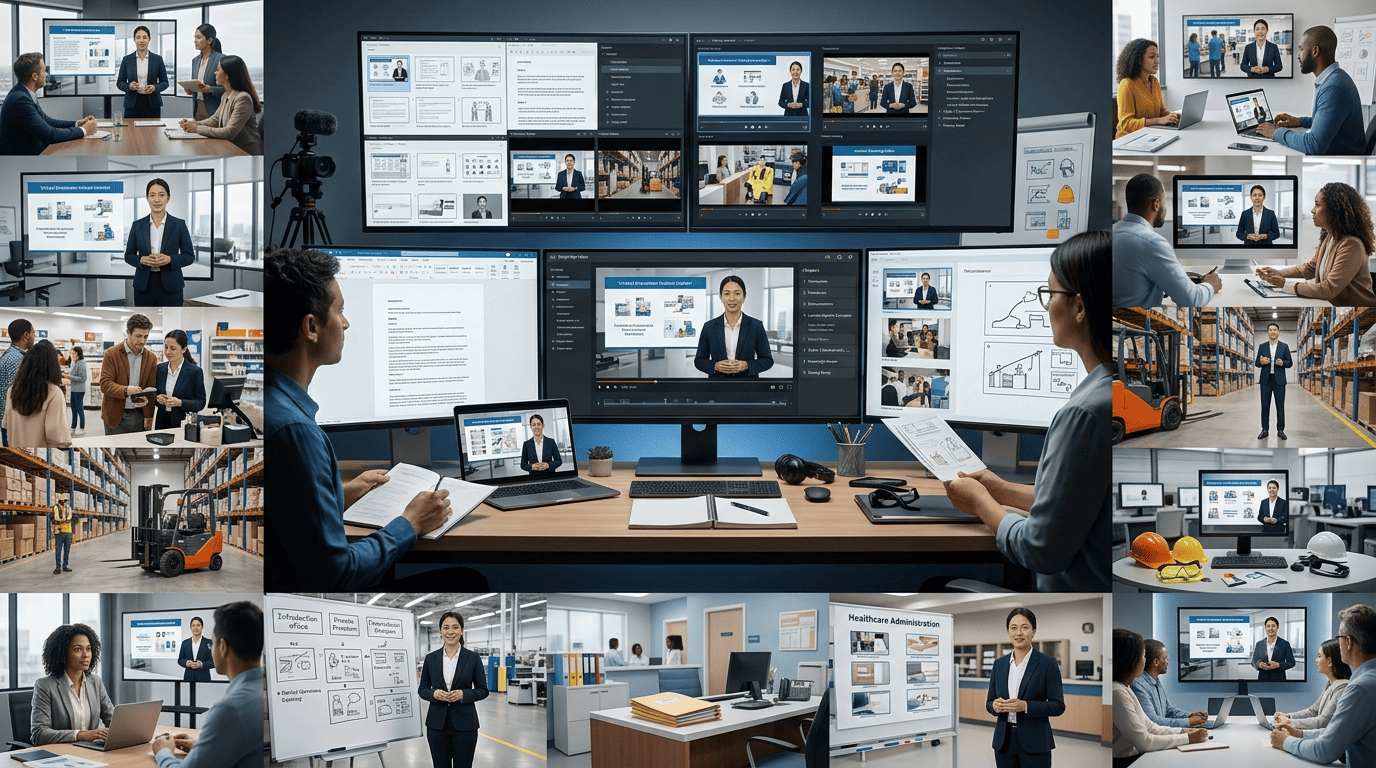
Generate the visual sequences. Describe the settings and processes the narration refers to and let the AI Long Video Generator produce material long enough to run under each section. Higgsfield holds a consistent look across modules, which is what makes seven separate videos feel like one training programme.
Film your own premises where it matters. An AI Long Video Generator handles context; your phone handles your actual counter, your actual kitchen, your actual stockroom. Generated material handles context; real footage handles the specifics people need to recognise.
Put critical detail on screen as text. Timings, quantities, contact numbers, escalation paths. People can pause written information.
Add captions. Essential for shift environments where sound is impractical, and helpful for everyone.
Deliver on mobile. Higgsfield exports at the sizes messaging apps handle without degrading. Frontline staff in India onboard on phones, not desktops. WhatsApp, a link in the joining message, or a code on the noticeboard.
What about multiple languages?
Unavoidable for most multi-location businesses here, and the reason many give up on training video entirely.
The economics used to be brutal: a second language meant filming everything again. It changes that, because the visual layer stays identical and only the narration and on-screen text change. In an AI Long Video Generator, a second version becomes an audio and caption task rather than a new production. Higgsfield keeps the language versions of one module grouped together.
Two cautions worth respecting.
Have a native speaker record and review each language, not a translation tool alone. Operational instructions carry consequences when they are misunderstood.
Update every language version together. The most common failure is one version being corrected while another quietly goes stale, which is worse than not having it.
How do you keep it current?
This determines whether a training library survives its first year.
Procedures change. Menus change. A supplier changes and the handling instruction changes with it. Guidance that was accurate in March becomes wrong by September, and staff trained on it are being trained incorrectly.
Reviews recommend revisiting training content at minimum every quarter. Waiting for an annual review means the team spends months operating on outdated information without knowing.
Traditionally that meant reshooting, which nobody did, so most small-business training video was made once and abandoned. Working in an AI Long Video Generator changes the calculation, because a correction is an edit rather than a production. In an AI Long Video Generator, you replace the affected section, update the caption and re-export.
A maintenance routine that works:
- Review the whole library quarterly against current procedure
- Date every module internally so nobody guesses at its age
- Keep the scripts alongside the finished videos
- Update all language versions in the same pass
- Withdraw anything that cannot be corrected promptly
Higgsfield keeping every version of a module together makes that quarterly review a manageable task rather than a search across phones and shared drives.
How do you get staff to actually watch it?
A library nobody opens is worse than no library, because it creates a false sense that training is handled.
Three things determine whether modules get watched, and none of them is production quality.
Send it before day one. A joining message with a link, watched at home the evening before, means the first shift starts with someone who already knows where the lockers are and who to report to. Operators consistently report this as the highest-return change they make.
Make it short enough to watch between things. Frontline staff watch on a phone, standing up, in a break. A module that requires a quiet half hour will not be watched. This is where an AI Long Video Generator needs discipline rather than indulging the fact that it can produce a twenty-minute film is not a reason to.
Tie it to something that happens. A manager asking two questions about the module at the end of week one costs a minute and changes whether people watch. It is not a test; it is a signal that somebody noticed.
And make the ask reasonable. Watching training outside paid hours is a genuine fairness question. Either pay for the time or keep the pre-start material genuinely brief and treat the rest as on-shift.
The businesses that get value from an AI Long Video Generator are the ones that treat distribution as seriously as production. The modules are the easy half.
What still needs a manager?
Quite a lot, and being clear about it is what stops this being oversold.
Shadowing. Watching somebody competent do the job remains the most effective training method there is. Video shortens it; it does not replace it.
Correction in the moment. Nobody learns to handle an angry customer from a module. They learn from doing it once badly with someone experienced nearby.
Judgement. Every procedure has exceptions, and knowing when to depart from the standard is what separates a trained employee from a good one.
The relationship. Early attrition is driven substantially by whether somebody feels supported in their first weeks. A video cannot do that.
What an AI Long Video Generator removes is the repetition of the same induction talk, the same POS walkthrough, the same hygiene briefing, delivered by hand at every branch forever. That frees managers for the parts of training that actually require a manager.
Frequently asked questions
Is this practical for a business with three or four outlets?
That is exactly the size it suits. Larger chains have training functions. Smaller ones do not, and the inconsistency between branches is sharpest at this scale.
How long should a training module be?
Long enough to cover one topic properly. Most useful modules are shorter than the person making them expects.
Does it need any video experience?
No. The work is deciding what to record and writing the script. An AI Long Video Generator such as Higgsfield handles the production side.
Can it be delivered over WhatsApp?
Yes. Export from Higgsfield or any comparable tool at a sensible file size, and for frontline staff in India that is usually the most practical channel. Keep file sizes reasonable and provide a link alternative.
How do you confirm someone has watched it?
Simplest is a short verbal check by the manager afterwards. It also creates a natural moment of contact in the first week, which helps retention on its own.
Does this replace hiring better managers?
No. It removes repetitive work from the managers you have, which is a different thing and usually more achievable.
Conclusion
Multi-location businesses do not have a training knowledge problem. They have a training delivery problem, and it is created by turnover that guarantees the same induction has to happen again next month, at every branch, indefinitely.
An AI Long Video Generator makes it possible to record that induction once, properly, in the languages your staff actually speak, and deliver it identically everywhere. Higgsfield and comparable platforms turn a training library from a project nobody has time for into a week of work.
Start with the talk your best manager gives. Record it. Build the visuals around it. Send it to the next joiner at every location.
Then spend the time you get back on the parts of training that a video was never going to do.