A SaaS startup can manage its first few referral partners with a spreadsheet and a shared folder. The model starts breaking when partners need deal registration, enablement, lead sharing, commissions, certifications and a reliable view of pipeline.
That is where partner relationship management software becomes useful. The goal is not to buy enterprise software early. The goal is to introduce enough structure that partners can sell without creating a second operations department.

What PRM Software Actually Does
PRM stands for Partner Relationship Management. Unlike a CRM, which primarily manages direct customers and prospects, PRM is designed around indirect revenue relationships such as resellers, referral partners, distributors, agencies and technology partners.
Modern PRM platforms commonly cover onboarding, partner portals, deal registration, enablement, incentives, co-marketing and performance reporting.
What a SaaS Startup Should Look For
- Fast partner onboarding
- Simple deal registration
- CRM synchronization
- Partner-facing content and training
- Commission or incentive workflows
- Partner performance reporting
- Role-based access
- APIs and integrations
A startup should also ask a harder question: what process are we actually trying to fix? If the answer is only “we need a partner portal,” a full PRM may be unnecessary.
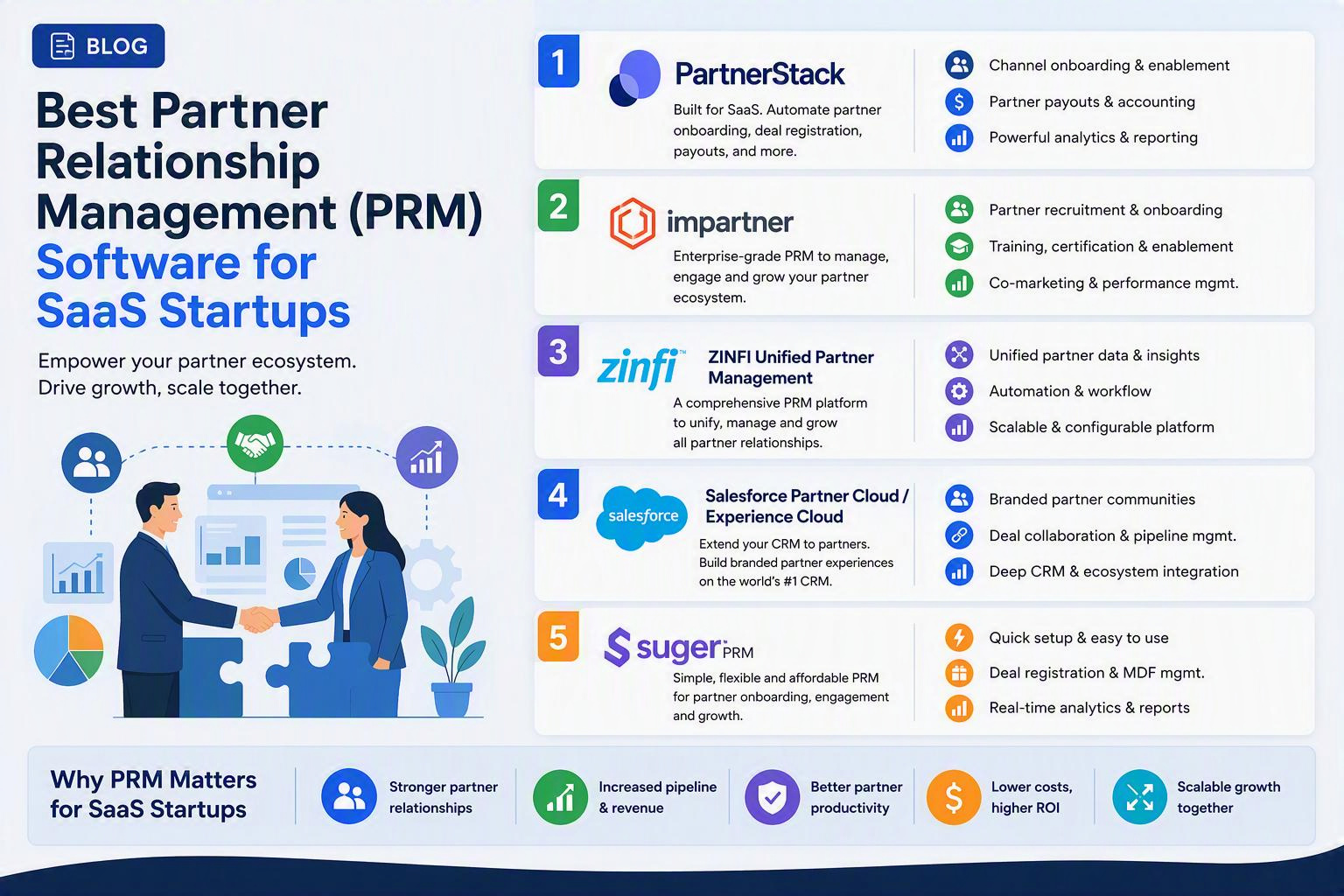
1. PartnerStack
Best for: SaaS companies with referral, affiliate and reseller motions.
PartnerStack is particularly relevant when partner acquisition, partner marketplace exposure and automated commissions are central to the programme. It is a natural fit for software businesses where partners generate measurable transactions or referrals.
Watch for
Define exactly how you want to attribute revenue and pay partners before selecting the platform. Attribution rules become much harder to change after a programme scales.
2. Impartner
Best for: Larger or more complex channel programmes.
Impartner has a broad PRM footprint covering partner onboarding, portals, deal registration, enablement and analytics. It is better suited to a startup that already knows it is building a substantial channel programme than to a founder testing a handful of referrals.
Current market sources describe pricing as quote-based, so model implementation and administration as part of total cost rather than comparing licence numbers alone.
3. ZINFI Unified Partner Management
Best for: SaaS or technology companies with multi-tier, multi-region or full-lifecycle partner programmes.
ZINFI positions PRM as one part of a broader unified channel platform covering onboarding, enablement, marketing, selling, incentives and analytics. That breadth can be powerful when a channel programme is mature.
4. Salesforce Partner Cloud / Experience Cloud
Best for: SaaS companies already deeply invested in Salesforce.
The attraction is architectural: partner workflows can live close to the CRM data model instead of introducing another core system. The tradeoff is configuration, licensing and implementation complexity.
If Salesforce is already the operational source of truth, compare the cost of extending it with the cost of introducing a separate PRM.
5. Suger PRM
Best for: SaaS companies combining marketplace co-selling with traditional channel partners.
Suger currently emphasizes deal registration, co-sell, commissions, partner portals and enablement, with CRM connections to Salesforce and HubSpot. Its positioning is particularly interesting for SaaS vendors that sell through cloud marketplaces while also working with VARs, resellers or ISVs.
Quick Comparison
| Platform | Best fit | Strength to evaluate |
|---|---|---|
| PartnerStack | Referral/affiliate/reseller SaaS | Partner growth and payouts |
| Impartner | Complex enterprise channel | Broad PRM lifecycle |
| ZINFI | Multi-tier technology ecosystems | Unified channel management |
| Salesforce Partner Cloud | Salesforce-centric teams | Native CRM architecture |
| Suger PRM | Modern SaaS co-sell | Deal registration and co-sell |
When Should a Startup Buy PRM Software?
Do not use partner count alone. Consider operational complexity.
- Partners are submitting deals by email.
- Sales and channel teams disagree on partner attribution.
- Commission calculations require spreadsheets.
- Partners cannot find current sales or marketing material.
- Onboarding a partner takes days of manual coordination.
- Partner performance cannot be measured consistently.
If none of these problems exist, a lightweight CRM workflow may be enough for now.
PRM vs CRM: The Simple Test
Ask: “Does this system need an external partner to log in and complete a channel workflow?” If yes, a dedicated PRM or partner portal layer becomes more compelling.
A CRM can store partner records. A PRM is designed to let partners participate in the revenue process.
Questions to Ask Vendors
- Can partners register deals without creating duplicate CRM records?
- How does deal conflict and named-account protection work?
- Can commissions be calculated automatically?
- Can partner tiers control content, discounts and incentives?
- How does the platform sync with our CRM?
- What data can we export if we leave?
- Which capabilities require professional services?
- What AI features are available today rather than only on the roadmap?
Implementation: Start With One Partner Motion
A SaaS startup should not launch every PRM module on day one. Start with the partner motion that produces the clearest business value.
- Define partner types and rules.
- Connect CRM data.
- Launch partner onboarding.
- Implement deal registration.
- Add enablement content.
- Measure partner-sourced pipeline.
- Add commissions and advanced automation after the basics work.
Final Takeaway
The best PRM for a SaaS startup is the platform that matches its partner motion and operational maturity—not necessarily the platform with the longest feature list.
For a referral-led startup, prioritize partner acquisition and payouts. For a reseller-led company, prioritize deal registration, CRM sync and enablement. For a mature ecosystem, look for lifecycle management, incentives, analytics and multi-tier governance.
Current 2026 PRM guidance also shows the category moving toward deeper CRM integration, AI-assisted partner operations and more complete lifecycle management. Treat those capabilities as evaluation criteria, not automatic reasons to upgrade.
Pricing is intentionally not presented as a fixed comparison because several major PRM vendors use quote-based or modular pricing. Obtain current commercial proposals and include implementation, integration and partner-user costs in your TCO.