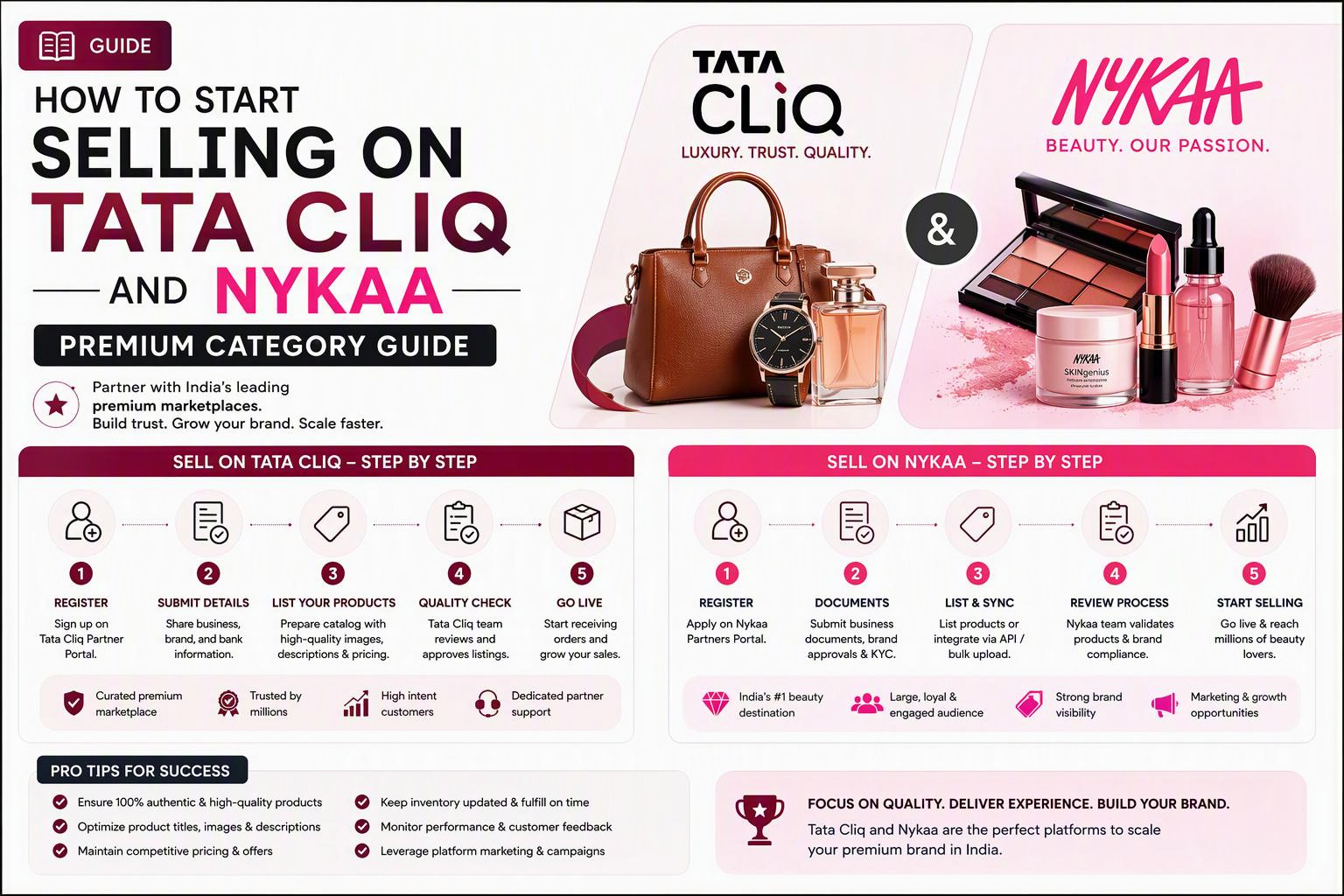
Thinking about selling on Tata CLiQ or Nykaa? Premium marketplaces can give a brand access to a highly relevant audience, but they are not simply another product-upload channel. Curation, brand fit, documentation, catalog quality, pricing, inventory discipline, and marketplace economics all matter.
This guide explains how to prepare for premium marketplace selling in India without assuming that every category follows the same onboarding process.

First: Understand the Difference Between Premium and Open Marketplaces
On an open marketplace, the basic mental model is: create an account, upload products, complete compliance checks, and start selling. Premium platforms can be more selective. The platform may care about the brand, category, assortment, product presentation, authenticity, and customer experience before a listing becomes commercially useful.
That makes your first task less about uploading SKUs and more about building a credible seller dossier.
What to Prepare Before You Apply
- Business and tax details, including an active GST registration where applicable.
- PAN and bank-account information that matches your legal business identity.
- Trademark or brand-authorisation documents when the platform or category requires them.
- Category-specific licences or certifications for regulated products.
- A clean brand presentation: website, social presence, brand story, product photography and catalogue.
- Accurate MRP, selling price, pack size, dimensions, ingredients or specifications and other mandatory product attributes.
For beauty and wellness categories, documentation can be more involved. Cosmetics and ingestible products may have additional regulatory requirements, so confirm the exact requirement for the product type rather than copying a generic seller checklist.
How to Approach Tata CLiQ
Tata CLiQ should be treated as a premium retail channel rather than simply another place to list the same catalogue. Before approaching the platform, define which products genuinely belong there.
Build a focused assortment
Do not start by submitting every SKU you have. Select products with strong margins, reliable supply, consistent packaging, and a clear premium proposition.
Make the brand presentation retail-ready
Your website, photography, packaging and product descriptions should tell the same story. If the marketplace team sees a premium positioning but your product pages look unfinished, the inconsistency weakens the pitch.
Prepare operational answers
Be ready to explain where inventory is held, how quickly you can dispatch, how you handle returns, and how you maintain stock accuracy. Premium customers expect a reliable experience after checkout, not just an attractive product page.
How to Approach Nykaa
Nykaa operates an approval-led seller and brand onboarding model. Its current public seller route is available through its Sell on Nykaa flow, while exact commercial terms and category requirements can vary. Recent 2026 guides also note that Nykaa’s beauty and Nykaa Fashion businesses should not be treated as identical programmes.
For beauty, skincare, haircare and wellness brands, prepare a compliance-first application. Keep GST, PAN, trademark or authorisation documentation, product labels, ingredient information and category licences ready where relevant.
Do not rely on a copied commission number
Third-party sources publish different commission ranges for Nykaa. That is a warning sign: do not build your business case around a blog’s estimated rate. Ask for your actual commercial terms and model commission, logistics, marketing contributions, returns and taxes together.
Build a Marketplace P&L Before You Apply
| Line item | Question to answer |
|---|---|
| Product cost | What is the landed cost per sellable unit? |
| Marketplace commission | What percentage or commercial structure applies to this category? |
| Fulfilment | Who pays shipping, storage and handling? |
| Returns | What happens financially when the customer returns? |
| Marketing | Are sponsored placements or campaign participation optional or expected? |
| Discounts | Who funds marketplace promotions and price reductions? |
A product with a healthy D2C gross margin can become unattractive after marketplace costs. Calculate contribution margin on a completed order, not just the difference between MRP and manufacturing cost.
Catalog Quality Can Make or Break the Launch
Premium marketplace shoppers compare products quickly. Your listing should answer the important questions without forcing the customer to search elsewhere.
- Use sharp, consistent product images.
- Keep titles factual and easy to scan.
- Explain materials, ingredients, dimensions, pack contents and usage clearly.
- Keep MRP, net quantity and variant information consistent with the physical product.
- Use the same product identity across your website and marketplace listings.
Inventory and Fulfilment Rules to Set Before Go-Live
Marketplace growth can expose weak inventory processes very quickly. Establish a minimum stock buffer, daily inventory reconciliation and a clear owner for listing updates.
If the same SKU sells through your own website and multiple marketplaces, consider a central inventory or order-management layer. Shopify’s current App Store, for example, has dedicated India shipping and logistics apps covering carrier aggregation, tracking, returns and inventory workflows.
Common Mistakes Premium Marketplace Sellers Make
- Applying before the brand and compliance documents are ready.
- Submitting too many weak SKUs instead of a focused assortment.
- Using inconsistent product information across channels.
- Ignoring returns and reverse-logistics costs.
- Assuming marketplace traffic automatically creates profitable sales.
- Using old fee estimates instead of the seller’s current commercial agreement.
A Practical 30-Day Preparation Plan
- Week 1: audit legal, tax, trademark and category documents.
- Week 2: select the initial assortment and calculate contribution margins.
- Week 3: finish product photography, descriptions, attributes and catalogue files.
- Week 4: prepare inventory, fulfilment, customer-service and reconciliation workflows.
Final Takeaway
Tata CLiQ and Nykaa can be valuable premium channels, but the winning approach is not “get listed and wait for orders.” Treat marketplace entry as a retail expansion project: prove brand fit, prepare compliance, choose a focused assortment, calculate the real contribution margin, and make operations dependable before scaling.
For broader marketplace economics, see our existing guide on how Nykaa competes in premium beauty.
Freshness note: marketplace application routes, fees, commercial terms and category requirements can change. Verify the live seller programme and your actual commercial agreement before committing inventory or advertising spend.