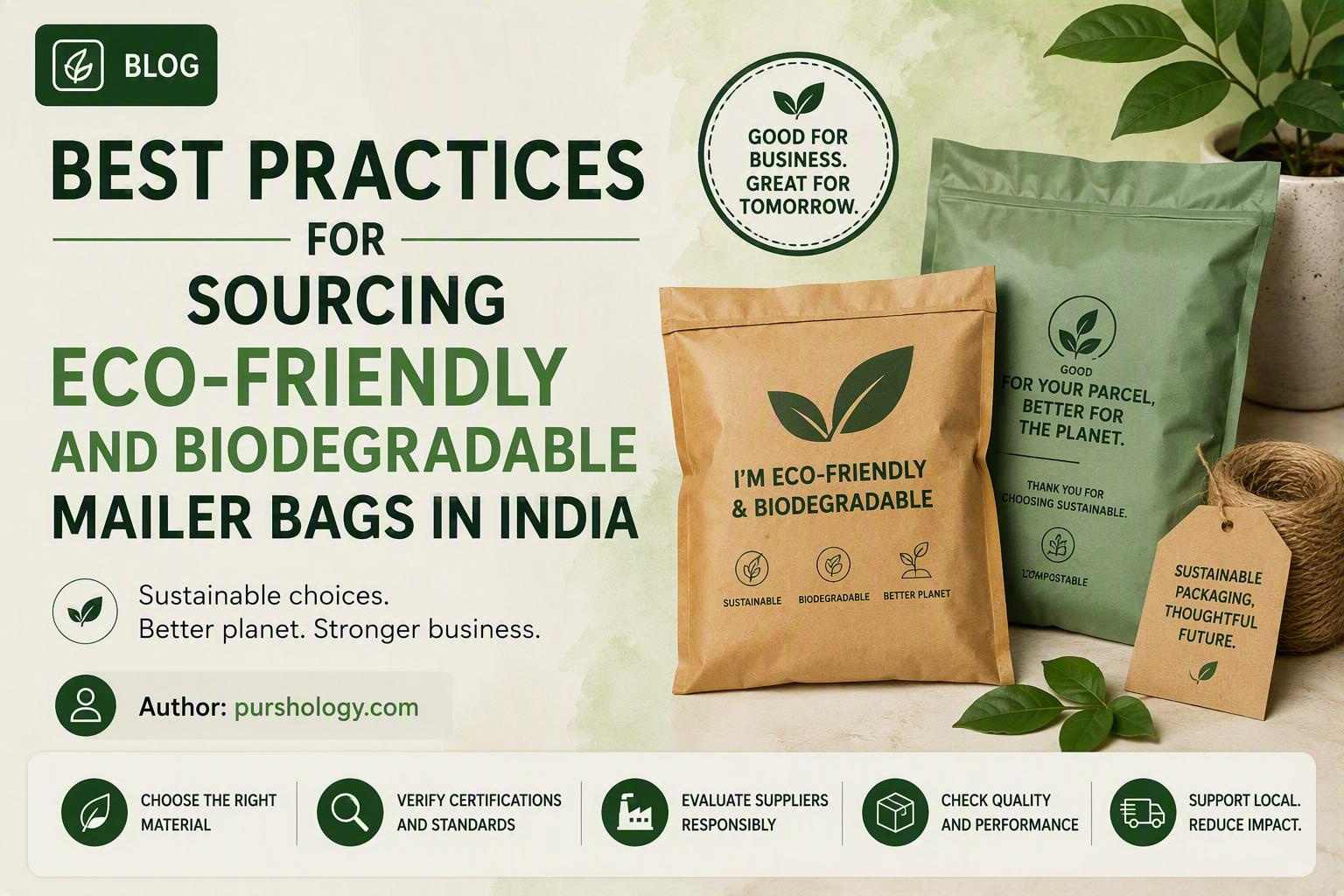
Choosing an “eco-friendly” mailer is not as simple as picking a bag with a green logo. For an Indian e-commerce business, the better decision starts with the product being shipped, the packaging format, the supplier’s documentation, the end-of-life route and the total cost per order.
Quick answer: start by deciding whether your product can move from plastic to paper. If plastic is necessary, compare recycled-content packaging with genuinely certified compostable packaging. Do not treat “biodegradable” as proof of compostability. For packaging marketed as compostable in India, ask for the relevant IS/ISO 17088 documentation and a valid CPCB registration/certification trail before placing a bulk order.

1. Match the mailer to the product first
Packaging should protect the order before it tries to make a sustainability statement. Apparel, books, documents and other dry, low-fragility items may work well with kraft or paper mailers. Products exposed to moisture, sharp edges or higher compression may need a different structure.
Make a list of your top 10 SKUs and record their dimensions, actual weight, fragility and moisture sensitivity. Then test two or three packaging formats against the same product. A packaging change that increases damage or returns is not a sustainable improvement.
2. Understand the difference between recyclable and compostable
Recyclable packaging is designed to enter a recycling stream and be processed into another material. Compostable packaging is designed to break down under defined composting conditions. Those are different end-of-life pathways.
India’s 2026 packaging environment also puts more emphasis on recycled content and documentation. A recent Amazon Shipping India guide notes that the Plastic Waste Management (Amendment) Rules, 2026 introduced recycled-content requirements for relevant plastic packaging, including flexible plastic packaging.
That means “plastic versus compostable” is not the only comparison. A recycled-content poly mailer may be the better operational choice for one SKU, while paper may be better for another.
3. Do not rely on the word “biodegradable”
This is one of the most important supplier checks. “Biodegradable” is often used as a broad marketing description, while compostability is tied to defined conditions and standards.
If a supplier claims a mailer is compostable, request the certification and registration documents rather than accepting a product brochure. CPCB maintains information on certified compostable plastic manufacturers and sellers, and the certification process is tied to the Plastic Waste Management Rules.
For a buyer, the practical rule is simple: documentation beats labels.
4. Ask suppliers these 10 questions
- What is the exact material composition?
- Is the product recyclable, compostable, or neither?
- If it is marketed as compostable, can you provide the current IS/ISO 17088 certificate?
- Can you provide the relevant CPCB registration/certification number?
- What standard and laboratory issued the supporting test report?
- What sizes and thicknesses are available?
- What is the minimum order quantity?
- What is the price at 1,000, 10,000 and 50,000 units?
- Can the supplier provide a sample before a production order?
- What printing inks, adhesives and coatings are used?
5. Test the bag before negotiating a large order
Ask for samples and run a simple internal test. Fill the bag with a normal shipment, seal it, stack it with similar parcels and handle it as your courier would. Check seal strength, tear resistance, moisture performance, label adhesion and barcode readability.
Then run a small real-world shipment batch. Record damage, leakage, customer complaints and courier exceptions. This gives you better evidence than a supplier’s generic claim that a bag is “strong.”
6. Compare total cost, not just bag price
A ₹4 mailer is not automatically cheaper than a ₹6 mailer. Include printing, minimum order quantity, wastage, storage, tape, dimensional weight, return packaging and compliance work.
For example, if a better-fitting mailer reduces package dimensions enough to lower shipping charges, the packaging premium may partly or fully pay for itself. The opposite is also true: a thick, oversized “eco” bag can raise logistics costs while doing little for sustainability.
7. Rightsize before switching materials
One of the lowest-risk sustainability improvements is to use less material. Measure your most frequently shipped products and remove unnecessary empty space. A closer-fit package can reduce material consumption, filler and shipping volume simultaneously.
This is especially useful for small D2C brands because it does not require a complete supplier change. It is an operations improvement before it is a procurement decision.
8. Be careful with green claims
A supplier may say “plastic-free,” “biodegradable,” “compostable,” “100% eco-friendly” or “zero environmental impact.” These phrases are not interchangeable. Avoid repeating a claim on your product packaging or website unless you have evidence that supports the exact wording.
Amazon Shipping India’s 2026 guidance specifically recommends verifying certification and registration for compostable packaging and checking recycled-content claims.
9. Build a supplier scorecard
| Factor | What to check |
|---|---|
| Material | Exact polymer, paper or fibre composition |
| Compliance | Applicable BIS/CPCB documents |
| Performance | Seal, tear, moisture and transit testing |
| Commercials | MOQ, unit cost, printing and lead time |
| Traceability | Batch documentation and supplier records |
| End of life | Realistic disposal/recycling/composting route |
10. A practical sourcing process for a small e-commerce brand
- Audit current packaging and identify your top-volume SKUs.
- Define the performance requirement for each SKU.
- Shortlist three suppliers for each packaging type.
- Request samples and compliance documents.
- Run a small shipment test.
- Compare landed cost per successful delivery.
- Choose the material that balances protection, cost and credible end-of-life handling.
- Keep the supplier documentation with your procurement records.
Bottom line
The best eco-friendly mailer is not necessarily the one with the most impressive label. It is the one that protects the product, uses an appropriate amount of material, fits your logistics model and comes with evidence for the environmental claims being made.
For Indian e-commerce sellers, the safest procurement habit in 2026 is to verify the standard, verify the supplier documentation, test the physical product and calculate the total delivered cost before committing to a large order.
Sources and further reading
- Amazon Shipping India: Eco-friendly shipping for Indian SMBs
- CPCB certified compostable plastic manufacturers and sellers
- Bureau of Indian Standards
Regulatory requirements can change. Verify current CPCB/BIS requirements and your business’s EPR obligations before making compliance-sensitive packaging claims.