Most modern businesses do not struggle because they lack software. They struggle because their software does not agree with itself.
Customer data lives in one system. Financial data in another. Operations are managed somewhere else entirely. On paper, the stack looks complete. In practice, small gaps appear between systems, and those gaps grow over time.

Shipment visibility is one of those gaps.
For businesses that ship physical goods, delivery information often sits outside the core software stack. It exists, but it is fragmented, delayed, or buried inside carrier portals. When that happens, even well-designed operations start to feel reactive.
What Centralized Shipment Visibility Looks Like in Real Operations
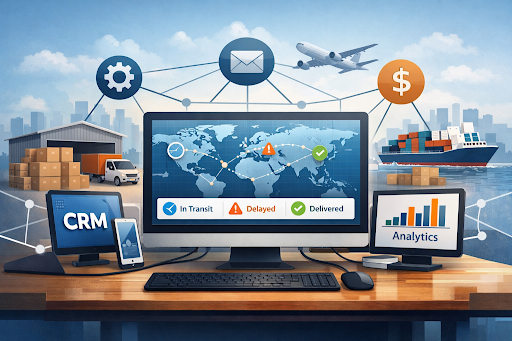
Centralized shipment visibility means that delivery status, movement, and exceptions can be understood from a single place, without switching tools or reconciling conflicting updates.
It is not just about knowing whether something shipped or arrived. It is about understanding what is happening in between and whether anything requires attention.
When teams share the same delivery reality, decisions become calmer. When they do not, assumptions fill the gaps.
How Fragmentation Quietly Slows Teams Down
Shipment issues rarely arrive as obvious failures. They show up as hesitation.
Support teams pause before replying because they are unsure. Operations teams double-check information that should already be clear. Managers ask follow-up questions that slow decisions rather than move them forward.
None of this feels dramatic. That is why it is tolerated.
As order volume increases, these small delays add up. What once felt manageable becomes constant background noise. Teams spend more time confirming reality than improving process.
Why Shipment Visibility Works Best as Infrastructure
Shipment visibility delivers the most value when it is treated as infrastructure, not as a side task.
In modern software environments, systems are expected to inform one another. CRM tools guide communication. Analytics tools guide decisions. Operational platforms coordinate execution. Delivery data should play the same role.
When businesses can track packages worldwide through a centralized layer, shipment information stops interrupting workflows and starts supporting them. Teams no longer chase updates. They work from shared context.
That shift changes how the entire stack behaves.
Shared Visibility Reduces Internal Friction
One of the least discussed benefits of centralized visibility is how it changes internal dynamics.
When shipment data is reliable, conversations become shorter. Support responses become more confident. Operations teams focus on patterns instead of isolated complaints. Leadership spends less time resolving confusion and more time setting direction.
This does not eliminate delivery problems. It makes them easier to handle.
Integration Is the Real Advantage
Many businesses focus on adding tools. Fewer focus on how those tools interact.
Centralized shipment visibility acts as a connector between physical delivery events and digital workflows. When delivery status aligns with customer communication, billing cycles, and internal planning, operations feel coherent instead of fragmented.
This matters more as businesses scale. Growth multiplies complexity. Visibility absorbs some of that complexity by keeping everyone oriented around the same facts.
Why Manual Oversight Breaks at Scale
Early on, manual shipment monitoring seems sufficient. Someone checks tracking links. Someone replies to emails. Someone follows up when needed.
This approach relies entirely on effort and memory.
As volume grows, those dependencies fail. Updates are missed. Context is lost between teams. Delivery issues escalate unnecessarily. Centralized visibility replaces effort with consistency.
The system remembers, even when people are busy.
Visibility as a Long-Term Operational Asset
Shipment visibility is often evaluated based on short-term efficiency. Its real value appears over time.
Patterns become visible. Certain routes underperform. Certain carriers behave differently depending on region. Operations teams gain the insight needed to adjust strategy instead of reacting case by case.
At the same time, customer trust stabilizes. Clear updates reduce anxiety, even when deliveries are delayed. Transparency becomes part of the experience.
Why This Layer Is No Longer Optional
Modern business software stacks are designed to reduce uncertainty. Shipment visibility addresses one of the most persistent sources of uncertainty in physical operations.
When delivery data is scattered, every system around it compensates poorly. When it is centralized, workflows align naturally.
Businesses that treat shipment visibility as a core layer operate with more confidence. Businesses that do not often feel organized on the surface but strained underneath.
Final Perspective
Centralized shipment visibility matters because it keeps reality visible.
When teams see the same information, decisions improve. When customers receive accurate updates, trust grows. When delivery data is integrated instead of scattered, software stacks behave the way they were meant to.
That is why shipment visibility is becoming a core layer in modern business software stacks. Not because it is fashionable, but because without it, too many decisions are made without clarity.

Emmanuel Fornillos is a logistics content specialist at Instant Parcels, a universal parcel-tracking platform connecting over 600 couriers worldwide. He writes about international shipping, freight visibility, and the latest innovations in global eCommerce logistics.