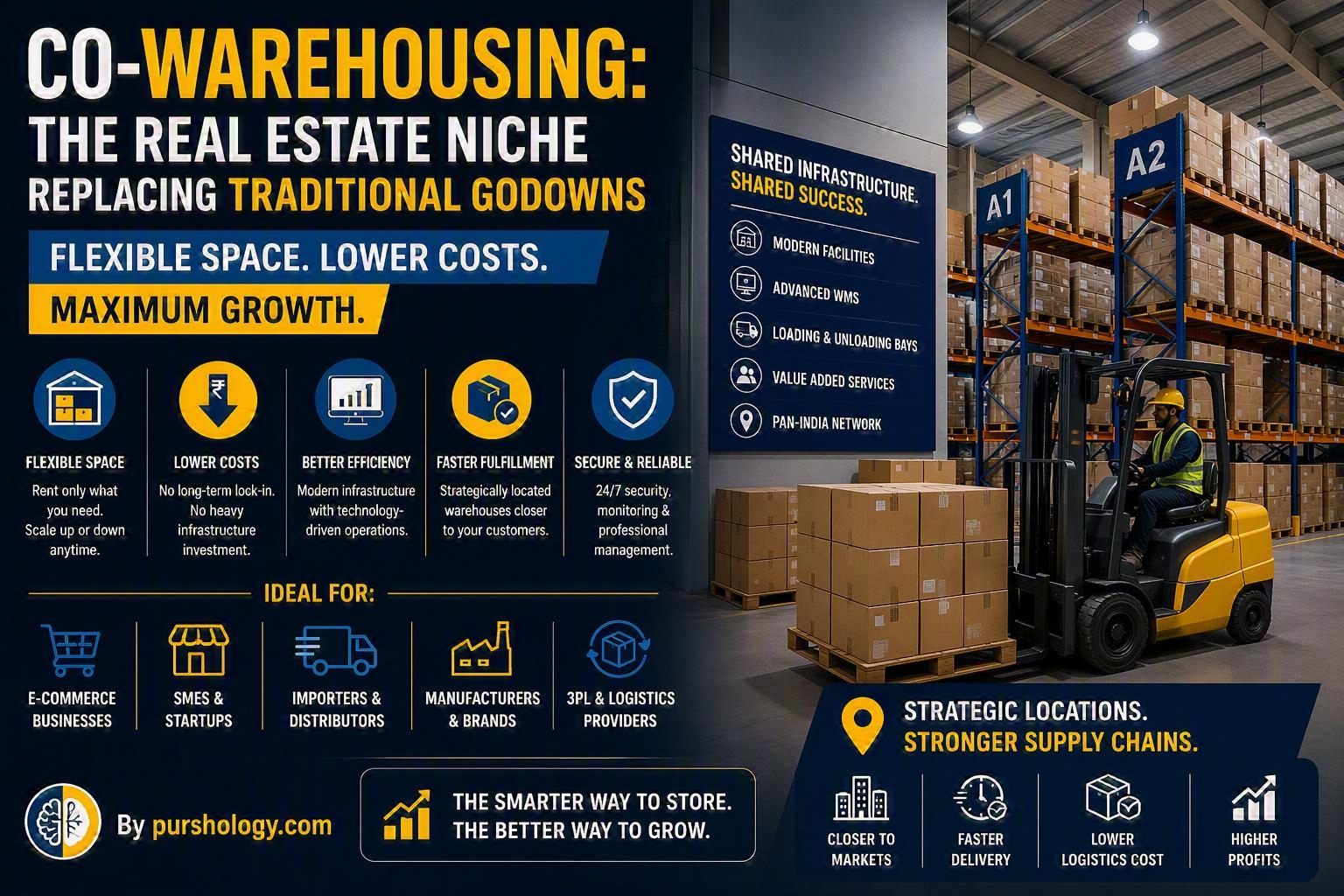
TL;DR:
Co-warehousing is emerging as one of the fastest-growing segments in commercial real estate. Much like co-working transformed office space, co-warehousing offers flexible, shared storage and fulfillment facilities for e-commerce brands, SMEs, distributors, and startups. As businesses seek scalable logistics solutions without long-term lease commitments, co-warehousing is positioning itself as the modern alternative to traditional godowns.
The commercial real estate industry is experiencing another major shift.

After co-working redefined how companies use office space, a similar transformation is now occurring in the warehousing sector. Businesses no longer want massive storage facilities locked into long-term contracts. Instead, they are seeking flexibility, scalability, and technology-driven logistics solutions.
This demand has given rise to co-warehousing—a shared warehousing model that provides businesses with storage space, fulfillment services, and logistics infrastructure without the burden of owning or leasing traditional warehouses.
For entrepreneurs, investors, and real estate developers, co-warehousing is becoming one of the most attractive opportunities in the rapidly growing logistics economy.
What Is Co-Warehousing?
Co-warehousing is a shared warehouse facility where multiple businesses operate under one roof while accessing common infrastructure and services.
Typically, tenants receive:
- Dedicated storage space
- Inventory management systems
- Loading and unloading zones
- Packing stations
- Shared office facilities
- Fulfillment services
- Logistics support
The model allows businesses to pay only for the space and services they actually need.
Why Traditional Godowns Are Losing Relevance
For decades, businesses relied on conventional godowns for inventory storage. While effective for large enterprises, these facilities often present challenges for smaller and growing businesses.
High Upfront Costs
Traditional warehouses usually require:
- Security deposits
- Long lease agreements
- Infrastructure setup
- Equipment investments
Many startups and SMEs cannot justify these expenses.
Poor Space Utilization
Businesses often lease more space than they need to accommodate future growth, resulting in underutilized capacity.
Limited Flexibility
As inventory fluctuates, businesses may find themselves paying for unused space or struggling to expand quickly.
Co-warehousing addresses these inefficiencies by offering flexible storage arrangements.
The Rise of E-Commerce Is Driving Demand
One of the biggest catalysts behind co-warehousing growth is e-commerce.
Online sellers face ongoing challenges such as:
- Inventory storage
- Order fulfillment
- Shipping coordination
- Returns management
Many small and mid-sized brands lack the resources to operate standalone warehouses.
Co-warehousing provides professional logistics infrastructure at a fraction of the cost.
Why Businesses Are Embracing Co-Warehousing
1. Scalability
Companies can expand or reduce warehouse space based on seasonal demand and business growth.
This flexibility is particularly valuable for:
- D2C brands
- Marketplace sellers
- Import-export businesses
- Consumer goods companies
2. Lower Capital Requirements
Businesses avoid substantial investments in:
- Real estate
- Racking systems
- Material handling equipment
- Warehouse management software
This frees up capital for growth initiatives.
3. Faster Market Entry
New businesses can begin operations immediately without the lengthy setup associated with traditional warehouses.
4. Professional Infrastructure
Most modern co-warehousing facilities include:
- Security systems
- CCTV monitoring
- Access controls
- Inventory software
- Loading docks
- High-speed internet
These features enhance operational efficiency.
Why Investors Are Paying Attention
Co-warehousing combines attractive aspects of both real estate and logistics.
Recurring Rental Revenue
Operators generate monthly income from multiple tenants instead of relying on a single large occupant.
Higher Utilization Rates
Shared facilities often achieve better occupancy levels through flexible leasing models.
Diversified Risk
Revenue comes from numerous businesses, reducing dependence on any one tenant.
Growing Market Demand
The continued rise of e-commerce and supply chain modernization supports long-term growth opportunities.
Ideal Customers for Co-Warehousing
The model appeals to a broad range of businesses.
E-Commerce Brands
Online sellers require storage, packing, and fulfillment capabilities close to urban markets.
Importers and Distributors
Flexible inventory space helps businesses manage fluctuating stock levels.
Manufacturers
Smaller manufacturers often need regional storage hubs without investing in dedicated warehouses.
Startups
Young companies can access professional logistics facilities without major upfront costs.
Technology Is Transforming Co-Warehousing
Modern facilities increasingly operate as technology-enabled logistics centers.
Common features include:
- Warehouse Management Systems (WMS)
- Inventory tracking
- RFID technology
- QR-code scanning
- Automated reporting
- Real-time stock monitoring
- Digital billing platforms
Technology improves efficiency while providing transparency for tenants.
Why India Is a High-Potential Market
India offers ideal conditions for co-warehousing growth.
E-Commerce Expansion
The rapid growth of online commerce continues increasing demand for fulfillment infrastructure.
SME Dominance
Millions of small and medium-sized businesses require flexible storage solutions.
Urban Consumption Growth
Major consumption centers such as:
- Mumbai
- Delhi NCR
- Bengaluru
- Hyderabad
- Chennai
- Pune
create strong demand for strategically located warehousing space.
Supply Chain Modernization
Companies are increasingly investing in efficient logistics networks to improve delivery performance.
Revenue Streams Beyond Storage
Successful co-warehousing operators often generate income from additional services.
Fulfillment Services
- Pick and pack
- Order processing
- Shipping coordination
Transportation Solutions
- Last-mile delivery
- Freight management
- Regional distribution
Value-Added Services
- Packaging
- Labeling
- Inventory audits
- Returns processing
These services can significantly increase profitability.
Challenges Entrepreneurs Should Consider
While the opportunity is attractive, execution remains critical.
Location Selection
Accessibility and proximity to transportation networks heavily influence facility performance.
Operational Excellence
Warehouse efficiency directly impacts customer satisfaction and retention.
Technology Investment
Robust software systems are essential for managing multiple tenants effectively.
Competition
As awareness grows, operators must differentiate through service quality and technology capabilities.
The Future of Warehousing Is Flexible
Businesses today demand agility.
They want logistics solutions that scale with growth, reduce capital commitments, and improve operational efficiency. Co-warehousing delivers exactly that.
Just as co-working transformed office real estate, co-warehousing is redefining industrial property by converting static storage facilities into dynamic logistics ecosystems.
As e-commerce, retail distribution, and supply chains continue evolving, flexible warehousing models are expected to become increasingly important.
For investors and entrepreneurs, co-warehousing represents a powerful intersection of real estate, logistics, and technology.
Ready to Capitalize on the Co-Warehousing Boom?
The future of warehousing isn’t bigger—it’s smarter, more flexible, and more efficient. Co-warehousing is helping businesses access professional logistics infrastructure without the costs and constraints of traditional godowns.
If you’re exploring opportunities in commercial real estate, logistics, or supply chain services, now is the ideal time to evaluate co-warehousing. Businesses are demanding flexibility, and the operators who meet that demand today could become the backbone of tomorrow’s logistics economy.